Cane toad (Rhinella marina)
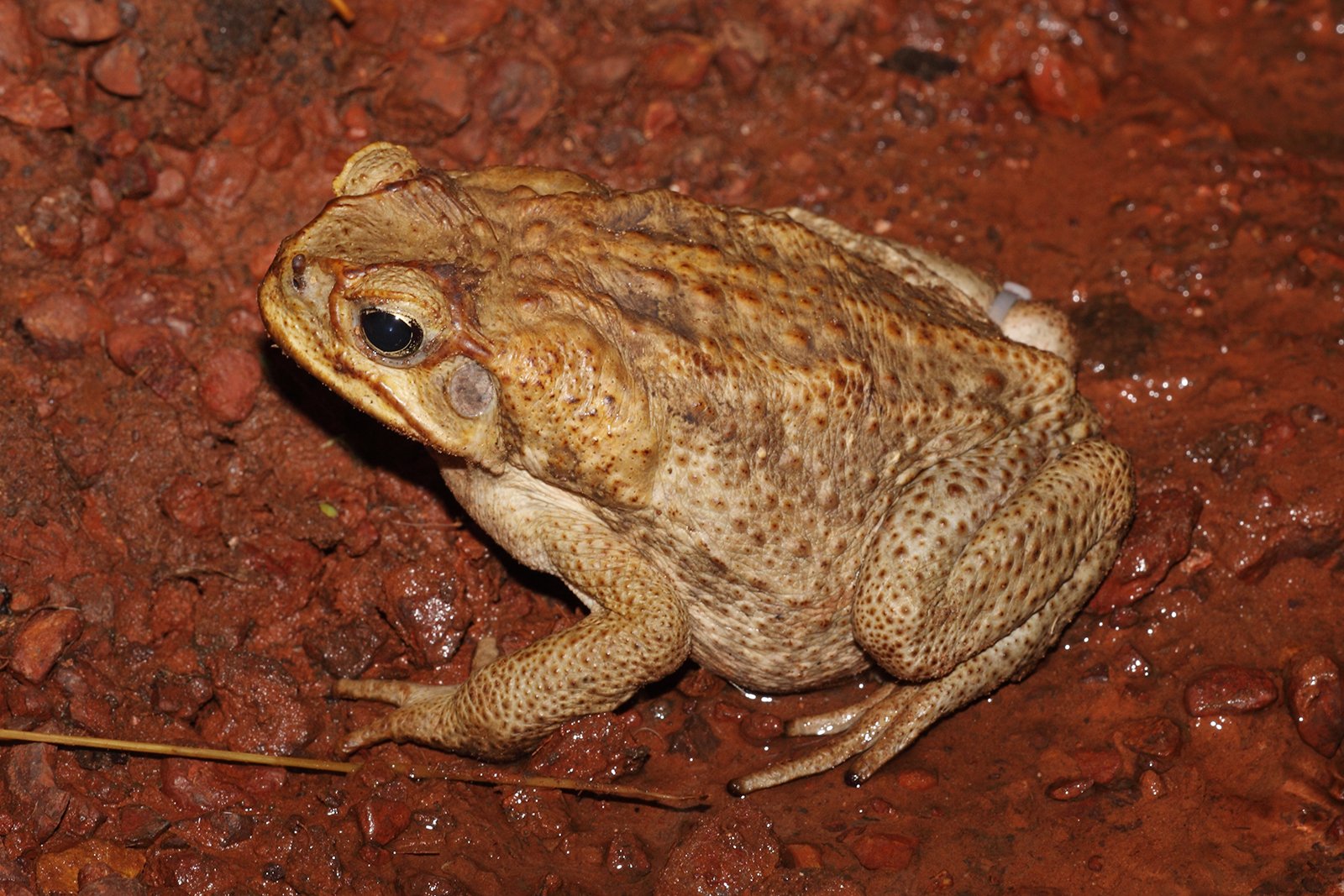
Amphibians · Difficulty: Beginner
Key facts and care guidance for Cane toad (Rhinella marina) (origin: Originally Central and South America, from the Amazon region through Central America to southern Texas; introduced to, among other places, Australia, Hawaii, Jamaica, Puerto Rico, the Philippines, Taiwan, Japan and Egypt. The IUCN lists it among the hundred most damaging invasive species worldwide, though it is not on the EU Union list.). Adult size around females up to about 23 cm body length and over 1 kg, males remain noticeably smaller. Life expectancy 10–15 years in the wild, up to 20 years with good care. The values below are carefully researched guidance.
Short answers
Cane toad: How big does the enclosure need to be?
120×60×60 cm for a pair.
Cane toad: What temperature does it need?
Daytime 24–28 °C, basking spot No basking spot, at night 20–23 °C.
Cane toad: Does it need UVB lighting?
UVB: Recommended (UVB 2–5 %).
Cane toad: How long do they live?
Life expectancy: 10–15 years in the wild, up to 20 years with good care.
Cane toad: Is it suitable for beginners?
Yes – it is considered suitable for beginners (difficulty: Beginner).
Climate
- Daytime temperature
- 24–28 °C
- Night temperature
- 20–23 °C
- Basking spot
- No basking spot
- Humidity
- 60–80 %
- UVB
- Recommended (UVB 2–5 %)
Enclosure
- Minimum size
- 120×60×60 cm for a pair
- Substrate
- Unfertilised potting or forest soil, or coco fibre, 10–20 cm deep and diggable, plus leaf litter and pieces of bark; a shallow water area of about 60×30 cm at around 10 cm water depth
Feeding
- Food
- Large insects, roaches, earthworms, the occasional nestling
- Feeding interval
- 2–3×/week
Key facts
- Adult size
- females up to about 23 cm body length and over 1 kg, males remain noticeably smaller
- Life expectancy
- 10–15 years in the wild, up to 20 years with good care
- Origin
- Originally Central and South America, from the Amazon region through Central America to southern Texas; introduced to, among other places, Australia, Hawaii, Jamaica, Puerto Rico, the Philippines, Taiwan, Japan and Egypt. The IUCN lists it among the hundred most damaging invasive species worldwide, though it is not on the EU Union list.
- Protection status
- Not on the EU list of invasive species, but considered highly invasive worldwide – never release it
- Brumation
- None
- Cohabitation
- Singly or as a pair; only similarly sized animals. Only put together animals of the same species and roughly the same size — smaller ones will otherwise be treated as food. Enough hides so that every animal can get out of the way.
Notes
A very large, powerful skin toxin (bufotoxin) in the parotoid glands – wash your hands after every contact, and it is life-threatening to dogs and cats. Straightforward and long-lived; it eats practically anything that moves. Never release it into the wild.
Do you keep this species?
Add your animal to Reptoria – Reptoria reminds you about feeding and shedding. Add your animal for free →
Related species
- African common toad (Sclerophrys regularis) – Beginner
- American toad (Anaxyrus americanus) – Beginner
- Asian common toad (Duttaphrynus melanostictus) – Beginner
- Colorado River toad (Incilius alvarius) – Intermediate
- Common toad (Bufo bufo) – Beginner
- Natterjack toad (Epidalea calamita) – Intermediate
- European green toad (Bufotes viridis) – Intermediate
- Alpine newt (Ichthyosaura alpestris) – Beginner
What you need to start
To keep Cane toad (Rhinella marina) you typically need: a suitable enclosure (120×60×60 cm for a pair), substrate (Unfertilised potting or forest soil, or coco fibre, 10–20 cm deep and diggable, plus leaf litter and pieces of bark; a shallow water area of about 60×30 cm at around 10 cm water depth), a heat source with a thermostat, UVB lighting, thermometer and hygrometer, a water dish and hides. You will find equipment in the Reptoria marketplace.
The complete, interactive care database is in the Reptoria app.
Last updated: 9 October 2026 · Editor: Reptoria editorial team · Sources include: Wikipedia DE, Wikipedia DE (Unionsliste invasiver Arten), einrichtungsbeispiele.de, eu_annex.txt (lokal, VO (EU) 2026/1383), interaquaristik.de
All values are non-binding guidance and do not replace expert advice. Research thoroughly from several sources before acquiring and keeping an animal, and observe the applicable law (species and animal protection in particular).