Chinese three-striped box turtle (Cuora trifasciata)
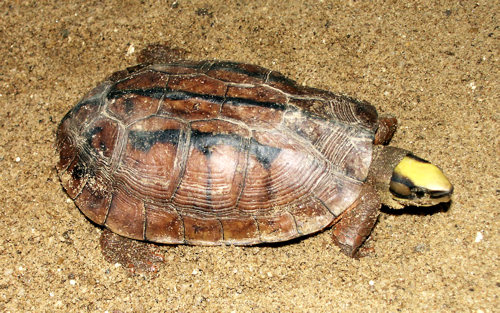
Turtles & tortoises · Difficulty: Expert
Key facts and care guidance for Chinese three-striped box turtle (Cuora trifasciata) (origin: Southern China (Hainan, Hong Kong), formerly Guangdong, Guangxi and Fujian). Adult size around up to 25 cm (usually ~20 cm). Life expectancy 20–40+ years. The values below are carefully researched guidance.
Short answers
Chinese three-striped box turtle: How big does the enclosure need to be?
An aqua-terrarium from ~150×60 cm / ~1000 l with a land section of ~0.3 m² (adult).
Chinese three-striped box turtle: What temperature does it need?
Daytime water 25–32 °C (summer), basking spot up to 40 °C (heat emitter above the land section), at night 20–25 °C.
Chinese three-striped box turtle: Does it need UVB lighting?
UVB: UVB needed (Ferguson zone 2–3).
Chinese three-striped box turtle: How long do they live?
Life expectancy: 20–40+ years.
Chinese three-striped box turtle: Is it suitable for beginners?
No – better suited to experienced keepers (difficulty: Expert).
Climate
- Daytime temperature
- water 25–32 °C (summer)
- Night temperature
- 20–25 °C
- Basking spot
- up to 40 °C (heat emitter above the land section)
- Humidity
- 70–90 % (land section)
- UVB
- UVB needed (Ferguson zone 2–3)
Enclosure
- Minimum size
- an aqua-terrarium from ~150×60 cm / ~1000 l with a land section of ~0.3 m² (adult)
- Substrate
- Water section: sand or fine gravel; land section: a sand and soil mix with roots and plants as hides
Feeding
- Food
- Omnivorous: fish, snails, worms, insects, a few water plants and fruit, pellets
- Feeding interval
- adults 2–3×/week, juveniles more often
Key facts
- Adult size
- up to 25 cm (usually ~20 cm)
- Life expectancy
- 20–40+ years
- Origin
- Southern China (Hainan, Hong Kong), formerly Guangdong, Guangxi and Fujian
- Protection status
- CITES Appendix II (a zero quota for wild-caught animals) / EU Annex B – registration required, with an unbroken chain of proof of breeding or origin. IUCN: Critically Endangered.
- Brumation
- A slight winter rest – lower the water to 20–25 °C, or a cooler rest period depending on their origin; subtropical, with no deep winter dormancy.
- Cohabitation
- Keep them singly; highly territorial, with fights between males. An extremely valuable species – breed them only under supervision.
Notes
A more aquatic Cuora species with a land section and a large water section. Because of its enormous trade value (TCM), almost only in conservation and commercial breeding; the wild populations are largely gone. Some husbandry figures are derived from related species (C. cyclornata) and Austrian minimum requirements.
Do you keep this species?
Add your animal to Reptoria – Reptoria reminds you about feeding and shedding. Add your animal for free →
Look for Chinese three-striped box turtle (Cuora trifasciata) in the marketplace →
Related species
- Southeast Asian box turtle (Cuora amboinensis) – Intermediate
- Bourret's box turtle (Cuora bourreti) – Expert
- Yellow-margined box turtle (Cuora flavomarginata) – Intermediate
- Yellow-headed box turtle (Cuora aurocapitata) – Expert
- Hainan box turtle (Cuora hainanensis) – Expert
- McCord's box turtle (Cuora mccordi) – Expert
- Pan's box turtle (Cuora pani) – Expert
- Southern Vietnam box turtle (Cuora picturata) – Expert
What you need to start
To keep Chinese three-striped box turtle (Cuora trifasciata) you typically need: a suitable enclosure (an aqua-terrarium from ~150×60 cm / ~1000 l with a land section of ~0.3 m² (adult)), substrate (Water section: sand or fine gravel; land section: a sand and soil mix with roots and plants as hides), a heat source with a thermostat, UVB lighting, thermometer and hygrometer, a water dish and hides. You will find equipment in the Reptoria marketplace.
The complete, interactive care database is in the Reptoria app.
Last updated: 9 October 2026 · Editor: Reptoria editorial team · Sources include: https://en.wikipedia.org/wiki/Golden_coin_turtle, https://reptile-database.reptarium.cz/species?genus=Cuora&species=trifasciata
All values are non-binding guidance and do not replace expert advice. Research thoroughly from several sources before acquiring and keeping an animal, and observe the applicable law (species and animal protection in particular).