Southeast Asian box turtle (Cuora amboinensis)
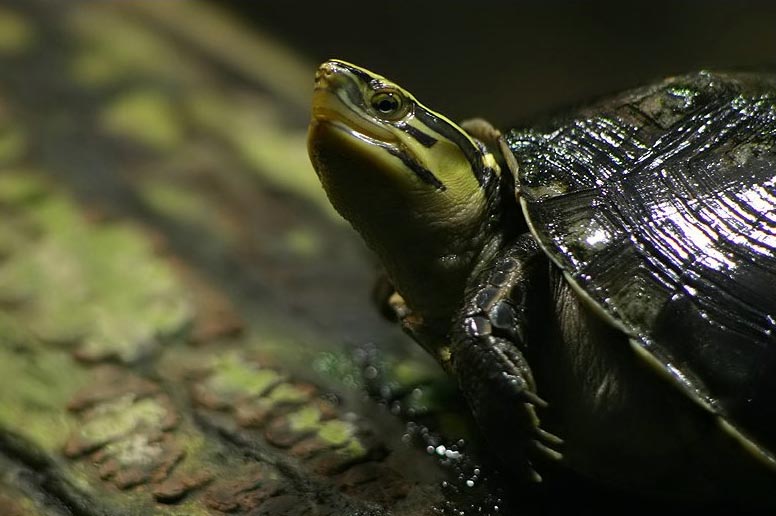
Turtles & tortoises · Difficulty: Intermediate
Key facts and care guidance for Southeast Asian box turtle (Cuora amboinensis) (origin: South and Southeast Asia: India, Bangladesh, Myanmar, Thailand, Cambodia, Vietnam, Malaysia, Indonesia (Sunda Islands) and the Philippines). Adult size around 18–22 cm. Life expectancy 25–40+ years. The values below are carefully researched guidance.
Short answers
Southeast Asian box turtle: How big does the enclosure need to be?
Aqua-terrarium from 150 × 60 cm for one animal, water depth 20–30 cm (expert report: shell width × 2) with a consistently structured water area and ways to climb out, plus a large moist land area with 15–20 cm of substrate and an egg-laying option.
Southeast Asian box turtle: What temperature does it need?
Daytime water 24–28 °C, air 26–30 °C, basking spot 35–40 °C at the basking spot, at night 22–24 °C.
Southeast Asian box turtle: Does it need UVB lighting?
UVB: Recommended.
Southeast Asian box turtle: How long do they live?
Life expectancy: 25–40+ years.
Southeast Asian box turtle: Is it suitable for beginners?
Rather not – it is considered an intermediate species (difficulty: Intermediate).
Climate
- Daytime temperature
- water 24–28 °C, air 26–30 °C
- Night temperature
- 22–24 °C
- Basking spot
- 35–40 °C at the basking spot
- Humidity
- High, 70–90 % (land section)
- UVB
- Recommended
Enclosure
- Minimum size
- aqua-terrarium from 150 × 60 cm for one animal, water depth 20–30 cm (expert report: shell width × 2) with a consistently structured water area and ways to climb out, plus a large moist land area with 15–20 cm of substrate and an egg-laying option
- Substrate
- Structured water; a damp land section (moss and leaf litter), an egg-laying site
Feeding
- Food
- Omnivorous, roughly half plant-based and half animal-based: aquatic plants, meadow herbs, lettuce, cucumber, courgette and fruit, as well as snails, earthworms, fish, mussel meat, shrimp and turtle pellets. In the first few months, juveniles eat almost no plant matter and need significantly more animal food.
- Feeding interval
- juveniles daily, adults 2–3×/week
Key facts
- Adult size
- 18–22 cm
- Life expectancy
- 25–40+ years
- Origin
- South and Southeast Asia: India, Bangladesh, Myanmar, Thailand, Cambodia, Vietnam, Malaysia, Indonesia (Sunda Islands) and the Philippines
- Protection status
- CITES Appendix II / EU Annex B – registration required; wild populations are severely threatened
- Brumation
- No winter dormancy. For breeding stimulation, a few weeks to months cooler at 20–24 °C water temperature with shortened lighting.
- Cohabitation
- Keeping singly is safest. Females get along with each other if given plenty of space; males are kept singly: they court all year round, harass females to the point of emaciation and can hold them under water while mounting. For breeding, put them together under supervision and separate them again; always plan for a way to separate them. The water section must have exit aids everywhere, because the species is a clumsy swimmer.
Notes
Keep it warm and humid all year; a poor swimmer – shallow, well-structured water with places to prop itself up and a large proportion of land.
Do you keep this species?
Add your animal to Reptoria – Reptoria reminds you about feeding and shedding. Add your animal for free →
Look for Southeast Asian box turtle (Cuora amboinensis) in the marketplace →
Related species
- Bourret's box turtle (Cuora bourreti) – Expert
- Yellow-margined box turtle (Cuora flavomarginata) – Intermediate
- Chinese three-striped box turtle (Cuora trifasciata) – Expert
- Yellow-headed box turtle (Cuora aurocapitata) – Expert
- Hainan box turtle (Cuora hainanensis) – Expert
- McCord's box turtle (Cuora mccordi) – Expert
- Pan's box turtle (Cuora pani) – Expert
- Southern Vietnam box turtle (Cuora picturata) – Expert
What you need to start
To keep Southeast Asian box turtle (Cuora amboinensis) you typically need: a suitable enclosure (aqua-terrarium from 150 × 60 cm for one animal, water depth 20–30 cm (expert report: shell width × 2) with a consistently structured water area and ways to climb out, plus a large moist land area with 15–20 cm of substrate and an egg-laying option), substrate (Structured water; a damp land section (moss and leaf litter), an egg-laying site), a heat source with a thermostat, UVB lighting, thermometer and hygrometer, a water dish and hides. You will find equipment in the Reptoria marketplace.
The complete, interactive care database is in the Reptoria app.
Last updated: 9 October 2026 · Editor: Reptoria editorial team · Sources include: chrysemys.com, schildkroetenteiche.de, gutachten.txt (BML 1997, lokal), einrichtungsbeispiele.de, EUR-Lex VO (EU) 2026/1383
All values are non-binding guidance and do not replace expert advice. Research thoroughly from several sources before acquiring and keeping an animal, and observe the applicable law (species and animal protection in particular).