Common boa (Boa constrictor imperator)
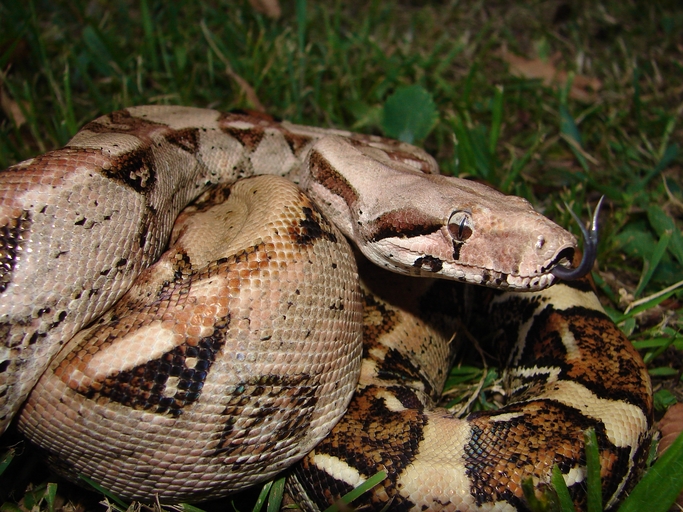
Snakes · Difficulty: Intermediate
Key facts and care guidance for Common boa (Boa constrictor imperator) (origin: Central America and northern South America). Adult size around 1.2–2.5 m depending on locality form; females larger. Life expectancy 20–30 years, individual animals over 30. The values below are carefully researched guidance.
Short answers
Common boa: How big does the enclosure need to be?
From 250×125×190 cm (minimum size per the 1997 expert report, American boas).
Common boa: What temperature does it need?
Daytime 25–28 °C in the gradient (cool zone 22–25 °C), basking spot 32–35 °C (local warm spot), at night 22–24 °C.
Common boa: Does it need UVB lighting?
UVB: UVB not essential; low-dose UVB optional and recommended.
Common boa: How long do they live?
Life expectancy: 20–30 years, individual animals over 30.
Common boa: Is it suitable for beginners?
Rather not – it is considered an intermediate species (difficulty: Intermediate).
Climate
- Daytime temperature
- 25–28 °C in the gradient (cool zone 22–25 °C)
- Night temperature
- 22–24 °C
- Basking spot
- 32–35 °C (local warm spot)
- Humidity
- 60–80 % (higher for shedding)
- UVB
- UVB not essential; low-dose UVB optional and recommended
Enclosure
- Minimum size
- from 250×125×190 cm (minimum size per the 1997 expert report, American boas)
- Substrate
- Pine bark, terrarium humus or beech chips; a large water basin, climbing branches, hides
Feeding
- Food
- Frozen food – rats of a suitable size
- Feeding interval
- adults every 2–3 weeks, juveniles every 7–10 days
Key facts
- Adult size
- 1.2–2.5 m depending on locality form; females larger
- Life expectancy
- 20–30 years, individual animals over 30
- Origin
- Central America and northern South America
- Protection status
- CITES Appendix II / EU Regulation Annex B; listed in Annex 5 of the BArtSchV -> exempt from the registration requirement since 2005, but proof of origin is mandatory.
- Brumation
- No real winter rest; a slight cooling period to stimulate breeding is possible
- Cohabitation
- Keep them singly – a loner; only for supervised breeding. Even where group keeping works, the feeding accident remains the risk: always feed them singly, ideally in separate boxes, and only house animals of roughly the same size together.
Notes
Collective entry for the common boa with no locality form given — intended for captive-bred animals from mixed pairings. The locality forms mainly differ in adult size: Nicaraguan boas often stay considerably smaller than Colombian ones.
Do you keep this species?
Add your animal to Reptoria – Reptoria reminds you about feeding and shedding. Add your animal for free →
Common boa (Boa constrictor imperator) currently offered
- Barry – Kaiserboa (Boa constrictor imperator) – Classic · Bergisch Gladbach · 120 €
- Boa Constrictor Imperator – Unterschiedlich · Köln · 120 €
- Boa Constrictor Imperator – Unterschiedlich · Köln · 100 €
- Boa Imperator Jungtier Hypo 66 % Het Albino (Kahl) – Hypo · Dortmund · 60 €
- Boa Imperator Jungtier Hypo 66 % Het Albino (Kahl) – Hypo · Dortmund · 80 €
- Boa Imperator Jungtier Hypo 66 % Het Albino (Kahl) – Hypo · Dortmund · 60 €
Related species
- Argentine boa (Boa constrictor occidentalis) – Intermediate
- True red-tailed boa – Guyana (Boa constrictor constrictor) – Intermediate
- True red-tailed boa – Peru (Boa constrictor constrictor) – Intermediate
- True red-tailed boa – Suriname (Boa constrictor constrictor) – Intermediate
- True red-tailed boa (Boa constrictor constrictor) – Intermediate
- Hog Island boa (Boa constrictor imperator) – Intermediate
- Common boa – Costa Rica (Boa constrictor imperator) – Intermediate
- Common boa – Honduras (Boa constrictor imperator) – Intermediate
What you need to start
To keep Common boa (Boa constrictor imperator) you typically need: a suitable enclosure (from 250×125×190 cm (minimum size per the 1997 expert report, American boas)), substrate (Pine bark, terrarium humus or beech chips; a large water basin, climbing branches, hides), a heat source with a thermostat, UVB lighting, thermometer and hygrometer, a water dish and hides. You will find equipment in the Reptoria marketplace.
The complete, interactive care database is in the Reptoria app.
Last updated: 30 October 2026 · Editor: Reptoria editorial team · Sources include: boa-constrictors.com, einrichtungsbeispiele.de, exotische-tierwelt.de, megazoo-nord.de, zenhabitats.ca
All values are non-binding guidance and do not replace expert advice. Research thoroughly from several sources before acquiring and keeping an animal, and observe the applicable law (species and animal protection in particular).