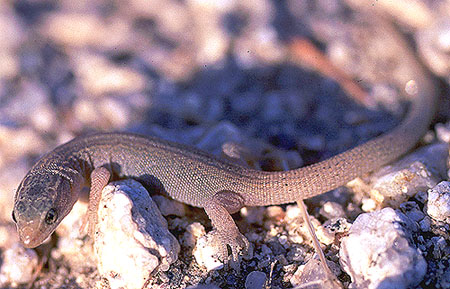
Desert night lizard (Xantusia vigilis)
Lizards · Difficulty: Intermediate
Key facts and care guidance for Desert night lizard (Xantusia vigilis) (origin: The south-western USA). Adult size around 9–12 cm. Life expectancy 8–15 years. The values below are carefully researched guidance.
Short answers
Desert night lizard: How big does the enclosure need to be?
100×50×50 cm for a pair.
Desert night lizard: What temperature does it need?
Daytime 22–27 °C, basking spot No basking spot — at most a warm corner up to 29 °C, at night 16–19 °C.
Desert night lizard: Does it need UVB lighting?
UVB: Not essential, weak UVB is possible.
Desert night lizard: How long do they live?
Life expectancy: 8–15 years.
Desert night lizard: Is it suitable for beginners?
Rather not – it is considered an intermediate species (difficulty: Intermediate).
Climate
- Daytime temperature
- 22–27 °C
- Night temperature
- 16–19 °C
- Basking spot
- No basking spot — at most a warm corner up to 29 °C
- Humidity
- 40–60 %
- UVB
- Not essential, weak UVB is possible
Enclosure
- Minimum size
- 100×50×50 cm for a pair
- Substrate
- A sand-loam mix with flat bark and stone hides
Feeding
- Food
- Crickets, roaches, house crickets and earthworms, dusted regularly with calcium and vitamins
- Feeding interval
- adults 2–3×/week
Key facts
- Adult size
- 9–12 cm
- Life expectancy
- 8–15 years
- Origin
- The south-western USA
- Protection status
- Not listed under CITES
- Brumation
- No winter rest; somewhat cooler and drier in winter
- Cohabitation
- Group housing as a family unit is unusually well documented for this species: in the wild it lives together with parents and offspring, huddling close for warmth in winter. Avoid pure male-male pairings; enough food and hides matter in groups, since cannibalism is documented when food is short.
Notes
A tiny species, diurnal despite its name, that lives under yucca bark. No basking spot needed, but flat hides instead.
Do you keep this species?
Add your animal to Reptoria – Reptoria reminds you about feeding and shedding. Add your animal for free →
Look for Desert night lizard (Xantusia vigilis) in the marketplace →
Related species
- Granite night lizard (Xantusia henshawi) – Intermediate
- Island night lizard (Xantusia riversiana) – Intermediate
- Sandstone night lizard (Xantusia gracilis) – Intermediate
- Large psammodromus (Psammodromus algirus) – Intermediate
- Pamphylian green lizard (Lacerta pamphylica) – Intermediate
- Madrean alligator lizard (Elgaria kingii) – Intermediate
- Artvin lizard (Darevskia derjugini) – Intermediate
- Asian glass lizard (Dopasia gracilis) – Intermediate
What you need to start
To keep Desert night lizard (Xantusia vigilis) you typically need: a suitable enclosure (100×50×50 cm for a pair), substrate (A sand-loam mix with flat bark and stone hides), a heat source with a thermostat, UVB lighting, thermometer and hygrometer, a water dish and hides. You will find equipment in the Reptoria marketplace.
The complete, interactive care database is in the Reptoria app.
Last updated: 5 November 2026 · Editor: Reptoria editorial team · Sources include: https://en.wikipedia.org/wiki/Desert_night_lizard, https://reptile-database.reptarium.cz/species?genus=Xantusia&species=vigilis, californiaherps.com Xantusia vigilis („Diurnal (contrary to the common name) and crepuscular. May be nocturnal during the heat of the summer.“); Josh's Frogs Care Sheet Desert Night Lizard (diurnal despite the name)
All values are non-binding guidance and do not replace expert advice. Research thoroughly from several sources before acquiring and keeping an animal, and observe the applicable law (species and animal protection in particular).