Dickerson's collared lizard (Crotaphytus dickersonae)
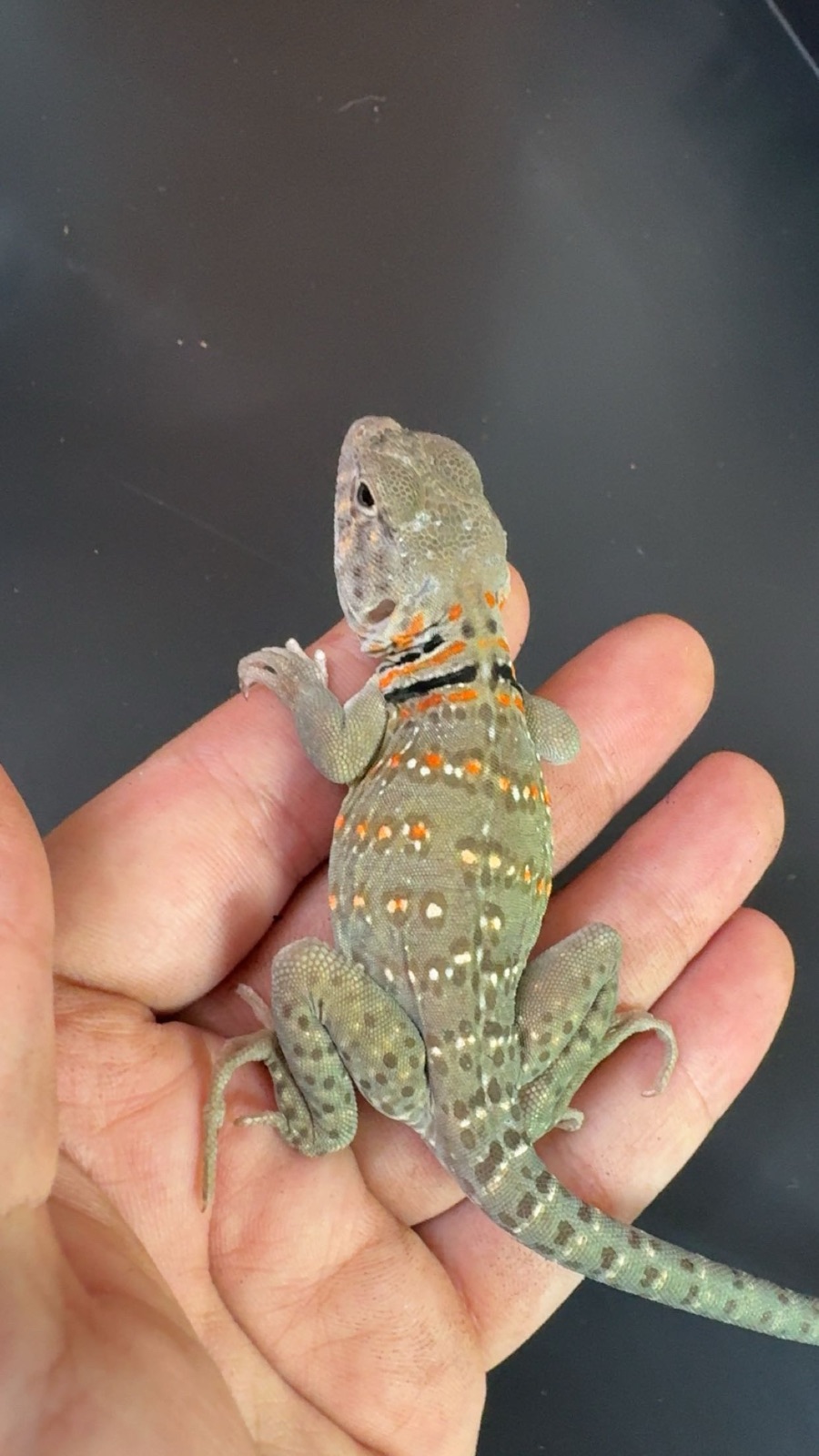
Iguanas · Difficulty: Intermediate
Key facts and care guidance for Dickerson's collared lizard (Crotaphytus dickersonae) (origin: Coastal Sonora and Isla Tiburón, Mexico – hot coastal desert). Adult size around 25–33 cm. Life expectancy 8–12 years. The values below are carefully researched guidance.
Short answers
Dickerson's collared lizard: How big does the enclosure need to be?
150×80×80 cm for a pair.
Dickerson's collared lizard: What temperature does it need?
Daytime 30–36 °C, basking spot 45–50 °C, at night 20–24 °C.
Dickerson's collared lizard: Does it need UVB lighting?
UVB: Essential (UVB 10.0, a very high requirement).
Dickerson's collared lizard: How long do they live?
Life expectancy: 8–12 years.
Dickerson's collared lizard: Is it suitable for beginners?
Rather not – it is considered an intermediate species (difficulty: Intermediate).
Climate
- Daytime temperature
- 30–36 °C
- Night temperature
- 20–24 °C
- Basking spot
- 45–50 °C
- Humidity
- 35–50 %
- UVB
- Essential (UVB 10.0, a very high requirement)
Enclosure
- Minimum size
- 150×80×80 cm for a pair
- Substrate
- A sand-loam mix they can dig in, with securely built rock slabs and stone structures on top
Feeding
- Food
- Robust insects; larger animals also take small lizards; calcium and vitamins regularly
- Feeding interval
- adults 3–4×/week
Key facts
- Adult size
- 25–33 cm
- Life expectancy
- 8–12 years
- Origin
- Coastal Sonora and Isla Tiburón, Mexico – hot coastal desert
- Protection status
- Not listed under CITES; IUCN: not threatened. A Mexican endemic — wild-caught animals may not leave Mexico, so only documented captive breeding.
- Brumation
- Optional: a short, mild rest of 4–6 weeks at 16–18 °C
- Cohabitation
- Kept in pairs (1.1); males must never be housed together. In closely related collared lizards it is documented that males placed together in a terrarium fight to the death; a single male, however, can claim and defend several females as a 'harem'. Females usually get along but need their own basking and hiding spots; feed separately if sizes differ.
Notes
The most colourful species in the genus: the males are brilliant blue to turquoise with white spotting and a black mouth. It comes from a markedly hotter and somewhat more humid coastal climate than the collared lizard — the night drop and the winter rest are milder. That is exactly why it is not one for beginners: cared for on the standard collared-lizard programme, the animals come through the resting phase badly.
Do you keep this species?
Add your animal to Reptoria – Reptoria reminds you about feeding and shedding. Add your animal for free →
Look for Dickerson's collared lizard (Crotaphytus dickersonae) in the marketplace →
Related species
- Baja collared lizard (Crotaphytus vestigium) – Intermediate
- Venerable collared lizard (Crotaphytus antiquus) – Expert
- Grismer's collared lizard (Crotaphytus grismeri) – Expert
- Great Basin collared lizard (Crotaphytus bicinctores) – Intermediate
- Common collared lizard (Crotaphytus collaris) – Intermediate
- Baja California collared lizard (Crotaphytus insularis) – Expert
- Reticulate collared lizard (Crotaphytus reticulatus) – Intermediate
- Sonoran collared lizard (Crotaphytus nebrius) – Intermediate
What you need to start
To keep Dickerson's collared lizard (Crotaphytus dickersonae) you typically need: a suitable enclosure (150×80×80 cm for a pair), substrate (A sand-loam mix they can dig in, with securely built rock slabs and stone structures on top), a heat source with a thermostat, UVB lighting, thermometer and hygrometer, a water dish and hides. You will find equipment in the Reptoria marketplace.
The complete, interactive care database is in the Reptoria app.
Last updated: 2 November 2026 · Editor: Reptoria editorial team · Sources include: https://en.wikipedia.org/wiki/Common_collared_lizard, https://en.wikipedia.org/wiki/Crotaphytus_dickersonae, https://en.wikipedia.org/wiki/Crotaphytus
All values are non-binding guidance and do not replace expert advice. Research thoroughly from several sources before acquiring and keeping an animal, and observe the applicable law (species and animal protection in particular).