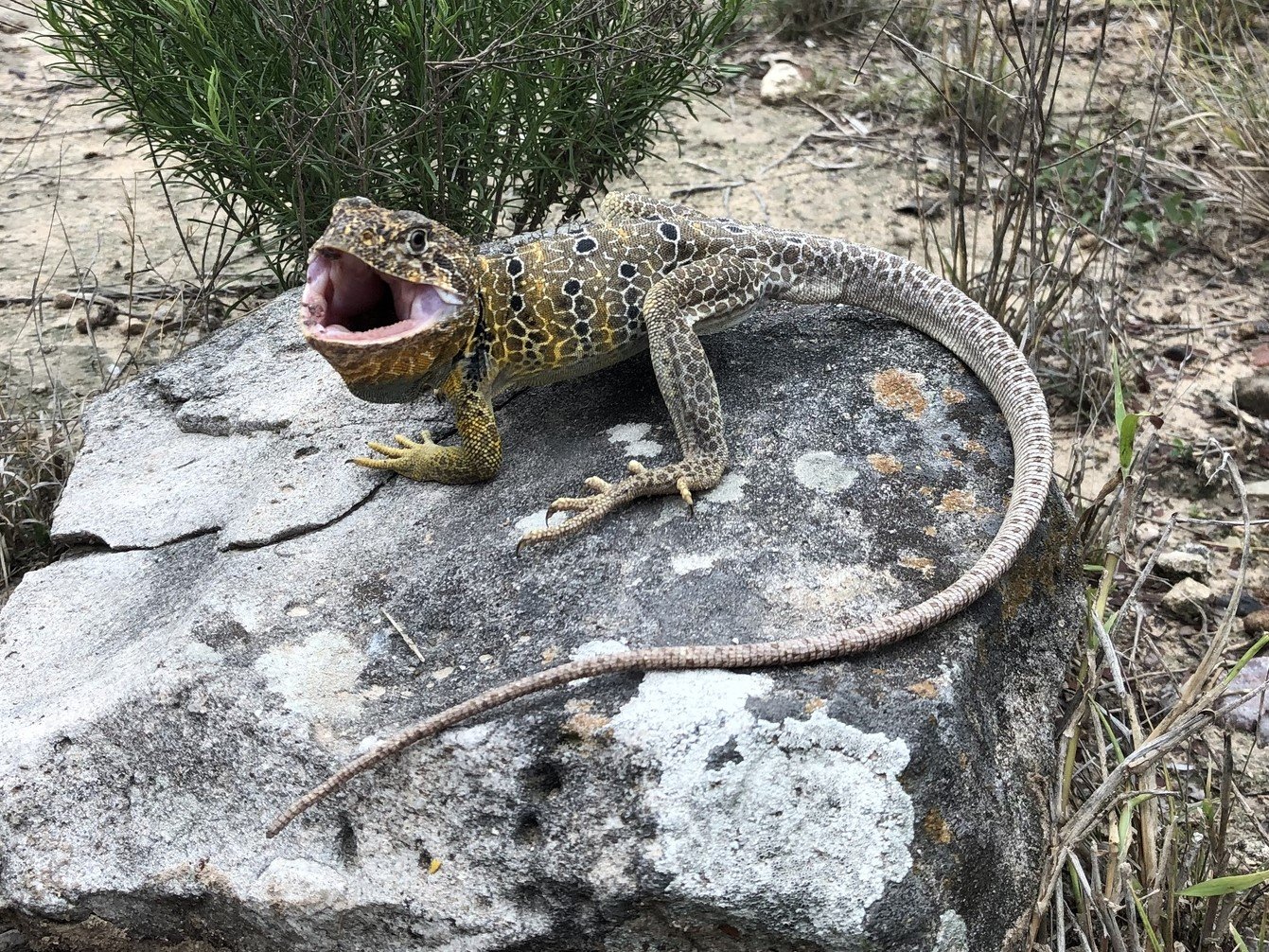
Reticulate collared lizard (Crotaphytus reticulatus)
Iguanas · Difficulty: Intermediate
Key facts and care guidance for Reticulate collared lizard (Crotaphytus reticulatus) (origin: Southern Texas and north-eastern Mexico – flat thorn scrub rather than rocky slopes). Adult size around 30–43 cm. Life expectancy 8–12 years. The values below are carefully researched guidance.
Short answers
Reticulate collared lizard: How big does the enclosure need to be?
180×90×80 cm for a pair — the largest species in the genus needs more floor space.
Reticulate collared lizard: What temperature does it need?
Daytime 28–34 °C, basking spot 45–50 °C, at night 18–22 °C.
Reticulate collared lizard: Does it need UVB lighting?
UVB: Essential (UVB 10.0, a very high requirement).
Reticulate collared lizard: How long do they live?
Life expectancy: 8–12 years.
Reticulate collared lizard: Is it suitable for beginners?
Rather not – it is considered an intermediate species (difficulty: Intermediate).
Climate
- Daytime temperature
- 28–34 °C
- Night temperature
- 18–22 °C
- Basking spot
- 45–50 °C
- Humidity
- 30–45 %
- UVB
- Essential (UVB 10.0, a very high requirement)
Enclosure
- Minimum size
- 180×90×80 cm for a pair — the largest species in the genus needs more floor space
- Substrate
- A sand-loam mix they can dig in with flat stones, plus thorn-scrub structure of branches and low hides
Feeding
- Food
- Robust insects; fully grown animals also take small lizards regularly; calcium and vitamins regularly
- Feeding interval
- adults 3×/week
Key facts
- Adult size
- 30–43 cm
- Life expectancy
- 8–12 years
- Origin
- Southern Texas and north-eastern Mexico – flat thorn scrub rather than rocky slopes
- Protection status
- Not listed under CITES, but IUCN "Vulnerable" and protected under Texas state law. Only with an unbroken chain of proof of captive breeding.
- Brumation
- A cooler rest of 8–10 weeks at 12–16 °C
- Cohabitation
- Kept in pairs (1.1); males must never be housed together. In closely related collared lizards it is documented that males placed together in a terrarium fight to the death; a single male, however, can claim and defend several females as a 'harem'. Females usually get along but need their own basking and hiding spots; feed separately if sizes differ.
Notes
The largest species in the genus and the only one without the double black collar — instead a net pattern of pale spots. Unlike all the other collared lizards it lives not on rocky slopes but flat in open thorn scrub. So the enclosure needs area and low cover, not tall climbing rocks. Clarify its protection status before buying.
Do you keep this species?
Add your animal to Reptoria – Reptoria reminds you about feeding and shedding. Add your animal for free →
Look for Reticulate collared lizard (Crotaphytus reticulatus) in the marketplace →
Related species
- Baja collared lizard (Crotaphytus vestigium) – Intermediate
- Venerable collared lizard (Crotaphytus antiquus) – Expert
- Grismer's collared lizard (Crotaphytus grismeri) – Expert
- Dickerson's collared lizard (Crotaphytus dickersonae) – Intermediate
- Great Basin collared lizard (Crotaphytus bicinctores) – Intermediate
- Common collared lizard (Crotaphytus collaris) – Intermediate
- Baja California collared lizard (Crotaphytus insularis) – Expert
- Sonoran collared lizard (Crotaphytus nebrius) – Intermediate
What you need to start
To keep Reticulate collared lizard (Crotaphytus reticulatus) you typically need: a suitable enclosure (180×90×80 cm for a pair — the largest species in the genus needs more floor space), substrate (A sand-loam mix they can dig in with flat stones, plus thorn-scrub structure of branches and low hides), a heat source with a thermostat, UVB lighting, thermometer and hygrometer, a water dish and hides. You will find equipment in the Reptoria marketplace.
The complete, interactive care database is in the Reptoria app.
Last updated: 30 October 2026 · Editor: Reptoria editorial team · Sources include: https://en.wikipedia.org/wiki/Common_collared_lizard, https://en.wikipedia.org/wiki/Crotaphytus_reticulatus, https://en.wikipedia.org/wiki/Crotaphytus
All values are non-binding guidance and do not replace expert advice. Research thoroughly from several sources before acquiring and keeping an animal, and observe the applicable law (species and animal protection in particular).