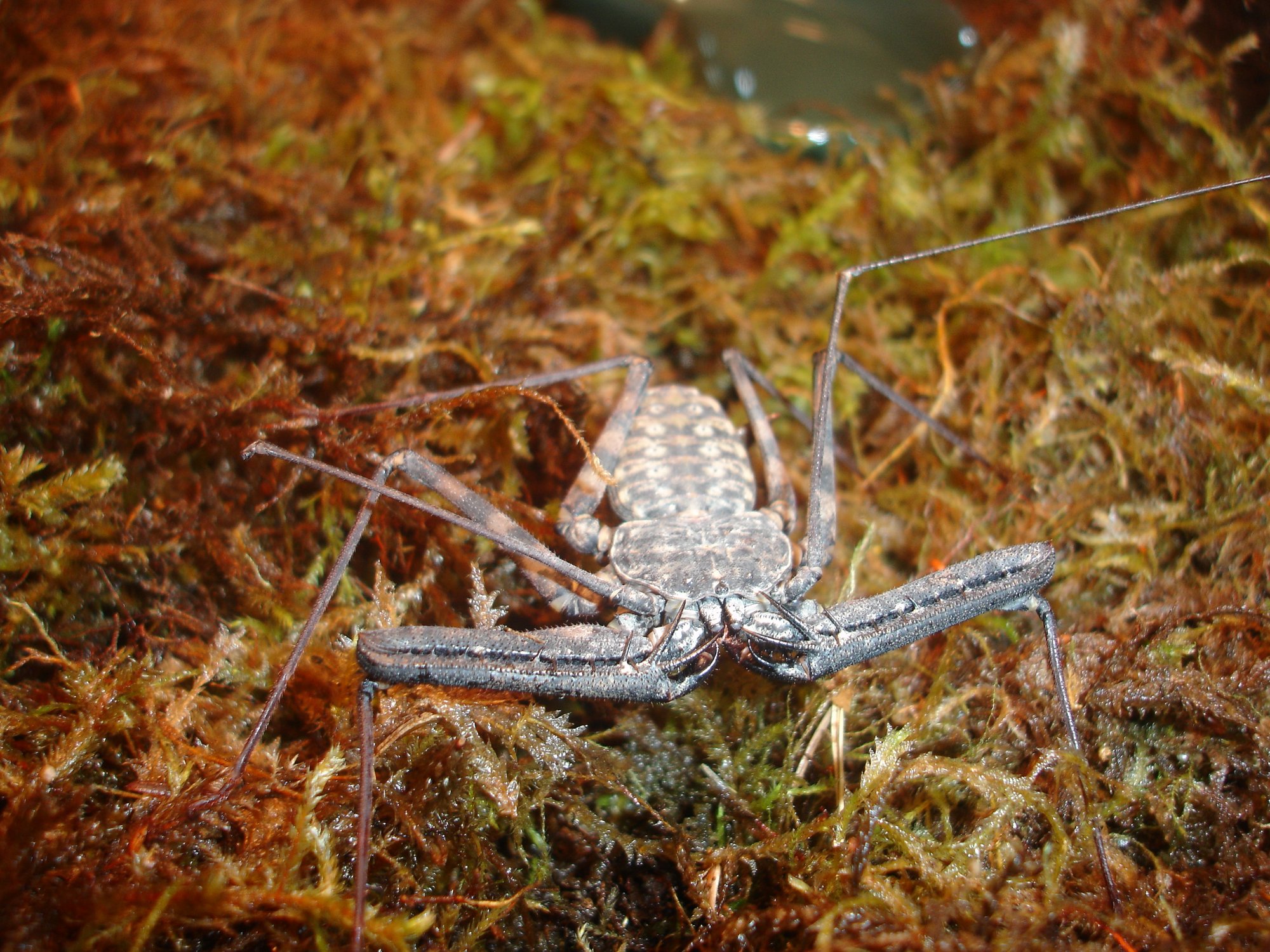
East African whip spider (Damon variegatus)
Invertebrates · Difficulty: Intermediate
Key facts and care guidance for East African whip spider (Damon variegatus) (origin: Eastern to south-eastern Africa (variable depending on the locality)). Adult size around One of the largest species – up to approx. 25 cm including the legs, body approx. 2.5 cm. Life expectancy 5–10 years (females longer). The values below are carefully researched guidance.
Short answers
East African whip spider: How big does the enclosure need to be?
30×30×40 cm (one animal); approx. 40×40×60 cm for a pair.
East African whip spider: What temperature does it need?
Daytime 24–28 °C, at night 20–22 °C.
East African whip spider: Does it need UVB lighting?
UVB: No UVB needed (nocturnal).
East African whip spider: How long do they live?
Life expectancy: 5–10 years (females longer).
East African whip spider: Is it suitable for beginners?
Rather not – it is considered an intermediate species (difficulty: Intermediate).
Climate
- Daytime temperature
- 24–28 °C
- Night temperature
- 20–22 °C
- Basking spot
- —
- Humidity
- 75–85 %
- UVB
- No UVB needed (nocturnal)
Enclosure
- Minimum size
- 30×30×40 cm (one animal); approx. 40×40×60 cm for a pair
- Substrate
- A soil and sand mix or coco humus, moisture-retaining; a back wall of cork bark
Feeding
- Food
- Crickets, roaches, locusts; matched to their size
- Feeding interval
- 1–2×/week
Key facts
- Adult size
- One of the largest species – up to approx. 25 cm including the legs, body approx. 2.5 cm
- Life expectancy
- 5–10 years (females longer)
- Origin
- Eastern to south-eastern Africa (variable depending on the locality)
- Protection status
- No known CITES or German protection; freely tradable
- Brumation
- None (tropical)
- Cohabitation
- Group housing is possible (an exception among arachnids), but tolerance depends strongly on the locality the animals come from — so more caution is needed than with D. diadema; provide plenty of vertical surface and hiding places, as males can be rivalrous.
Notes
Non-venomous, without silk glands, and harmless. Mist daily; it likes to sit on the terrarium walls. Moulting needs height. Breeding is described scientifically (Weygoldt).
Do you keep this species?
Add your animal to Reptoria – Reptoria reminds you about feeding and shedding. Add your animal for free →
Look for East African whip spider (Damon variegatus) in the marketplace →
Related species
- Johnston's whip spider (Damon johnstonii) – Intermediate
- Tanzanian whip spider (Damon diadema) – Beginner
- Tanzanian whip spider (Damon medius) – Beginner
- African whip spider (Euphrynichus amanica) – Beginner to intermediate
- Amazonian whip spider (Heterophrynus elaphus) – Intermediate
- Tailless whip scorpion (Phrynus marginemaculatus) – Intermediate
- Israeli whip spider (Charinus israelensis) – Expert
- Small whip spider (Phrynus parvulus) – Intermediate
What you need to start
To keep East African whip spider (Damon variegatus) you typically need: a suitable enclosure (30×30×40 cm (one animal); approx. 40×40×60 cm for a pair), substrate (A soil and sand mix or coco humus, moisture-retaining; a back wall of cork bark), a heat source with a thermostat, UVB lighting, thermometer and hygrometer, a water dish and hides. You will find equipment in the Reptoria marketplace.
The complete, interactive care database is in the Reptoria app.
Last updated: 9 October 2026 · Editor: Reptoria editorial team · Sources include: https://en.wikipedia.org/wiki/Damon_(genus), https://en.wikipedia.org/wiki/Damon_variegatus, https://en.wikipedia.org/wiki/Damon_medius
All values are non-binding guidance and do not replace expert advice. Research thoroughly from several sources before acquiring and keeping an animal, and observe the applicable law (species and animal protection in particular).