East Indian brown mabuya (Eutropis multifasciata)
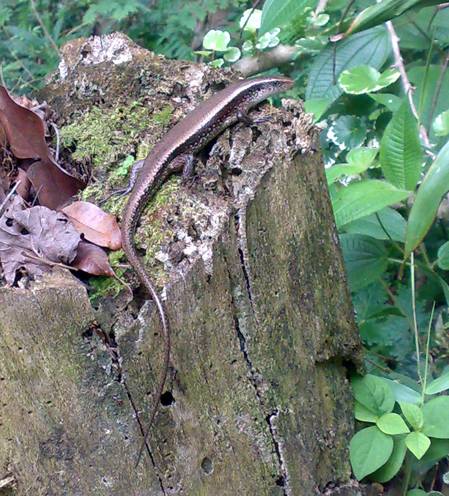
Skinks · Difficulty: Intermediate
Key facts and care guidance for East Indian brown mabuya (Eutropis multifasciata) (origin: South and South-East Asia (India, southern China, Myanmar, Thailand, Indochina to Malaysia, Sumatra, Borneo, Java, the Philippines); invasive in Florida). Adult size around up to ~35 cm total length (SVL up to ~13 cm; the tail 1.3–1.6× the SVL). Life expectancy 8+ years in captivity. The values below are carefully researched guidance.
Short answers
East Indian brown mabuya: How big does the enclosure need to be?
~90×45×45 cm for one animal; larger is better (offer climbing and structure).
East Indian brown mabuya: What temperature does it need?
Daytime 27–32 °C (cooler side), basking spot 35–40 °C basking spot, at night ~18–21 °C.
East Indian brown mabuya: Does it need UVB lighting?
UVB: UVB needed (a diurnal basker, Ferguson zone 2–3, UV index 2–4).
East Indian brown mabuya: How long do they live?
Life expectancy: 8+ years in captivity.
East Indian brown mabuya: Is it suitable for beginners?
Rather not – it is considered an intermediate species (difficulty: Intermediate).
Climate
- Daytime temperature
- 27–32 °C (cooler side)
- Night temperature
- ~18–21 °C
- Basking spot
- 35–40 °C basking spot
- Humidity
- 60–80 % (tropical; mist once or twice a day, water dish)
- UVB
- UVB needed (a diurnal basker, Ferguson zone 2–3, UV index 2–4)
Enclosure
- Minimum size
- ~90×45×45 cm for one animal; larger is better (offer climbing and structure)
- Substrate
- Humus-rich substrate they can dig in (soil, coco humus or plantation soil), ~7–10 cm; not pure desert sand
Feeding
- Food
- Mostly insects (roaches, crickets, black soldier fly larvae, worms, snails, silkworms), occasionally fruit (banana, papaya, berries)
- Feeding interval
- adults daily to every other day (as much as is eaten in about 5 minutes)
Key facts
- Adult size
- up to ~35 cm total length (SVL up to ~13 cm; the tail 1.3–1.6× the SVL)
- Life expectancy
- 8+ years in captivity
- Origin
- South and South-East Asia (India, southern China, Myanmar, Thailand, Indochina to Malaysia, Sumatra, Borneo, Java, the Philippines); invasive in Florida
- Protection status
- Not listed under CITES; IUCN "Least Concern"; not specially protected in Germany, no registration duty
- Brumation
- None (a tropical species, warm and even all year)
- Cohabitation
- Keeping them singly is the safest choice for beginners. Experienced keepers can try female groups or one male with several females in a large enclosure (about 120x60x60 cm for up to three animals) with plenty of structure and close observation. Never keep males together: violent fights are documented repeatedly for the species.
Notes
Very fast and skittish → a well-secured terrarium, a lid, and visual screening. Live-bearing (viviparous), with no egg-laying. Common mistakes: too dry (a tropical species!), too little space, and housing males together. Older animals often lose the thick tail base (described as natural).
Do you keep this species?
Add your animal to Reptoria – Reptoria reminds you about feeding and shedding. Add your animal for free →
Look for East Indian brown mabuya (Eutropis multifasciata) in the marketplace →
Related species
- Bronze grass skink (Eutropis macularia) – Beginner with some knowledge
- Long-tailed sun skink (Eutropis longicaudata) – Beginner
- Rough-scaled sun skink (Eutropis rugifera) – Beginner with some knowledge
- Keeled grass skink (Eutropis carinata) – Beginner with some knowledge
- African five-lined skink (Trachylepis quinquetaeniata) – Intermediate
- Algerian skink (Eumeces algeriensis) – Intermediate
- Berber skink (Eumeces schneideri) – Beginner to intermediate
- Berdmore's water skink (Tropidophorus berdmorei) – Beginner with some knowledge
What you need to start
To keep East Indian brown mabuya (Eutropis multifasciata) you typically need: a suitable enclosure (~90×45×45 cm for one animal; larger is better (offer climbing and structure)), substrate (Humus-rich substrate they can dig in (soil, coco humus or plantation soil), ~7–10 cm; not pure desert sand), a heat source with a thermostat, UVB lighting, thermometer and hygrometer, a water dish and hides. You will find equipment in the Reptoria marketplace.
The complete, interactive care database is in the Reptoria app.
Last updated: 9 October 2026 · Editor: Reptoria editorial team · Sources include: https://en.wikipedia.org/wiki/Eutropis_multifasciata, https://reptile-database.reptarium.cz/species?genus=Eutropis&species=multifasciata
All values are non-binding guidance and do not replace expert advice. Research thoroughly from several sources before acquiring and keeping an animal, and observe the applicable law (species and animal protection in particular).