Eastern box turtle (Terrapene carolina)
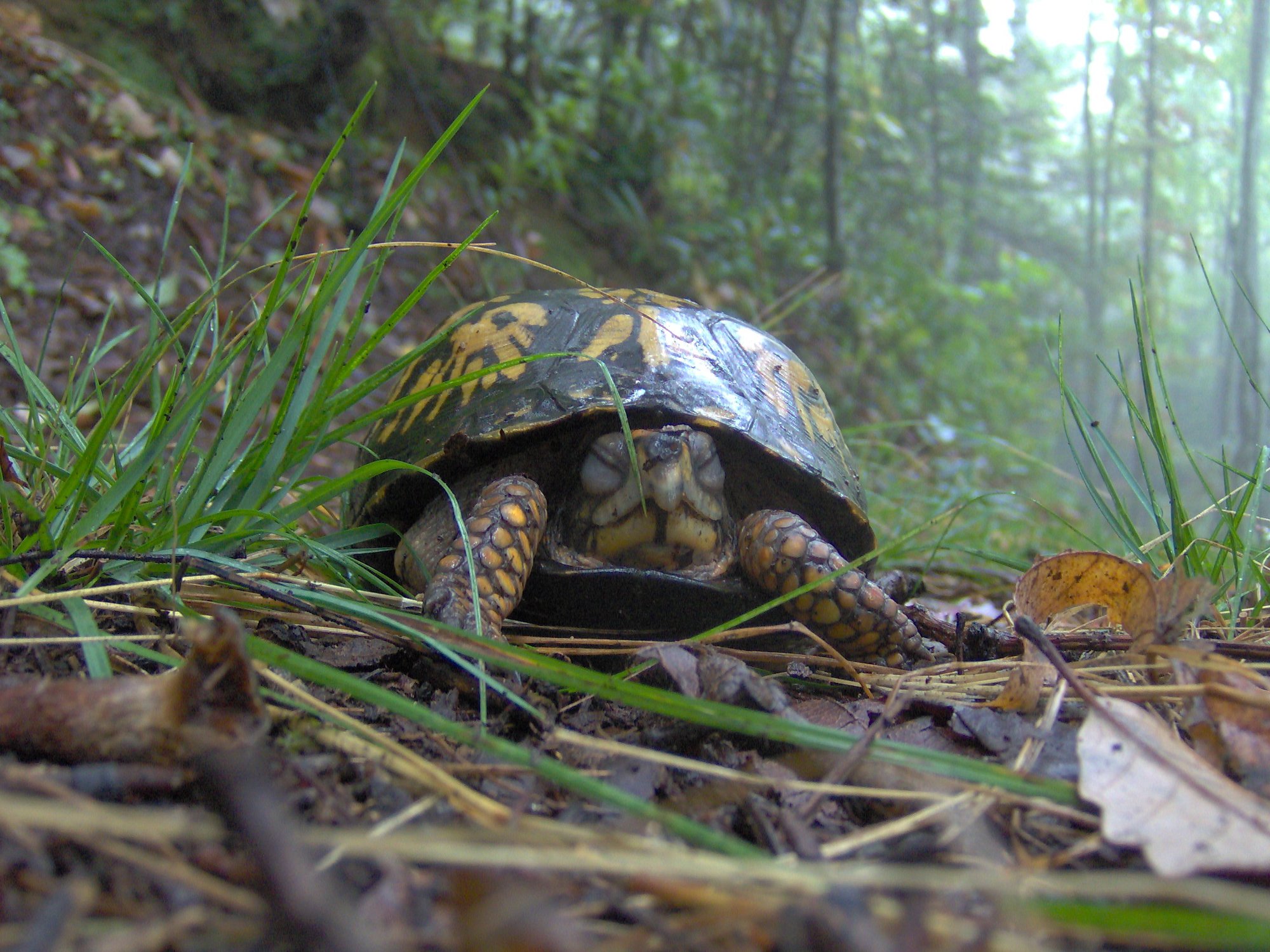
Turtles & tortoises · Difficulty: Intermediate
Key facts and care guidance for Eastern box turtle (Terrapene carolina) (origin: The eastern USA). Adult size around 11–16 cm shell length. Life expectancy 30–50+ years (in captivity; occasionally up to ~100 in the wild). The values below are carefully researched guidance.
Short answers
Eastern box turtle: How big does the enclosure need to be?
A land dweller with a high humidity requirement: a floor area from ~120×90 cm (at least 8 sq ft), an enclosed pen rather than an open table; a shallow water dish; keeping them outdoors in summer is ideal.
Eastern box turtle: What temperature does it need?
Daytime 21–27 °C (cool side ~21–24, warm side ~27–29), basking spot 29–31 °C (basking spot), at night 15–21 °C.
Eastern box turtle: Does it need UVB lighting?
UVB: UVB needed (Ferguson zone 2–3, UV index 2–4).
Eastern box turtle: How long do they live?
Life expectancy: 30–50+ years (in captivity; occasionally up to ~100 in the wild).
Eastern box turtle: Is it suitable for beginners?
Rather not – it is considered an intermediate species (difficulty: Intermediate).
Climate
- Daytime temperature
- 21–27 °C (cool side ~21–24, warm side ~27–29)
- Night temperature
- 15–21 °C
- Basking spot
- 29–31 °C (basking spot)
- Humidity
- 60–80 %
- UVB
- UVB needed (Ferguson zone 2–3, UV index 2–4)
Enclosure
- Minimum size
- a land dweller with a high humidity requirement: a floor area from ~120×90 cm (at least 8 sq ft), an enclosed pen rather than an open table; a shallow water dish; keeping them outdoors in summer is ideal
- Substrate
- Moisture-retaining: soil, leaf litter and bark mulch, with a damp sphagnum hide
Feeding
- Food
- Omnivorous: snails, earthworms, insects as well as greens, fungi, berries and windfall fruit (juveniles are more carnivorous)
- Feeding interval
- adults every other day, juveniles daily
Key facts
- Adult size
- 11–16 cm shell length
- Life expectancy
- 30–50+ years (in captivity; occasionally up to ~100 in the wild)
- Origin
- The eastern USA
- Protection status
- CITES Appendix II / EU Annex B: registration plus proof of origin with the local nature conservation authority
- Brumation
- Yes – a winter rest or brumation for animals from temperate regions, ~2–4 months at 4–10 °C; it depends on the species and origin (southern populations shorter and milder)
- Cohabitation
- Keeping them singly is preferable. The males are territorial and constant courtship stresses the females; a group only in a large outdoor enclosure with a surplus of females, and never two males
Notes
A land tortoise despite being grouped with freshwater turtles, and not a swimmer. A common mistake: too dry (which leads to eye, respiratory and shell problems) and too little area. Prone to stress, and site-faithful.
Do you keep this species?
Add your animal to Reptoria – Reptoria reminds you about feeding and shedding. Add your animal for free →
Look for Eastern box turtle (Terrapene carolina) in the marketplace →
Related species
- Spotted box turtle (Terrapene nelsoni) – Expert
- Ornate box turtle (Terrapene ornata) – Intermediate
- Three-toed box turtle (Terrapene triunguis) – Intermediate
- Flattened musk turtle (Sternotherus depressus) – Intermediate
- Alligator snapping turtle (Macrochelys temminckii) – Expert
- Loggerhead musk turtle (Sternotherus minor) – Intermediate
- Rough-footed mud turtle (Kinosternon hirtipes) – Intermediate
- Mississippi mud turtle (Kinosternon subrubrum hippocrepis) – Intermediate
What you need to start
To keep Eastern box turtle (Terrapene carolina) you typically need: a suitable enclosure (a land dweller with a high humidity requirement: a floor area from ~120×90 cm (at least 8 sq ft), an enclosed pen rather than an open table; a shallow water dish; keeping them outdoors in summer is ideal), substrate (Moisture-retaining: soil, leaf litter and bark mulch, with a damp sphagnum hide), a heat source with a thermostat, UVB lighting, thermometer and hygrometer, a water dish and hides. You will find equipment in the Reptoria marketplace.
The complete, interactive care database is in the Reptoria app.
Last updated: 5 November 2026 · Editor: Reptoria editorial team · Sources include: https://en.wikipedia.org/wiki/Common_box_turtle, https://reptifiles.com/eastern-box-turtle-care/, https://reptile-database.reptarium.cz/species?genus=Terrapene&species=carolina, Reptile Database Terrapene carolina (deutscher Name Carolina-Dosenschildkröte); de.wikipedia „Carolina-Dosenschildkröte“
All values are non-binding guidance and do not replace expert advice. Research thoroughly from several sources before acquiring and keeping an animal, and observe the applicable law (species and animal protection in particular).