Loggerhead musk turtle (Sternotherus minor)
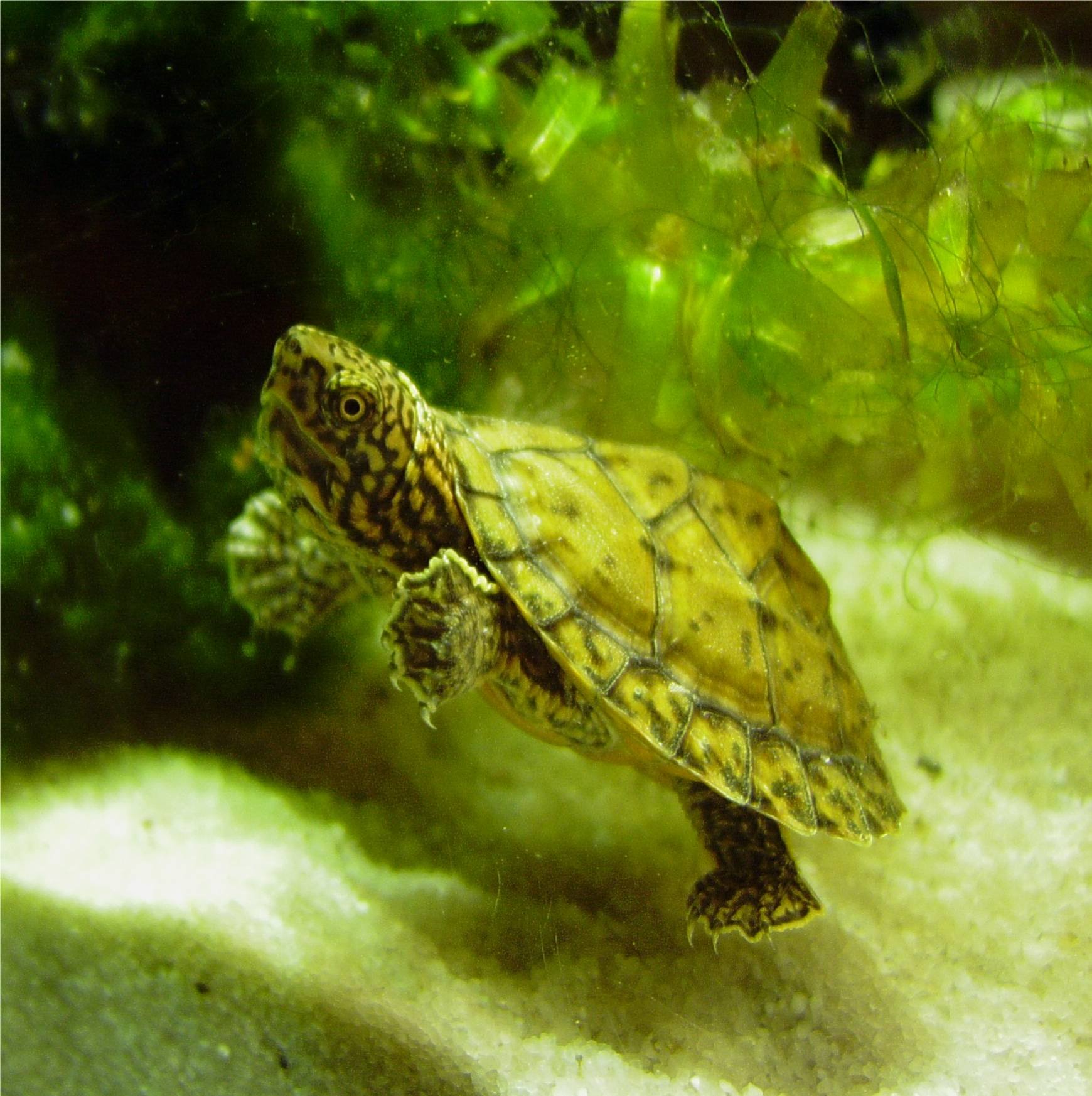
Turtles & tortoises · Difficulty: Intermediate
Key facts and care guidance for Loggerhead musk turtle (Sternotherus minor) (origin: The south-eastern USA (Florida, Georgia, Alabama, Tennessee)). Adult size around 10–14 cm (females up to ~14.5 cm, males smaller). Life expectancy 20–30+ years (up to ~50). The values below are carefully researched guidance.
Short answers
Loggerhead musk turtle: How big does the enclosure need to be?
An aquarium from ~80×40×40 cm for one animal; a low water level with plenty of climbing and exit aids (a moderate swimmer), a reachable basking spot; strong filtration.
Loggerhead musk turtle: What temperature does it need?
Daytime 22–26 °C water temperature, basking spot 32–35 °C (basking spot, ~90–95 °F), at night slight drop.
Loggerhead musk turtle: Does it need UVB lighting?
UVB: UVB needed (Ferguson zone 2, UV index 2–3) above the basking spot.
Loggerhead musk turtle: How long do they live?
Life expectancy: 20–30+ years (up to ~50).
Loggerhead musk turtle: Is it suitable for beginners?
Rather not – it is considered an intermediate species (difficulty: Intermediate).
Climate
- Daytime temperature
- 22–26 °C water temperature
- Night temperature
- slight drop
- Basking spot
- 32–35 °C (basking spot, ~90–95 °F)
- Humidity
- aquatic (—)
- UVB
- UVB needed (Ferguson zone 2, UV index 2–3) above the basking spot
Enclosure
- Minimum size
- an aquarium from ~80×40×40 cm for one animal; a low water level with plenty of climbing and exit aids (a moderate swimmer), a reachable basking spot; strong filtration
- Substrate
- Sand or fine gravel (they like to bury themselves partly)
Feeding
- Food
- Mainly carnivorous: water and land snails, mussels, crustaceans, worms, insects, fish (powerful jaws for molluscs)
- Feeding interval
- adults 2–3×/week, juveniles daily
Key facts
- Adult size
- 10–14 cm (females up to ~14.5 cm, males smaller)
- Life expectancy
- 20–30+ years (up to ~50)
- Origin
- The south-eastern USA (Florida, Georgia, Alabama, Tennessee)
- Protection status
- CITES Appendix II / EU Annex B (Sternotherus spp. listed since 2023): registration requirement + proof of origin.
- Brumation
- No compulsory winter dormancy in captivity; a slight drop in winter temperature (cooling) can stimulate breeding – depending on their origin
- Cohabitation
- Keep them singly. Aggressive towards its own kind and towards other species (bite injuries), especially the males; do not house it with anything
Notes
A small, ground-oriented aquatic turtle that swims badly – a risk of drowning if the water is too deep with no way out. Under stress it releases musk. A mollusc specialist – a proportion of snails matters for wearing down the jaws.
Do you keep this species?
Add your animal to Reptoria – Reptoria reminds you about feeding and shedding. Add your animal for free →
Look for Loggerhead musk turtle (Sternotherus minor) in the marketplace →
Related species
- Flattened musk turtle (Sternotherus depressus) – Intermediate
- Razorback musk turtle (Sternotherus carinatus) – Beginner
- Common musk turtle (Sternotherus odoratus) – Beginner
- Eastern box turtle (Terrapene carolina) – Intermediate
- Spotted box turtle (Terrapene nelsoni) – Expert
- Alligator snapping turtle (Macrochelys temminckii) – Expert
- Rough-footed mud turtle (Kinosternon hirtipes) – Intermediate
- Mississippi mud turtle (Kinosternon subrubrum hippocrepis) – Intermediate
What you need to start
To keep Loggerhead musk turtle (Sternotherus minor) you typically need: a suitable enclosure (an aquarium from ~80×40×40 cm for one animal; a low water level with plenty of climbing and exit aids (a moderate swimmer), a reachable basking spot; strong filtration), substrate (Sand or fine gravel (they like to bury themselves partly)), a heat source with a thermostat, UVB lighting, thermometer and hygrometer, a water dish and hides. You will find equipment in the Reptoria marketplace.
The complete, interactive care database is in the Reptoria app.
Last updated: 30 October 2026 · Editor: Reptoria editorial team · Sources include: https://de.wikipedia.org/wiki/Kleine_Moschusschildkr%C3%B6te, https://en.wikipedia.org/wiki/Sternotherus_minor
All values are non-binding guidance and do not replace expert advice. Research thoroughly from several sources before acquiring and keeping an animal, and observe the applicable law (species and animal protection in particular).