Razorback musk turtle (Sternotherus carinatus)
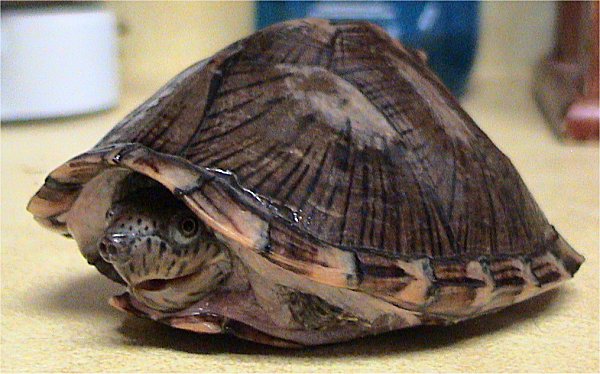
Turtles & tortoises · Difficulty: Beginner
Key facts and care guidance for Razorback musk turtle (Sternotherus carinatus) (origin: The southern USA (Oklahoma, Texas, Mississippi)). Adult size around 10–16 cm (males up to ~18 cm). Life expectancy 20–30 years, sometimes over 50. The values below are carefully researched guidance.
Short answers
Razorback musk turtle: How big does the enclosure need to be?
An aquarium from 80×40 cm, better 100×50 cm; water approx. 30 cm deep for adults.
Razorback musk turtle: What temperature does it need?
Daytime 24–27 °C water (juveniles 26–28 °C), basking spot 35–40 °C (warm spot on the land section), at night 20–22 °C (small drop).
Razorback musk turtle: Does it need UVB lighting?
UVB: UVB recommended (weak to moderate above the basking spot).
Razorback musk turtle: How long do they live?
Life expectancy: 20–30 years, sometimes over 50.
Razorback musk turtle: Is it suitable for beginners?
Yes – it is considered suitable for beginners (difficulty: Beginner).
Climate
- Daytime temperature
- 24–27 °C water (juveniles 26–28 °C)
- Night temperature
- 20–22 °C (small drop)
- Basking spot
- 35–40 °C (warm spot on the land section)
- Humidity
- — (aquatic)
- UVB
- UVB recommended (weak to moderate above the basking spot)
Enclosure
- Minimum size
- an aquarium from 80×40 cm, better 100×50 cm; water approx. 30 cm deep for adults
- Substrate
- Fine sand
Feeding
- Food
- Carnivorous – earthworms, fish or mussel meat, snails, prawns, occasionally beef heart; plant food is barely taken
- Feeding interval
- adults 2–3×/week, juveniles (almost) daily
Key facts
- Adult size
- 10–16 cm (males up to ~18 cm)
- Life expectancy
- 20–30 years, sometimes over 50
- Origin
- The southern USA (Oklahoma, Texas, Mississippi)
- Protection status
- CITES Appendix II (Sternotherus spp., since CoP19 in 2022), EU Regulation Annex B; proof of origin required
- Brumation
- Brumation of about 3 months at 4–7 °C (depending on where they come from)
- Cohabitation
- Keep them singly. Adult males must generally be kept on their own (they are aggressive); keeping females singly is recommended as well.
Notes
A rather poor swimmer – climbing and exit aids up to the surface and shallower zones matter. Good filtration and clear water. Pond keeping is not recommended.
Do you keep this species?
Add your animal to Reptoria – Reptoria reminds you about feeding and shedding. Add your animal for free →
Look for Razorback musk turtle (Sternotherus carinatus) in the marketplace →
Related species
- Flattened musk turtle (Sternotherus depressus) – Intermediate
- Loggerhead musk turtle (Sternotherus minor) – Intermediate
- Common musk turtle (Sternotherus odoratus) – Beginner
- Eastern box turtle (Terrapene carolina) – Intermediate
- Spotted box turtle (Terrapene nelsoni) – Expert
- Alligator snapping turtle (Macrochelys temminckii) – Expert
- Rough-footed mud turtle (Kinosternon hirtipes) – Intermediate
- Mississippi mud turtle (Kinosternon subrubrum hippocrepis) – Intermediate
What you need to start
To keep Razorback musk turtle (Sternotherus carinatus) you typically need: a suitable enclosure (an aquarium from 80×40 cm, better 100×50 cm; water approx. 30 cm deep for adults), substrate (Fine sand), a heat source with a thermostat, UVB lighting, thermometer and hygrometer, a water dish and hides. You will find equipment in the Reptoria marketplace.
The complete, interactive care database is in the Reptoria app.
Last updated: 30 October 2026 · Editor: Reptoria editorial team · Sources include: https://de.wikipedia.org/wiki/Dach-Moschusschildkr%C3%B6te, https://en.wikipedia.org/wiki/Razorback_musk_turtle, https://en.wikipedia.org/wiki/Sternotherus
All values are non-binding guidance and do not replace expert advice. Research thoroughly from several sources before acquiring and keeping an animal, and observe the applicable law (species and animal protection in particular).