Common musk turtle (Sternotherus odoratus)
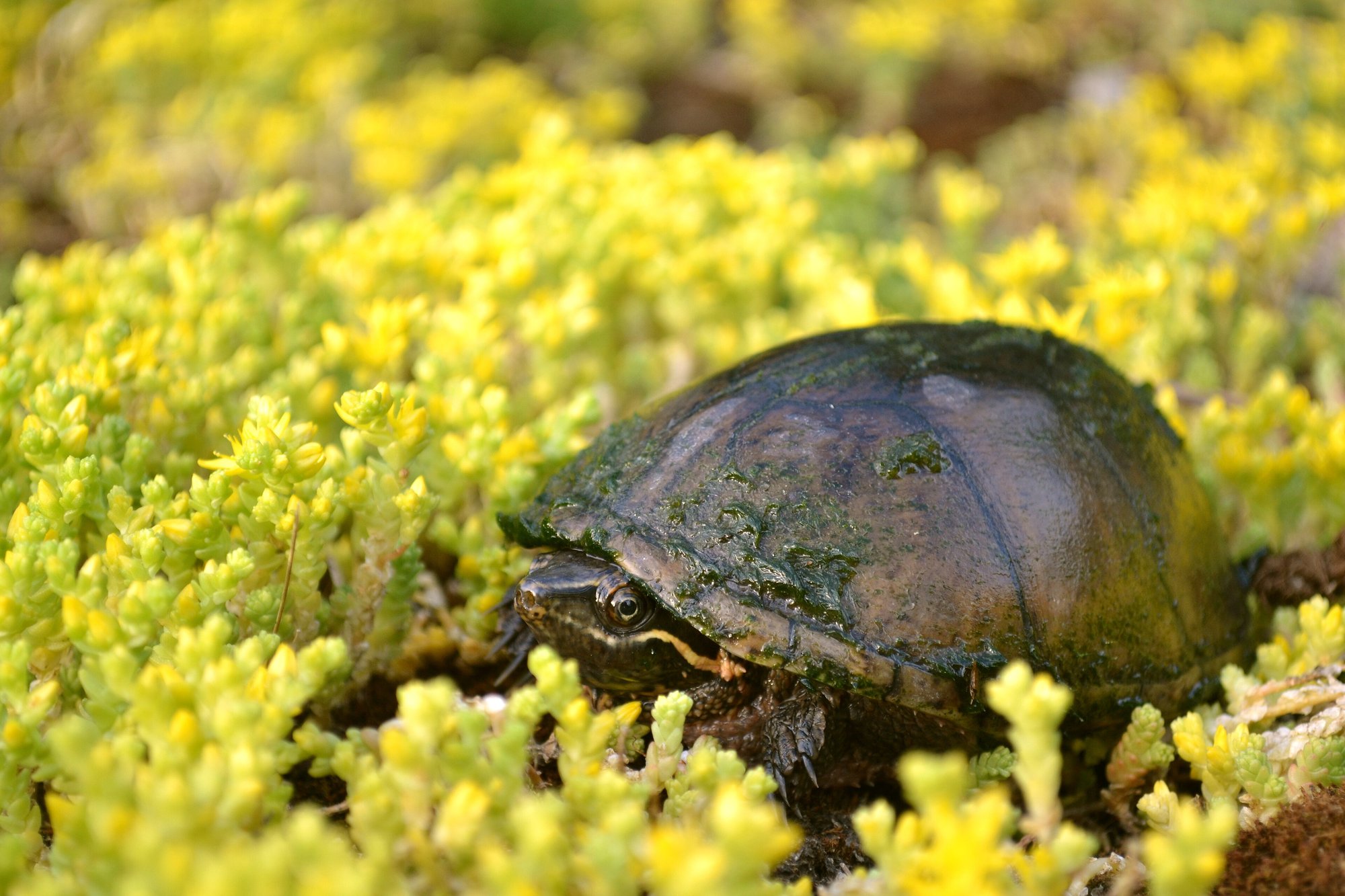
Turtles & tortoises · Difficulty: Beginner
Key facts and care guidance for Common musk turtle (Sternotherus odoratus) (origin: Eastern North America (southern Canada to Florida, west to Texas)). Adult size around 8–14 cm (average ~10 cm). Life expectancy 30–50 years, individual animals over 50. The values below are carefully researched guidance.
Short answers
Common musk turtle: How big does the enclosure need to be?
Aqua-terrarium from 100 × 50 cm (around 200 l) for a single animal; water depth 30–40 cm for adults, more is fine if roots and branches reach up to the surface; a shallow land area with a basking spot.
Common musk turtle: What temperature does it need?
Daytime 22–26 °C water, basking spot 35–40 °C (warm spot on the land section), at night approx. 20 °C (small drop).
Common musk turtle: Does it need UVB lighting?
UVB: UVB recommended (weak to moderate above the basking spot).
Common musk turtle: How long do they live?
Life expectancy: 30–50 years, individual animals over 50.
Common musk turtle: Is it suitable for beginners?
Yes – it is considered suitable for beginners (difficulty: Beginner).
Climate
- Daytime temperature
- 22–26 °C water
- Night temperature
- approx. 20 °C (small drop)
- Basking spot
- 35–40 °C (warm spot on the land section)
- Humidity
- — (aquatic)
- UVB
- UVB recommended (weak to moderate above the basking spot)
Enclosure
- Minimum size
- Aqua-terrarium from 100 × 50 cm (around 200 l) for a single animal; water depth 30–40 cm for adults, more is fine if roots and branches reach up to the surface; a shallow land area with a basking spot
- Substrate
- Fine sand
Feeding
- Food
- Carnivorous – earthworms, fish or mussel meat, snails, prawns, beef heart; occasionally duckweed
- Feeding interval
- adults 2–3×/week, juveniles (almost) daily
Key facts
- Adult size
- 8–14 cm (average ~10 cm)
- Life expectancy
- 30–50 years, individual animals over 50
- Origin
- Eastern North America (southern Canada to Florida, west to Texas)
- Protection status
- CITES Appendix II (Sternotherus spp., since CoP19 in 2022), EU Regulation Annex B; proof of origin required
- Brumation
- Brumation of about 3 months at ~10 °C (northern animals 4–5 °C, southern animals 10–15 °C)
- Cohabitation
- Solitary animal. Adult males must be housed singly, and single housing is the safe solution for females too. The reason is aggression, not predation: the animals bite each other's legs, tail and neck. Anyone who does try two animals needs a noticeably larger tank with visual barriers and underwater hiding places, and must be able to separate them at any time.
Notes
A poor swimmer – climbing and exit aids are needed. When threatened it releases musk (hence the name "stinkpot"). Often an impulse purchase because of the low price → many animals handed in.
Do you keep this species?
Add your animal to Reptoria – Reptoria reminds you about feeding and shedding. Add your animal for free →
Common musk turtle (Sternotherus odoratus) currently offered
- Mosschusschildkröte – München · 280 €
Related species
- Flattened musk turtle (Sternotherus depressus) – Intermediate
- Loggerhead musk turtle (Sternotherus minor) – Intermediate
- Razorback musk turtle (Sternotherus carinatus) – Beginner
- Eastern box turtle (Terrapene carolina) – Intermediate
- Spotted box turtle (Terrapene nelsoni) – Expert
- Alligator snapping turtle (Macrochelys temminckii) – Expert
- Rough-footed mud turtle (Kinosternon hirtipes) – Intermediate
- Mississippi mud turtle (Kinosternon subrubrum hippocrepis) – Intermediate
What you need to start
To keep Common musk turtle (Sternotherus odoratus) you typically need: a suitable enclosure (Aqua-terrarium from 100 × 50 cm (around 200 l) for a single animal; water depth 30–40 cm for adults, more is fine if roots and branches reach up to the surface; a shallow land area with a basking spot), substrate (Fine sand), a heat source with a thermostat, UVB lighting, thermometer and hygrometer, a water dish and hides. You will find equipment in the Reptoria marketplace.
The complete, interactive care database is in the Reptoria app.
Last updated: 9 October 2026 · Editor: Reptoria editorial team · Sources include: Wikipedia EN, bmleh.de, exotische-tierwelt.de, fws.gov, klappschildkroete.de
All values are non-binding guidance and do not replace expert advice. Research thoroughly from several sources before acquiring and keeping an animal, and observe the applicable law (species and animal protection in particular).