Emerald tree skink (Lamprolepis smaragdina)
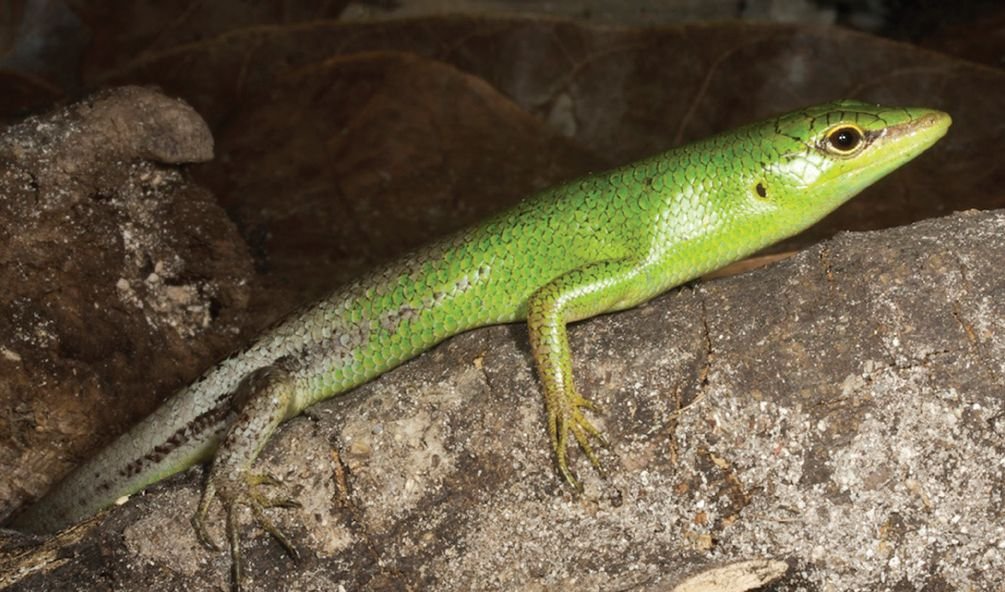
Skinks · Difficulty: Intermediate
Key facts and care guidance for Emerald tree skink (Lamprolepis smaragdina) (origin: South-East Asia and Oceania (the canopy of tropical forests)). Adult size around 20–25 cm. Life expectancy 8–15 years. The values below are carefully researched guidance.
Short answers
Emerald tree skink: How big does the enclosure need to be?
60 × 45 × 90 cm (kept singly, arboreal and tall; larger for a pair).
Emerald tree skink: What temperature does it need?
Daytime 24–30 °C (gradient), basking spot ~35 °C, at night ~20 °C.
Emerald tree skink: Does it need UVB lighting?
UVB: Essential (10–12 % UVB).
Emerald tree skink: How long do they live?
Life expectancy: 8–15 years.
Emerald tree skink: Is it suitable for beginners?
Rather not – it is considered an intermediate species (difficulty: Intermediate).
Climate
- Daytime temperature
- 24–30 °C (gradient)
- Night temperature
- ~20 °C
- Basking spot
- ~35 °C
- Humidity
- 70–80 % (up to 100 % at night)
- UVB
- Essential (10–12 % UVB)
Enclosure
- Minimum size
- 60 × 45 × 90 cm (kept singly, arboreal and tall; larger for a pair)
- Substrate
- Coco humus or forest floor, plenty of branches and plants (suitable for a bioactive setup)
Feeding
- Food
- Insects (crickets, house crickets, roaches), occasionally fruit
- Feeding interval
- Almost daily to 3×/week
Key facts
- Adult size
- 20–25 cm
- Life expectancy
- 8–15 years
- Origin
- South-East Asia and Oceania (the canopy of tropical forests)
- Protection status
- —
- Brumation
- None
- Cohabitation
- Single housing is safest. Keeping a pair (1,1) or one male with two females (1,2) is also possible given enough space, climbing opportunities and several hiding spots - the key is only one male per enclosure. Two males do not get along: they fight over territory and basking spots until one is permanently displaced and feeds poorly, without any visible injury.
Notes
Strictly arboreal: a tall, densely planted terrarium and UVB are needed. Shy and quick, not an animal for handling; high humidity prevents shedding problems.
Do you keep this species?
Add your animal to Reptoria – Reptoria reminds you about feeding and shedding. Add your animal for free →
Look for Emerald tree skink (Lamprolepis smaragdina) in the marketplace →
Related species
- African five-lined skink (Trachylepis quinquetaeniata) – Intermediate
- Algerian skink (Eumeces algeriensis) – Intermediate
- Berber skink (Eumeces schneideri) – Beginner to intermediate
- Berdmore's water skink (Tropidophorus berdmorei) – Beginner with some knowledge
- Mountain skink (Plestiodon callicephalus) – Beginner with some knowledge
- Pacific blue-tailed skink (Emoia caeruleocauda) – Beginner with some knowledge
- Blue-tongued water skink (Tropidophorus cocincinensis) – Beginner with some knowledge
- Bouton's snake-eyed skink (Cryptoblepharus boutonii) – Beginner with some knowledge
What you need to start
To keep Emerald tree skink (Lamprolepis smaragdina) you typically need: a suitable enclosure (60 × 45 × 90 cm (kept singly, arboreal and tall; larger for a pair)), substrate (Coco humus or forest floor, plenty of branches and plants (suitable for a bioactive setup)), a heat source with a thermostat, UVB lighting, thermometer and hygrometer, a water dish and hides. You will find equipment in the Reptoria marketplace.
The complete, interactive care database is in the Reptoria app.
Last updated: 30 October 2026 · Editor: Reptoria editorial team · Sources include: https://en.wikipedia.org/wiki/Emerald_tree_skink, https://reptile-database.reptarium.cz/species?genus=Lamprolepis&species=smaragdina
All values are non-binding guidance and do not replace expert advice. Research thoroughly from several sources before acquiring and keeping an animal, and observe the applicable law (species and animal protection in particular).