Fire millipede (Centrobolus splendidus)
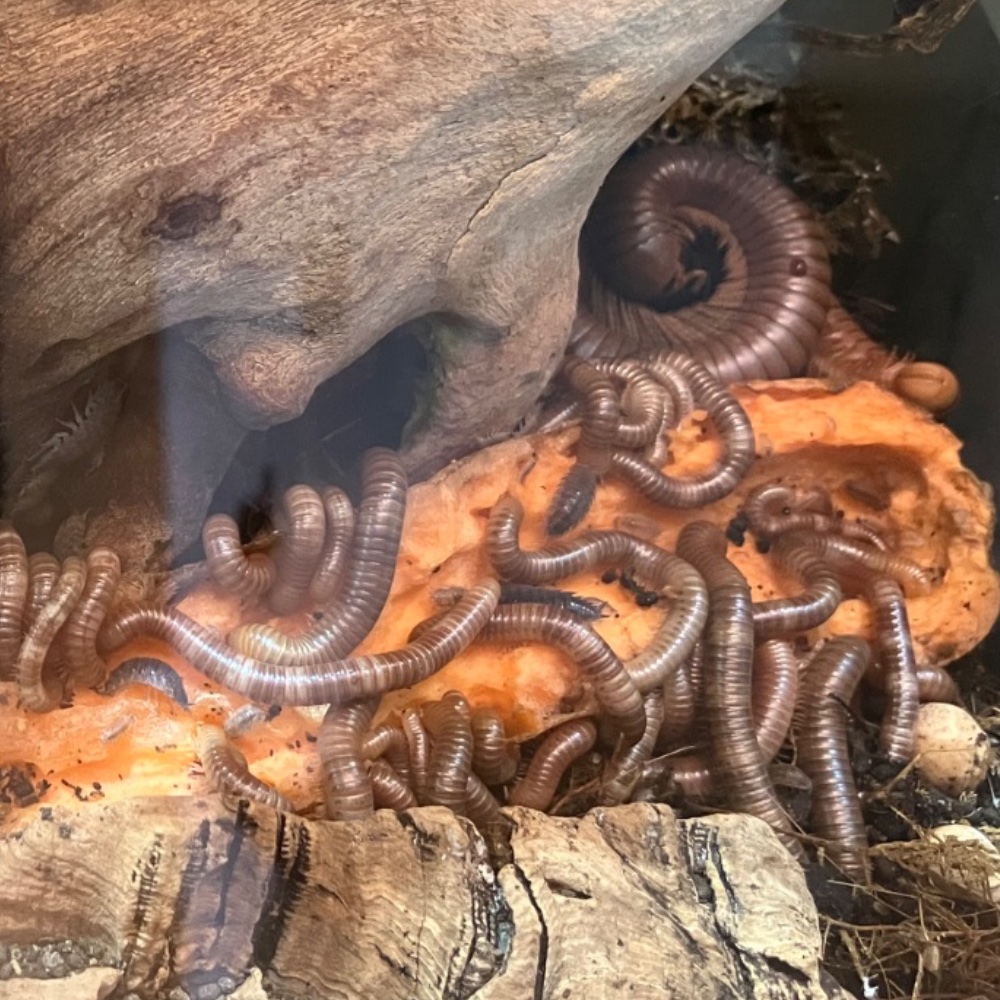
Invertebrates · Difficulty: Beginner
Key facts and care guidance for Fire millipede (Centrobolus splendidus) (origin: Southern Mozambique (East Africa), tropical coastal forest and savannah). Adult size around approx. 4–7 cm (figures range from 1.5–2 inches to ~7–9 cm). Life expectancy approx. 2–4 years (millipedes live several years; species-specific figures are sparse). The values below are carefully researched guidance.
Short answers
Fire millipede: How big does the enclosure need to be?
30×30×30 cm for a small group (about 5 animals); ~30×30×40 cm for about 10 animals.
Fire millipede: What temperature does it need?
Daytime 22–26 °C, at night ~20–22 °C.
Fire millipede: Does it need UVB lighting?
UVB: No UVB needed.
Fire millipede: How long do they live?
Life expectancy: approx. 2–4 years (millipedes live several years; species-specific figures are sparse).
Fire millipede: Is it suitable for beginners?
Yes – it is considered suitable for beginners (difficulty: Beginner).
Climate
- Daytime temperature
- 22–26 °C
- Night temperature
- ~20–22 °C
- Basking spot
- —
- Humidity
- 70–80 %
- UVB
- No UVB needed
Enclosure
- Minimum size
- 30×30×30 cm for a small group (about 5 animals); ~30×30×40 cm for about 10 animals
- Substrate
- At least 10 cm of a loose mix of leaf humus, white-rotted wood, coco humus plus a little cork granulate; permanently slightly damp, never wet; a damp and a dry zone
Feeding
- Food
- Fallen leaves and rotten white wood (the staple); plus soft vegetables (carrot, courgette, cucumber), a little protein (fish flakes for example) and calcium
- Feeding interval
- leaf litter and wood always in the tank; top up with vegetables 1–2×/week
Key facts
- Adult size
- approx. 4–7 cm (figures range from 1.5–2 inches to ~7–9 cm)
- Life expectancy
- approx. 2–4 years (millipedes live several years; species-specific figures are sparse)
- Origin
- Southern Mozambique (East Africa), tropical coastal forest and savannah
- Protection status
- Not protected (not listed under CITES or German nature conservation law); captive-bred animals in the trade
- Brumation
- None
- Cohabitation
- Colony/group housing explicitly recommended and common (e.g. around 5–10 animals); peaceful, sociable, not cannibalistic. Deep, moist substrate for shedding and reproduction (juveniles develop underground). You see more of them in a group, but they are not dependent on it — kept alone, such an animal carries on just as unobtrusively.
Notes
A striking red-and-black dwarf millipede. It buries itself to moult – do not dig it out (this interrupts the moult and is often fatal). When disturbed it releases a defensive secretion (benzoquinones) – wash your hands after contact and keep it away from your eyes. Its life expectancy is poorly documented for the species (a guide value).
Do you keep this species?
Add your animal to Reptoria – Reptoria reminds you about feeding and shedding. Add your animal for free →
Look for Fire millipede (Centrobolus splendidus) in the marketplace →
Related species
- Mozambique giant millipede (Centrobolus sp. Mosambik) – Beginner
- Red fire millipede (Centrobolus ruber) – Beginner
- Giant African millipede (Archispirostreptus gigas) – Beginner
- American giant millipede (Narceus americanus) – Beginner
- Bumblebee millipede (Anadenobolus monilicornis) – Beginner
- Ghana giant millipede (Ophistreptus guineensis) – Beginner
- Ghana black-foot millipede (Spirostreptus gregorius) – Beginner
- Green millipede (Telodeinopus aoutii) – Beginner
What you need to start
To keep Fire millipede (Centrobolus splendidus) you typically need: a suitable enclosure (30×30×30 cm for a small group (about 5 animals); ~30×30×40 cm for about 10 animals), substrate (At least 10 cm of a loose mix of leaf humus, white-rotted wood, coco humus plus a little cork granulate; permanently slightly damp, never wet; a damp and a dry zone), a heat source with a thermostat, UVB lighting, thermometer and hygrometer, a water dish and hides. You will find equipment in the Reptoria marketplace.
The complete, interactive care database is in the Reptoria app.
Last updated: 25 September 2026 · Editor: Reptoria editorial team · Sources include: https://dubiaroaches.com/blogs/invert-care/african-giant-millipede-care-sheet, https://www.amentsoc.org/insects/caresheets/millipedes.html, https://www.thedefiantforest.com/blogs/news/mozambique-fire-millipede-care-guide-centrobolus-splendidus
All values are non-binding guidance and do not replace expert advice. Research thoroughly from several sources before acquiring and keeping an animal, and observe the applicable law (species and animal protection in particular).