Red fire millipede (Centrobolus ruber)
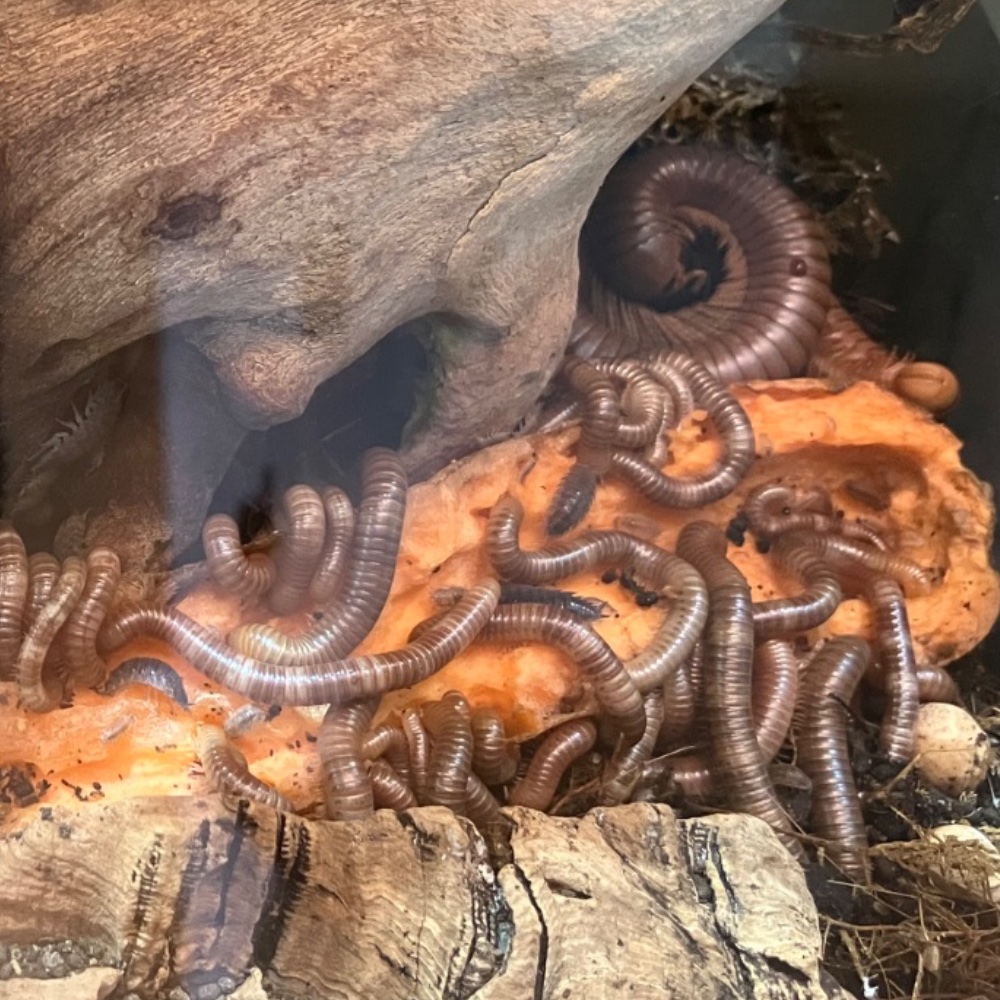
Invertebrates · Difficulty: Beginner
Key facts and care guidance for Red fire millipede (Centrobolus ruber) (origin: Southern Africa (mainly KwaZulu-Natal, South Africa)). Adult size around approx. 4–6 cm (38–45 body segments). Life expectancy approx. 3–5 years. The values below are carefully researched guidance.
Short answers
Red fire millipede: How big does the enclosure need to be?
30×30×30 cm for a small group (60 cm in length is more comfortable).
Red fire millipede: What temperature does it need?
Daytime 22–26 °C, at night 20–22 °C.
Red fire millipede: Does it need UVB lighting?
UVB: No UVB needed.
Red fire millipede: How long do they live?
Life expectancy: approx. 3–5 years.
Red fire millipede: Is it suitable for beginners?
Yes – it is considered suitable for beginners (difficulty: Beginner).
Climate
- Daytime temperature
- 22–26 °C
- Night temperature
- 20–22 °C
- Basking spot
- —
- Humidity
- 65–80 %
- UVB
- No UVB needed
Enclosure
- Minimum size
- 30×30×30 cm for a small group (60 cm in length is more comfortable)
- Substrate
- 10–15 cm of leaf humus plus white-rotted wood and cork; damp, but never waterlogged; a calcium source
Feeding
- Food
- Fallen leaves and white-rotted wood as the base, soft vegetables (cucumber, courgette), little fruit, some protein
- Feeding interval
- leaf litter and wood always available; vegetables and protein several times a week
Key facts
- Adult size
- approx. 4–6 cm (38–45 body segments)
- Life expectancy
- approx. 3–5 years
- Origin
- Southern Africa (mainly KwaZulu-Natal, South Africa)
- Protection status
- No CITES or protected status
- Brumation
- None
- Cohabitation
- A group is possible and common: millipedes are peaceful and not cannibalistic, and there is no competition over hides or food. A single animal kept alone does not suffer either - a group is only needed if you want to breed them.
Notes
Brilliant red and diurnal; a defensive secretion (benzoquinones) under stress – wash your hands, and keep it out of your eyes. Some of the husbandry figures come by analogy from the genus and relatives (C. splendidus, Mozambique).
Do you keep this species?
Add your animal to Reptoria – Reptoria reminds you about feeding and shedding. Add your animal for free →
Look for Red fire millipede (Centrobolus ruber) in the marketplace →
Related species
- Fire millipede (Centrobolus splendidus) – Beginner
- Mozambique giant millipede (Centrobolus sp. Mosambik) – Beginner
- Giant African millipede (Archispirostreptus gigas) – Beginner
- American giant millipede (Narceus americanus) – Beginner
- Bumblebee millipede (Anadenobolus monilicornis) – Beginner
- Ghana giant millipede (Ophistreptus guineensis) – Beginner
- Ghana black-foot millipede (Spirostreptus gregorius) – Beginner
- Green millipede (Telodeinopus aoutii) – Beginner
What you need to start
To keep Red fire millipede (Centrobolus ruber) you typically need: a suitable enclosure (30×30×30 cm for a small group (60 cm in length is more comfortable)), substrate (10–15 cm of leaf humus plus white-rotted wood and cork; damp, but never waterlogged; a calcium source), a heat source with a thermostat, UVB lighting, thermometer and hygrometer, a water dish and hides. You will find equipment in the Reptoria marketplace.
The complete, interactive care database is in the Reptoria app.
Last updated: 25 September 2026 · Editor: Reptoria editorial team · Sources include: https://bioone.org/journals/african-invertebrates/volume-56/issue-1/afin.056.0111/English-Names-of-the-Millipedes-Diplopoda-of-KwaZulu-Natal/10.5733/afin.056.0111.pdf, https://researchspace.ukzn.ac.za/items/18af2385-20ff-4351-b91b-06ac72b91669, https://www.millibase.org/aphia.php?p=taxlist&tName=Centrobolus, https://www.sanbi.org/animal-of-the-week/41889/, https://www.thedefiantforest.com/blogs/news/mozambique-fire-millipede-care-guide-centrobolus-splendidus
All values are non-binding guidance and do not replace expert advice. Research thoroughly from several sources before acquiring and keeping an animal, and observe the applicable law (species and animal protection in particular).