Fire skink (Lepidothyris fernandi)
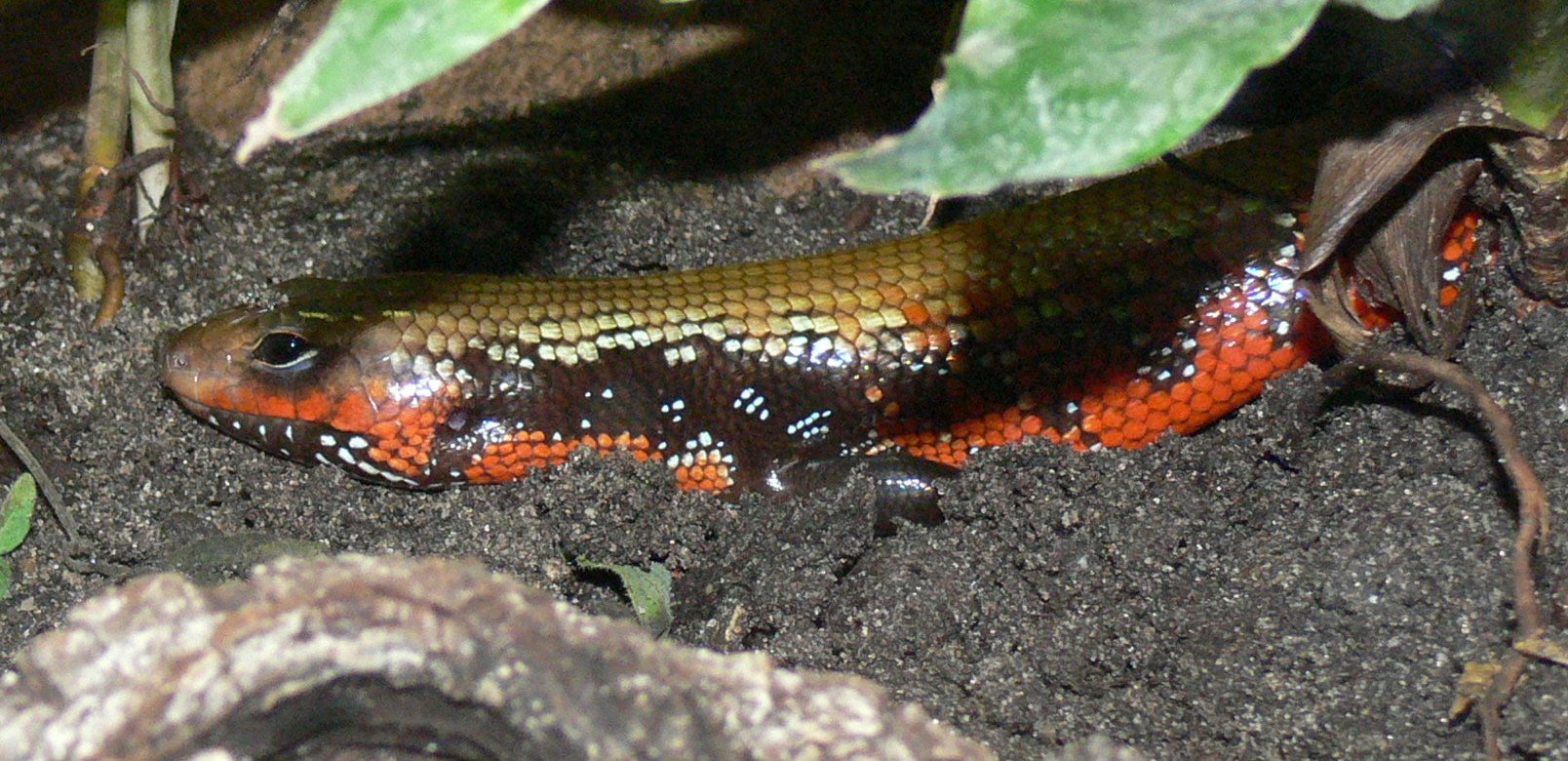
Skinks · Difficulty: Beginner
Key facts and care guidance for Fire skink (Lepidothyris fernandi) (origin: West and Central Africa (humid forests and forest edges)). Adult size around 25–37 cm. Life expectancy 10–20 years. The values below are carefully researched guidance.
Short answers
Fire skink: How big does the enclosure need to be?
100 × 50 × 50 cm (kept singly or as a pair).
Fire skink: What temperature does it need?
Daytime 25–28 °C, basking spot 30–35 °C, at night 20–22 °C.
Fire skink: Does it need UVB lighting?
UVB: Recommended (low).
Fire skink: How long do they live?
Life expectancy: 10–20 years.
Fire skink: Is it suitable for beginners?
Yes – it is considered suitable for beginners (difficulty: Beginner).
Climate
- Daytime temperature
- 25–28 °C
- Night temperature
- 20–22 °C
- Basking spot
- 30–35 °C
- Humidity
- 70–90 %
- UVB
- Recommended (low)
Enclosure
- Minimum size
- 100 × 50 × 50 cm (kept singly or as a pair)
- Substrate
- Deep, damp terrarium humus or coco with sphagnum (it digs), plenty of hides
Feeding
- Food
- Insects (crickets, worms, roaches), occasionally fruit
- Feeding interval
- 2–3×/week
Key facts
- Adult size
- 25–37 cm
- Life expectancy
- 10–20 years
- Origin
- West and Central Africa (humid forests and forest edges)
- Protection status
- —
- Brumation
- None
- Cohabitation
- Keep singly: this is the least stressful choice; the species is regarded as solitary. A pair (one male and one female) is possible, but needs a larger enclosure, separate feeding spots and observation, because food rivalry and real fights can occur. Two males must never be kept together, and no more than two animals should share an enclosure.
Notes
A ground dweller with a high humidity requirement that digs a lot – deep damp substrate and plenty of hides. Colourful and a good beginner's animal.
Do you keep this species?
Add your animal to Reptoria – Reptoria reminds you about feeding and shedding. Add your animal for free →
Look for Fire skink (Lepidothyris fernandi) in the marketplace →
Related species
- African five-lined skink (Trachylepis quinquetaeniata) – Intermediate
- Algerian skink (Eumeces algeriensis) – Intermediate
- Berber skink (Eumeces schneideri) – Beginner to intermediate
- Berdmore's water skink (Tropidophorus berdmorei) – Beginner with some knowledge
- Mountain skink (Plestiodon callicephalus) – Beginner with some knowledge
- Pacific blue-tailed skink (Emoia caeruleocauda) – Beginner with some knowledge
- Blue-tongued water skink (Tropidophorus cocincinensis) – Beginner with some knowledge
- Bouton's snake-eyed skink (Cryptoblepharus boutonii) – Beginner with some knowledge
What you need to start
To keep Fire skink (Lepidothyris fernandi) you typically need: a suitable enclosure (100 × 50 × 50 cm (kept singly or as a pair)), substrate (Deep, damp terrarium humus or coco with sphagnum (it digs), plenty of hides), a heat source with a thermostat, UVB lighting, thermometer and hygrometer, a water dish and hides. You will find equipment in the Reptoria marketplace.
The complete, interactive care database is in the Reptoria app.
Last updated: 7 November 2026 · Editor: Reptoria editorial team · Sources include: Reptile Database: Mochlus fernandi (=Lepidothyris fernandi) – oviparous – https://reptile-database.reptarium.cz/species?genus=Mochlus&species=fernandi, Wikipedia: Mochlus fernandi (Fire skink) – 5-9 Eier, Inkubation 40-50 Tage bei 29°C – https://en.wikipedia.org/wiki/Mochlus_fernandi, https://en.wikipedia.org/wiki/Lepidothyris_fernandi, https://reptile-database.reptarium.cz/species?genus=Mochlus&species=fernandi, https://reptilesmagazine.com/african-fire-skink-care-sheet/
All values are non-binding guidance and do not replace expert advice. Research thoroughly from several sources before acquiring and keeping an animal, and observe the applicable law (species and animal protection in particular).