Fringed ornamental tarantula (Poecilotheria ornata)
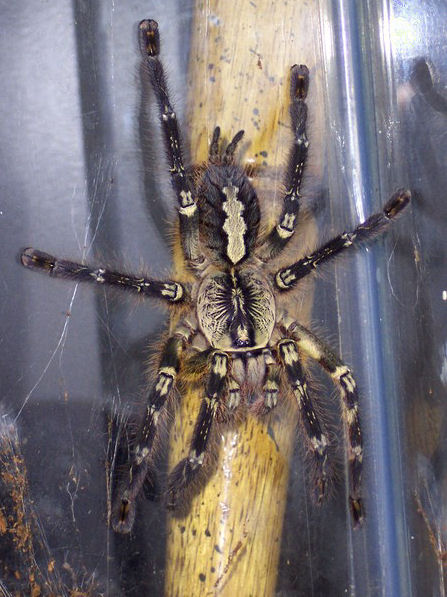
Invertebrates · Difficulty: Expert
Key facts and care guidance for Fringed ornamental tarantula (Poecilotheria ornata) (origin: Sri Lanka). Adult size around 20–25 cm leg span; one of the largest Poecilotheria species. Life expectancy females 12–15 years, males 3–4 years. The values below are carefully researched guidance.
Short answers
Fringed ornamental tarantula: How big does the enclosure need to be?
40×30×45 cm (height over floor area, a vertical cork tube).
Fringed ornamental tarantula: What temperature does it need?
Daytime 24–28 °C, basking spot — (no basking spot; even room warmth), at night 20–22 °C.
Fringed ornamental tarantula: Does it need UVB lighting?
UVB: No UVB needed (nocturnal).
Fringed ornamental tarantula: How long do they live?
Life expectancy: females 12–15 years, males 3–4 years.
Fringed ornamental tarantula: Is it suitable for beginners?
No – better suited to experienced keepers (difficulty: Expert).
Climate
- Daytime temperature
- 24–28 °C
- Night temperature
- 20–22 °C
- Basking spot
- — (no basking spot; even room warmth)
- Humidity
- 70–80 %
- UVB
- No UVB needed (nocturnal)
Enclosure
- Minimum size
- 40×30×45 cm (height over floor area, a vertical cork tube)
- Substrate
- Coco humus, 5 cm; a vertical piece of cork bark or a cork tube as a hide; moderately damp, well ventilated, a water bowl
Feeding
- Food
- Insects: crickets, roaches, locusts. No vertebrates are needed
- Feeding interval
- adults 1×/week or every 1–2 weeks, juveniles 2–3×/week
Key facts
- Adult size
- 20–25 cm leg span; one of the largest Poecilotheria species
- Life expectancy
- females 12–15 years, males 3–4 years
- Origin
- Sri Lanka
- Protection status
- CITES Appendix II / EU Regulation Annex B (since 2019, the whole genus Poecilotheria) – proof of origin or purchase (an unbroken chain of documentation) is required
- Brumation
- None
- Cohabitation
- Keeping them singly is the standard. An Old World arboreal species, territorial and cannibalistic. Communal keeping is attempted by some experienced keepers (the genus has a degree of tolerance), but it is risky and NOT recommended as standard
Notes
Old World, with NO urticating hairs, but very fast, defensive and with medically significant, strong venom – only for very experienced keepers, never handling, and secure against escape. CITES-protected: buy or pass it on only with papers.
Do you keep this species?
Add your animal to Reptoria – Reptoria reminds you about feeding and shedding. Add your animal for free →
Look for Fringed ornamental tarantula (Poecilotheria ornata) in the marketplace →
Related species
- Gooty sapphire ornamental tarantula (Poecilotheria metallica) – Expert
- Mysore ornamental tarantula (Poecilotheria striata) – Expert
- Indian ornamental tarantula (Poecilotheria regalis) – Expert
- Ivory ornamental tarantula (Poecilotheria subfusca) – Expert
- Ghost ornamental tarantula (Poecilotheria vittata) – Expert
- Red slate ornamental tarantula (Poecilotheria rufilata) – Expert
- Sri Lankan ornamental tarantula (Poecilotheria fasciata) – Expert
- Amazon birdeater (Iridopelma hirsutum) – Intermediate
What you need to start
To keep Fringed ornamental tarantula (Poecilotheria ornata) you typically need: a suitable enclosure (40×30×45 cm (height over floor area, a vertical cork tube)), substrate (Coco humus, 5 cm; a vertical piece of cork bark or a cork tube as a hide; moderately damp, well ventilated, a water bowl), a heat source with a thermostat, UVB lighting, thermometer and hygrometer, a water dish and hides. You will find equipment in the Reptoria marketplace.
The complete, interactive care database is in the Reptoria app.
Last updated: 2 November 2026 · Editor: Reptoria editorial team · Sources include: https://de.wikipedia.org/wiki/Poecilotheria_ornata, https://en.wikipedia.org/wiki/Poecilotheria
All values are non-binding guidance and do not replace expert advice. Research thoroughly from several sources before acquiring and keeping an animal, and observe the applicable law (species and animal protection in particular).