Mysore ornamental tarantula (Poecilotheria striata)
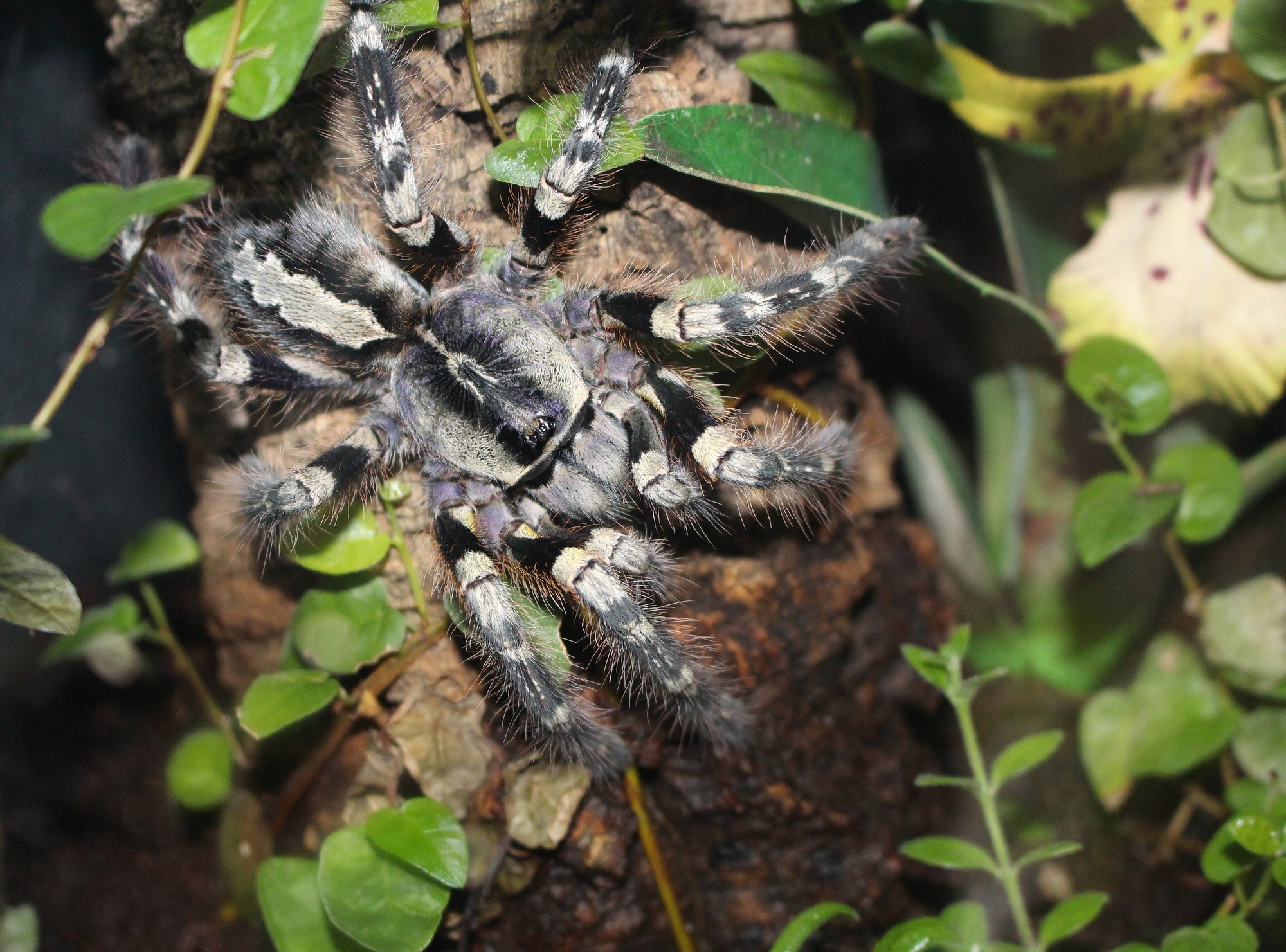
Invertebrates · Difficulty: Expert
Key facts and care guidance for Mysore ornamental tarantula (Poecilotheria striata) (origin: India (the Western Ghats, Karnataka/Mysore)). Adult size around 15–18 cm leg span; grows quickly. Life expectancy females 12–15 years, males 3–4 years. The values below are carefully researched guidance.
Short answers
Mysore ornamental tarantula: How big does the enclosure need to be?
30×30×40 cm (height over floor area, a vertical cork tube).
Mysore ornamental tarantula: What temperature does it need?
Daytime 24–28 °C (summer up to 30 °C), basking spot — (no basking spot; even room warmth), at night 20–22 °C.
Mysore ornamental tarantula: Does it need UVB lighting?
UVB: No UVB needed (nocturnal).
Mysore ornamental tarantula: How long do they live?
Life expectancy: females 12–15 years, males 3–4 years.
Mysore ornamental tarantula: Is it suitable for beginners?
No – better suited to experienced keepers (difficulty: Expert).
Climate
- Daytime temperature
- 24–28 °C (summer up to 30 °C)
- Night temperature
- 20–22 °C
- Basking spot
- — (no basking spot; even room warmth)
- Humidity
- 65–75 %
- UVB
- No UVB needed (nocturnal)
Enclosure
- Minimum size
- 30×30×40 cm (height over floor area, a vertical cork tube)
- Substrate
- Coco humus, 5 cm; a vertical piece of cork bark or a cork tube as a hide; moderately damp, well ventilated, a water bowl
Feeding
- Food
- Insects: crickets, roaches, locusts. No vertebrates are needed
- Feeding interval
- adults 1×/week or every 1–2 weeks, juveniles 2–3×/week
Key facts
- Adult size
- 15–18 cm leg span; grows quickly
- Life expectancy
- females 12–15 years, males 3–4 years
- Origin
- India (the Western Ghats, Karnataka/Mysore)
- Protection status
- CITES Appendix II / EU Regulation Annex B (since 2019, the whole genus Poecilotheria) – proof of origin or purchase (an unbroken chain of documentation) is required
- Brumation
- No real winter rest; a seasonal drop (20–24 °C, somewhat drier) in winter is close to nature
- Cohabitation
- Keeping them singly is the standard. An Old World arboreal species, territorial and cannibalistic. Communal keeping is attempted only by experienced keepers, is risky and is NOT recommended as standard
Notes
Old World, with NO urticating hairs, but very fast and with strong, medically significant venom; considered somewhat calmer within the genus, but it remains an expert's species – never handling, and secure against escape. CITES-protected: buy or pass it on only with papers.
Do you keep this species?
Add your animal to Reptoria – Reptoria reminds you about feeding and shedding. Add your animal for free →
Look for Mysore ornamental tarantula (Poecilotheria striata) in the marketplace →
Related species
- Gooty sapphire ornamental tarantula (Poecilotheria metallica) – Expert
- Fringed ornamental tarantula (Poecilotheria ornata) – Expert
- Indian ornamental tarantula (Poecilotheria regalis) – Expert
- Ivory ornamental tarantula (Poecilotheria subfusca) – Expert
- Ghost ornamental tarantula (Poecilotheria vittata) – Expert
- Red slate ornamental tarantula (Poecilotheria rufilata) – Expert
- Sri Lankan ornamental tarantula (Poecilotheria fasciata) – Expert
- Amazon birdeater (Iridopelma hirsutum) – Intermediate
What you need to start
To keep Mysore ornamental tarantula (Poecilotheria striata) you typically need: a suitable enclosure (30×30×40 cm (height over floor area, a vertical cork tube)), substrate (Coco humus, 5 cm; a vertical piece of cork bark or a cork tube as a hide; moderately damp, well ventilated, a water bowl), a heat source with a thermostat, UVB lighting, thermometer and hygrometer, a water dish and hides. You will find equipment in the Reptoria marketplace.
The complete, interactive care database is in the Reptoria app.
Last updated: 2 November 2026 · Editor: Reptoria editorial team · Sources include: https://en.wikipedia.org/wiki/Poecilotheria, https://en.wikipedia.org/wiki/Poecilotheria_striata
All values are non-binding guidance and do not replace expert advice. Research thoroughly from several sources before acquiring and keeping an animal, and observe the applicable law (species and animal protection in particular).