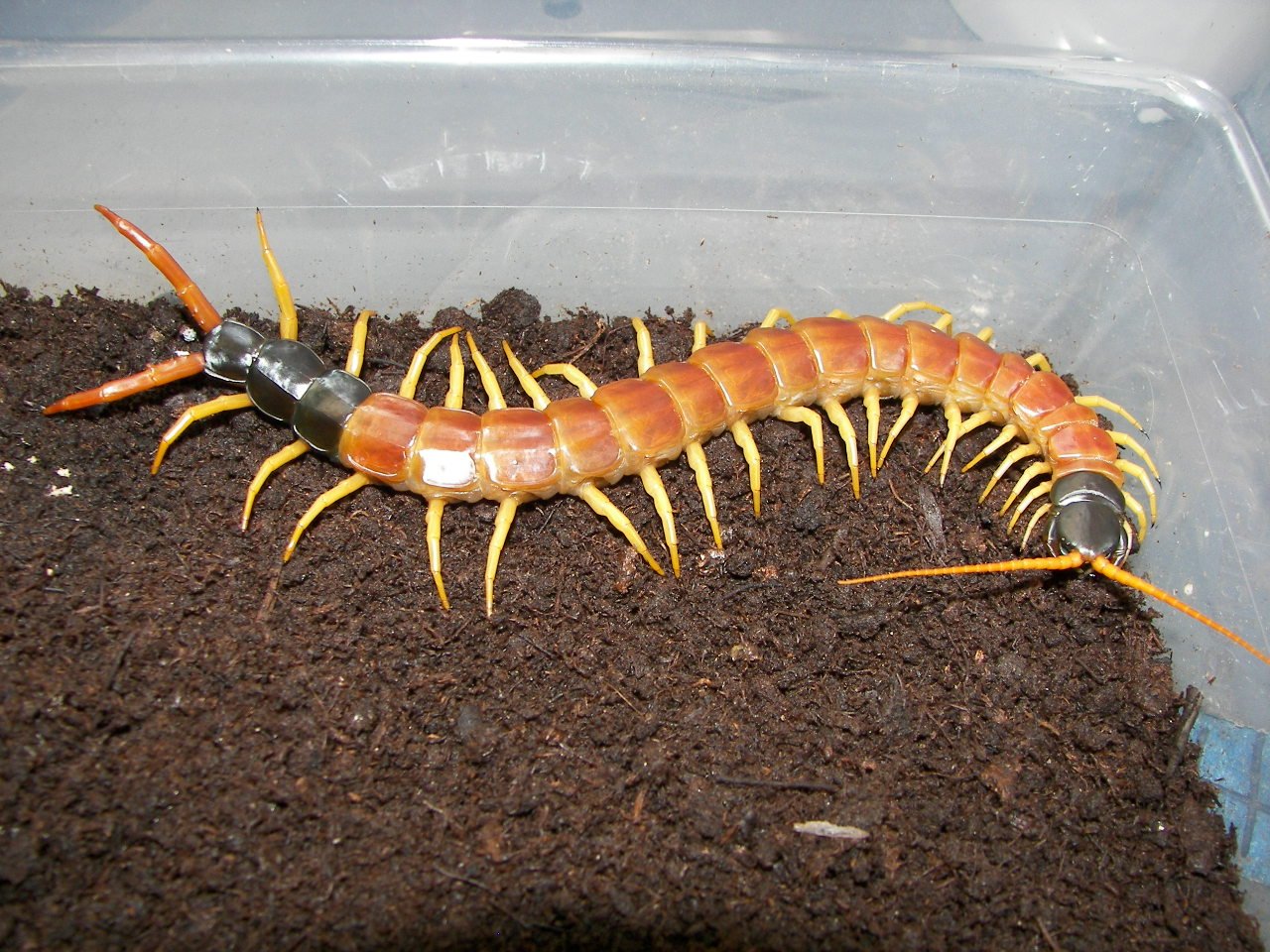
Giant desert centipede (Scolopendra heros)
Invertebrates · Difficulty: Expert
Key facts and care guidance for Giant desert centipede (Scolopendra heros) (origin: The south-western USA, northern Mexico). Adult size around 15–22 cm. Life expectancy 5–10 years. The values below are carefully researched guidance.
Short answers
Giant desert centipede: How big does the enclosure need to be?
40×30×25 cm, absolutely escape-proof.
Giant desert centipede: What temperature does it need?
Daytime 25–31 °C, basking spot No basking spot, at night 18–22 °C.
Giant desert centipede: Does it need UVB lighting?
UVB: Not required.
Giant desert centipede: How long do they live?
Life expectancy: 5–10 years.
Giant desert centipede: Is it suitable for beginners?
No – better suited to experienced keepers (difficulty: Expert).
Climate
- Daytime temperature
- 25–31 °C
- Night temperature
- 18–22 °C
- Basking spot
- No basking spot
- Humidity
- 50–65 %
- UVB
- Not required
Enclosure
- Minimum size
- 40×30×25 cm, absolutely escape-proof
- Substrate
- Sand-loam 10–15 cm for digging, flat stones, cork bark
Feeding
- Food
- Roaches, house crickets, the occasional nestling
- Feeding interval
- every 7–14 days
Key facts
- Adult size
- 15–22 cm
- Life expectancy
- 5–10 years
- Origin
- The south-western USA, northern Mexico
- Protection status
- A DANGEROUS ANIMAL – a very painful bite; keeping it requires notification or a permit, varying by German state
- Brumation
- A cooler dry spell of 6–8 weeks
- Cohabitation
- Keep strictly singly: solitary and cannibalistic - two animals in one enclosure regularly end up as one. This applies even to animals of equal size and even when both are well fed. For breeding, the male is introduced under observation and separated again immediately.
Notes
Strikingly coloured black, red and yellow. To be kept drier than the tropical centipedes, but it digs just as deep. The container has to close genuinely tightly – centipedes find every gap.
Do you keep this species?
Add your animal to Reptoria – Reptoria reminds you about feeding and shedding. Add your animal for free →
Look for Giant desert centipede (Scolopendra heros) in the marketplace →
Related species
- Amazonian giant centipede (Scolopendra gigantea) – Intermediate to expert
- Chinese red-headed centipede (Scolopendra subspinipes) – Expert
- Chinese red-headed centipede (Scolopendra mutilans) – Expert
- Tanzanian blue ringleg centipede (Scolopendra morsitans) – Intermediate
- Indian tiger centipede (Scolopendra hardwickei) – Expert
- Caribbean giant centipede (Scolopendra alternans) – Expert
- Mediterranean banded centipede (Scolopendra cingulata) – Intermediate
- Tiger centipede (Scolopendra polymorpha) – Intermediate
What you need to start
To keep Giant desert centipede (Scolopendra heros) you typically need: a suitable enclosure (40×30×25 cm, absolutely escape-proof), substrate (Sand-loam 10–15 cm for digging, flat stones, cork bark), a heat source with a thermostat, thermometer and hygrometer, a water dish and hides. You will find equipment in the Reptoria marketplace.
The complete, interactive care database is in the Reptoria app.
Last updated: 2 November 2026 · Editor: Reptoria editorial team · Sources include: https://de.wikipedia.org/wiki/Scolopendra_heros, https://en.wikipedia.org/wiki/Scolopendra
All values are non-binding guidance and do not replace expert advice. Research thoroughly from several sources before acquiring and keeping an animal, and observe the applicable law (species and animal protection in particular).