Giant Ghana snail (Achatina achatina)
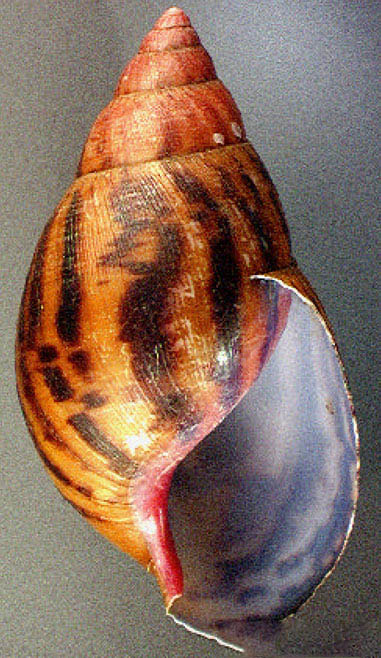
Invertebrates · Difficulty: Beginner
Key facts and care guidance for Giant Ghana snail (Achatina achatina) (origin: West Africa (rainforest)). Adult size around The largest land snail – shell up to ~20 cm (record ~27 cm), the animal up to ~30 cm. Life expectancy 5–10 years. The values below are carefully researched guidance.
Short answers
Giant Ghana snail: How big does the enclosure need to be?
From 50×40×40 cm (a single animal); ~80×50×50 cm for a group of about 5.
Giant Ghana snail: What temperature does it need?
Daytime 26–29 °C, at night 24–25 °C.
Giant Ghana snail: Does it need UVB lighting?
UVB: No UVB needed (nocturnal); only a day/night rhythm.
Giant Ghana snail: How long do they live?
Life expectancy: 5–10 years.
Giant Ghana snail: Is it suitable for beginners?
Yes – it is considered suitable for beginners (difficulty: Beginner).
Climate
- Daytime temperature
- 26–29 °C
- Night temperature
- 24–25 °C
- Basking spot
- —
- Humidity
- 85–90 %
- UVB
- No UVB needed (nocturnal); only a day/night rhythm
Enclosure
- Minimum size
- from 50×40×40 cm (a single animal); ~80×50×50 cm for a group of about 5
- Substrate
- A loose coco humus and sphagnum mix with a moss covering, deep and permanently damp and warm; rich in calcium
Feeding
- Food
- Vegetables, fruit, flowers, dandelion; a cuttlebone or calcium is essential for the shell
- Feeding interval
- Fresh food daily (in the evening); always offer a calcium source
Key facts
- Adult size
- The largest land snail – shell up to ~20 cm (record ~27 cm), the animal up to ~30 cm
- Life expectancy
- 5–10 years
- Origin
- West Africa (rainforest)
- Protection status
- No CITES listing; freely keepable in Germany. Invasive/banned in some countries (including the USA) - do not release.
- Brumation
- None (tropical). Cold or dry conditions risk aestivation – keep them constantly warm and humid.
- Cohabitation
- Group keeping is straightforward and recommended – sociable hermaphrodites with no territoriality.
Notes
More demanding than L. fulica in humidity and warmth (higher values are needed, and a heat lamp is usually required). Harder to breed in captivity. The main mistakes: too cool, too dry, and a lack of calcium.
Do you keep this species?
Add your animal to Reptoria – Reptoria reminds you about feeding and shedding. Add your animal for free →
Look for Giant Ghana snail (Achatina achatina) in the marketplace →
Related species
- Giant African land snail (Lissachatina immaculata) – Beginner
- Roman snail (Helix pomatia) – Beginner
- Flame land snail (Limicolaria flammea) – Beginner
- Garden snail (Cornu aspersum) – Beginner
- Giant African land snail (Lissachatina fulica) – Beginner
- Giant West African land snail (Archachatina marginata) – Beginner
- Cuban land snail (Caracolus sagemon) – Intermediate
- Giant land snail (Megalobulimus oblongus) – Intermediate
What you need to start
To keep Giant Ghana snail (Achatina achatina) you typically need: a suitable enclosure (from 50×40×40 cm (a single animal); ~80×50×50 cm for a group of about 5), substrate (A loose coco humus and sphagnum mix with a moss covering, deep and permanently damp and warm; rich in calcium), a heat source with a thermostat, UVB lighting, thermometer and hygrometer, a water dish and hides. You will find equipment in the Reptoria marketplace.
The complete, interactive care database is in the Reptoria app.
Last updated: 9 October 2026 · Editor: Reptoria editorial team · Sources include: https://bantam.earth/giant-tiger-land-snail-achatina-achatina/, https://en.wikipedia.org/wiki/Achatina_achatina
All values are non-binding guidance and do not replace expert advice. Research thoroughly from several sources before acquiring and keeping an animal, and observe the applicable law (species and animal protection in particular).