Green tree python – Aru (Morelia viridis)
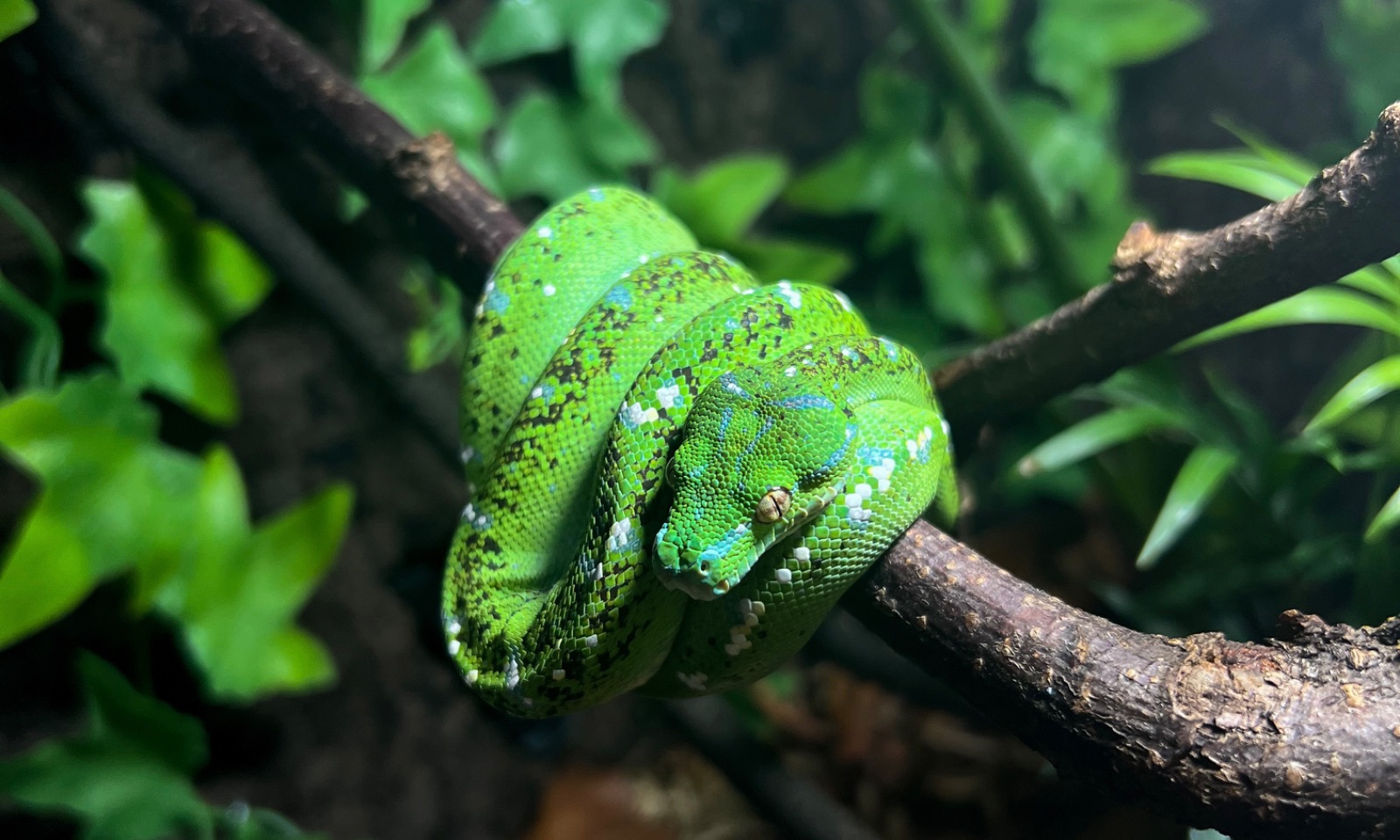
Snakes · Difficulty: Intermediate
Key facts and care guidance for Green tree python – Aru (Morelia viridis) (origin: The Aru Islands (a local form of Morelia viridis)). Adult size around 150–180 cm. Life expectancy 15–20 years, well-cared-for individuals over 25 years. The values below are carefully researched guidance.
Short answers
Green tree python – Aru: How big does the enclosure need to be?
At least 135×90×200 cm for 1 adult animal (BMEL expert report: 0.75 × 0.5 × 1.5 times total length, height capped at 2.0 m); height, horizontal perching branches and strong ventilation matter more than floor space.
Green tree python – Aru: What temperature does it need?
Daytime 26–30 °C (cooler near the floor, 24–26 °C), basking spot 30–33 °C (upper perch branch under a heat emitter), at night 22–24 °C.
Green tree python – Aru: Does it need UVB lighting?
UVB: UVB not essential (nocturnal), low UVB optional.
Green tree python – Aru: How long do they live?
Life expectancy: 15–20 years, well-cared-for individuals over 25 years.
Green tree python – Aru: Is it suitable for beginners?
Rather not – it is considered an intermediate species (difficulty: Intermediate).
Climate
- Daytime temperature
- 26–30 °C (cooler near the floor, 24–26 °C)
- Night temperature
- 22–24 °C
- Basking spot
- 30–33 °C (upper perch branch under a heat emitter)
- Humidity
- 60–90 % (average ~70–80 %, higher at night; good ventilation is essential)
- UVB
- UVB not essential (nocturnal), low UVB optional
Enclosure
- Minimum size
- at least 135×90×200 cm for 1 adult animal (BMEL expert report: 0.75 × 0.5 × 1.5 times total length, height capped at 2.0 m); height, horizontal perching branches and strong ventilation matter more than floor space
- Substrate
- Moisture-retaining: coco humus, forest floor, pine bark
Feeding
- Food
- Mice and rats (of a suitable size)
- Feeding interval
- Adults every 14–28 days, subadults every 14–21 days, juveniles every 5–7 days.
Key facts
- Adult size
- 150–180 cm
- Life expectancy
- 15–20 years, well-cared-for individuals over 25 years
- Origin
- The Aru Islands (a local form of Morelia viridis)
- Protection status
- CITES Appendix II, EU Regulation 338/97 Annex B → specially protected under German law; proof of origin plus registration required
- Brumation
- No real winter rest; a slight seasonal night-time drop or dry spell to stimulate breeding
- Cohabitation
- Keep them singly – tree pythons are stress-prone loners; put them together only under supervision for breeding, then separate them; never keep males together
Notes
Aru animals lack the continuous blue dorsal band; it is considered a comparatively calm and even-tempered local form. Sensitive to temperature, humidity and ventilation. Minimise handling.
Do you keep this species?
Add your animal to Reptoria – Reptoria reminds you about feeding and shedding. Add your animal for free →
Green tree python – Aru (Morelia viridis) currently offered
- Morelia Viridis Aru 1.0 Melanistischer Genetik – Aru · Neustadt an der Weinstraße · 1,200 €
Related species
- Centralian carpet python (Morelia bredli) – Intermediate
- Darwin carpet python (Morelia spilota variegata) – Beginner
- Green tree python – Biak (Morelia viridis) – Intermediate
- Green tree python – Jayapura (Morelia viridis) – Intermediate
- Green tree python – Lereh (Morelia viridis) – Intermediate
- Green tree python – Merauke (Morelia viridis) – Intermediate
- Green tree python – Sorong (Morelia viridis) – Intermediate
- Green tree python (Morelia viridis) – Intermediate
What you need to start
To keep Green tree python – Aru (Morelia viridis) you typically need: a suitable enclosure (at least 135×90×200 cm for 1 adult animal (BMEL expert report: 0.75 × 0.5 × 1.5 times total length, height capped at 2.0 m); height, horizontal perching branches and strong ventilation matter more than floor space), substrate (Moisture-retaining: coco humus, forest floor, pine bark), a heat source with a thermostat, UVB lighting, thermometer and hygrometer, a water dish and hides. You will find equipment in the Reptoria marketplace.
The complete, interactive care database is in the Reptoria app.
Last updated: 23 September 2026 · Editor: Reptoria editorial team · Sources include: Wikipedia DE, bmleh.de, einrichtungsbeispiele.de, festland-baumpythons.de, little-big-giants.com
All values are non-binding guidance and do not replace expert advice. Research thoroughly from several sources before acquiring and keeping an animal, and observe the applicable law (species and animal protection in particular).