Green tree python – Sorong (Morelia viridis)
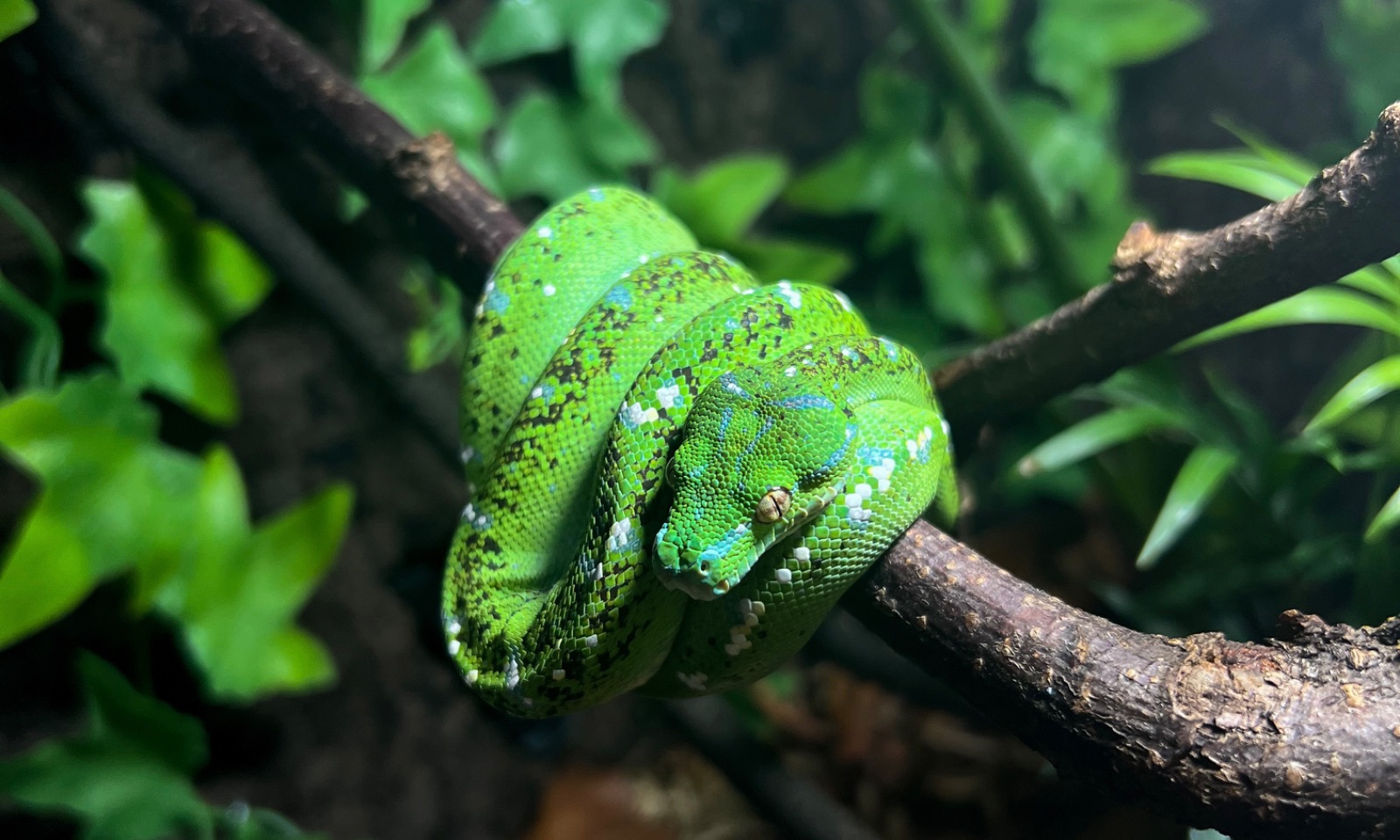
Snakes · Difficulty: Intermediate
Key facts and care guidance for Green tree python – Sorong (Morelia viridis) (origin: Sorong (the Vogelkop, western New Guinea, the mainland form) – a local form of Morelia viridis (taxonomically in part Morelia azurea)). Adult size around 150–180 cm. Life expectancy 15–20+ years. The values below are carefully researched guidance.
Short answers
Green tree python – Sorong: How big does the enclosure need to be?
From 135×90×200 cm (minimum size per the 1997 expert report, diamond and amethystine pythons up to 2 m, tree pythons — this species lives in the branches, so height matters more than floor area).
Green tree python – Sorong: What temperature does it need?
Daytime 26–30 °C (cooler near the floor, 24–26 °C), basking spot 30–33 °C (upper perch branch under a heat emitter), at night 22–24 °C.
Green tree python – Sorong: Does it need UVB lighting?
UVB: UVB not essential (nocturnal), low UVB optional.
Green tree python – Sorong: How long do they live?
Life expectancy: 15–20+ years.
Green tree python – Sorong: Is it suitable for beginners?
Rather not – it is considered an intermediate species (difficulty: Intermediate).
Climate
- Daytime temperature
- 26–30 °C (cooler near the floor, 24–26 °C)
- Night temperature
- 22–24 °C
- Basking spot
- 30–33 °C (upper perch branch under a heat emitter)
- Humidity
- 60–90 % (average ~70–80 %, higher at night; good ventilation is essential)
- UVB
- UVB not essential (nocturnal), low UVB optional
Enclosure
- Minimum size
- from 135×90×200 cm (minimum size per the 1997 expert report, diamond and amethystine pythons up to 2 m, tree pythons — this species lives in the branches, so height matters more than floor area)
- Substrate
- Moisture-retaining: coco humus, forest floor, pine bark
Feeding
- Food
- Mice and rats (of a suitable size)
- Feeding interval
- adults every 10–21 days, juveniles every 5–7 days
Key facts
- Adult size
- 150–180 cm
- Life expectancy
- 15–20+ years
- Origin
- Sorong (the Vogelkop, western New Guinea, the mainland form) – a local form of Morelia viridis (taxonomically in part Morelia azurea)
- Protection status
- CITES Appendix II, EU Regulation 338/97 Annex B → specially protected under German law; proof of origin plus registration required
- Brumation
- No real winter rest; a slight seasonal night-time drop or dry spell to stimulate breeding
- Cohabitation
- Keep them singly – tree pythons are stress-prone loners; put them together only under supervision for breeding, then separate them; never keep males together
Notes
Sorong: the mainland form, usually with a continuous blue dorsal band, and considered fairly calm. Taxonomically, mainland animals are sometimes split off as Morelia azurea. Care as for the species standard.
Do you keep this species?
Add your animal to Reptoria – Reptoria reminds you about feeding and shedding. Add your animal for free →
Look for Green tree python – Sorong (Morelia viridis) in the marketplace →
Related species
- Centralian carpet python (Morelia bredli) – Intermediate
- Darwin carpet python (Morelia spilota variegata) – Beginner
- Green tree python – Aru (Morelia viridis) – Intermediate
- Green tree python – Biak (Morelia viridis) – Intermediate
- Green tree python – Jayapura (Morelia viridis) – Intermediate
- Green tree python – Lereh (Morelia viridis) – Intermediate
- Green tree python – Merauke (Morelia viridis) – Intermediate
- Green tree python (Morelia viridis) – Intermediate
What you need to start
To keep Green tree python – Sorong (Morelia viridis) you typically need: a suitable enclosure (from 135×90×200 cm (minimum size per the 1997 expert report, diamond and amethystine pythons up to 2 m, tree pythons — this species lives in the branches, so height matters more than floor area)), substrate (Moisture-retaining: coco humus, forest floor, pine bark), a heat source with a thermostat, UVB lighting, thermometer and hygrometer, a water dish and hides. You will find equipment in the Reptoria marketplace.
The complete, interactive care database is in the Reptoria app.
Last updated: 24 September 2026 · Editor: Reptoria editorial team · Sources include: http://morelia-viridis.blogspot.com/2009/03/localities-and-chondro-races.html, https://en.wikipedia.org/wiki/Green_tree_python, https://reptifiles.com/green-tree-python-care-sheet/, https://reptile-database.reptarium.cz/species?genus=Morelia&species=azurea, https://reptile-database.reptarium.cz/species?genus=Morelia&species=viridis
All values are non-binding guidance and do not replace expert advice. Research thoroughly from several sources before acquiring and keeping an animal, and observe the applicable law (species and animal protection in particular).