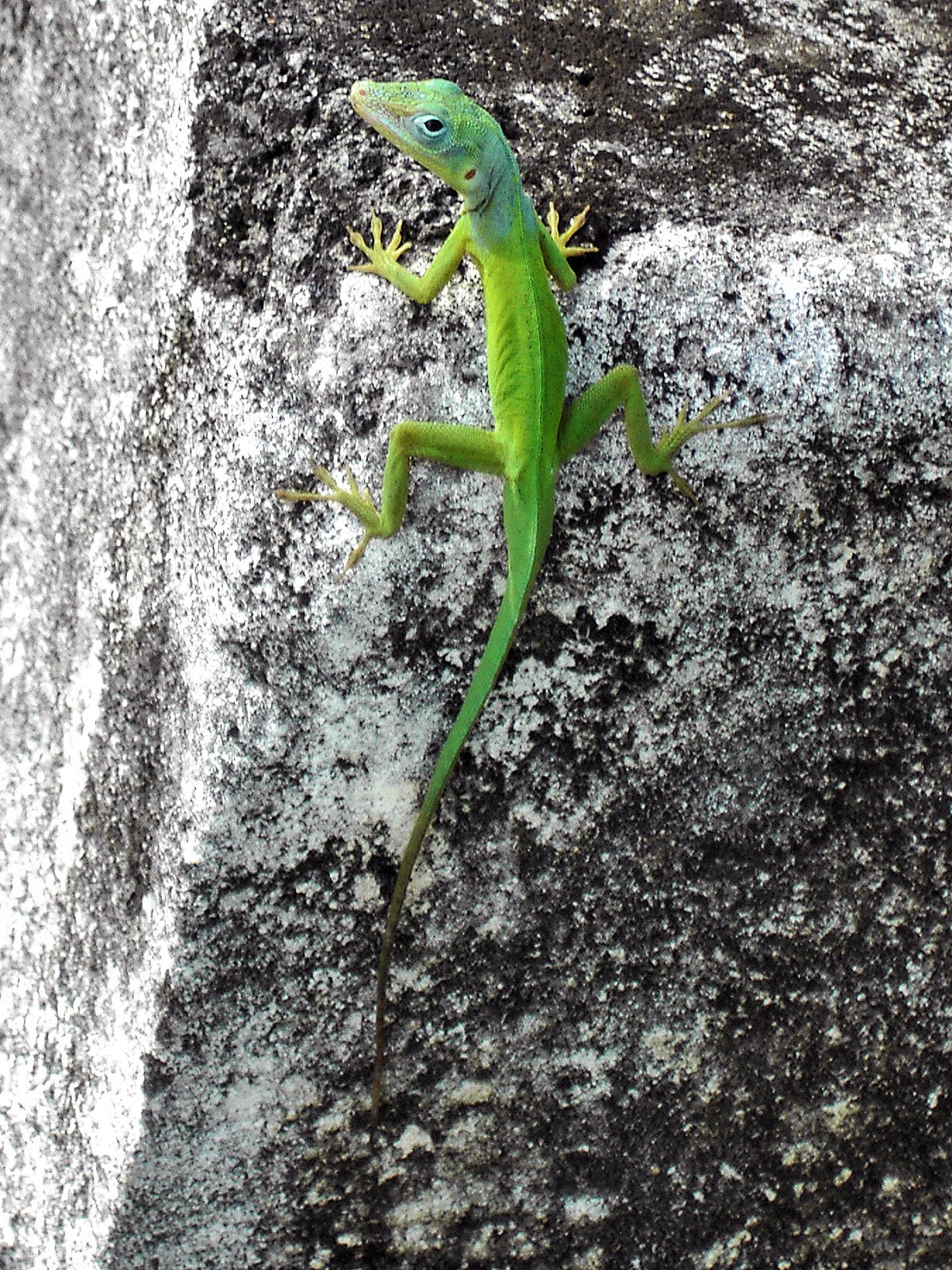
Guadeloupe anole (Anolis marmoratus)
Iguanas · Difficulty: Intermediate
Key facts and care guidance for Guadeloupe anole (Anolis marmoratus) (origin: Guadeloupe (endemic, the Lesser Antilles); several highly variable subspecies and colour forms). Adult size around total length ~15–20 cm including the tail. Life expectancy 3–7 years; males around 6 years on average, females often only 3 years because of constant egg production. The values below are carefully researched guidance.
Short answers
Guadeloupe anole: How big does the enclosure need to be?
Single animal from 50×50×70 cm; for a pair 60×50×90 cm — upright format, densely planted, one continuous diagonal branch plus a horizontal basking branch under the lamp.
Guadeloupe anole: What temperature does it need?
Daytime 26–30 °C, basking spot Local basking spot up to 35 °C, at night 20–24 °C.
Guadeloupe anole: Does it need UVB lighting?
UVB: UVB needed (Ferguson zone 2–3, UV index 2–4).
Guadeloupe anole: How long do they live?
Life expectancy: 3–7 years; males around 6 years on average, females often only 3 years because of constant egg production.
Guadeloupe anole: Is it suitable for beginners?
Rather not – it is considered an intermediate species (difficulty: Intermediate).
Climate
- Daytime temperature
- 26–30 °C
- Night temperature
- 20–24 °C
- Basking spot
- Local basking spot up to 35 °C
- Humidity
- 60–80 %, fluctuations are well tolerated
- UVB
- UVB needed (Ferguson zone 2–3, UV index 2–4)
Enclosure
- Minimum size
- Single animal from 50×50×70 cm; for a pair 60×50×90 cm — upright format, densely planted, one continuous diagonal branch plus a horizontal basking branch under the lamp
- Substrate
- Damp tropical substrate, leaf litter, dense planting
Feeding
- Food
- Insects (crickets, roaches, flies); occasionally soft fruit
- Feeding interval
- adults 2–3×/week, juveniles daily
Key facts
- Adult size
- total length ~15–20 cm including the tail
- Life expectancy
- 3–7 years; males around 6 years on average, females often only 3 years because of constant egg production
- Origin
- Guadeloupe (endemic, the Lesser Antilles); several highly variable subspecies and colour forms
- Protection status
- Not listed under CITES; no German registration duty as a non-native species; prefer captive-bred animals
- Brumation
- None (tropical)
- Cohabitation
- Pair housing (1.1) is the norm. Never males together. Several females only in a noticeably larger, heavily structured enclosure with several basking spots and visual barriers — otherwise one animal occupies the basking spot and the other loses condition. Juveniles are raised separately, as they otherwise attack each other.
Notes
Extremely variable in colour (the leopard or marble anole), with an orange-yellow dewlap. The males are stronger and more colourful. The husbandry figures are largely derived from general Antillean anole care.
Do you keep this species?
Add your animal to Reptoria – Reptoria reminds you about feeding and shedding. Add your animal for free →
Look for Guadeloupe anole (Anolis marmoratus) in the marketplace →
Related species
- Ghost anole (Anolis lemurinus) – Intermediate
- Ahl's anole (Anolis ahli) – Intermediate
- Aliniger anole (Anolis aliniger) – Beginner with some knowledge
- Allogus anole (Anolis allogus) – Beginner with some knowledge
- Bahaman green anole (Anolis smaragdinus) – Beginner
- Bahoruco anole (Anolis bahorucoensis) – Beginner with some knowledge
- Baleatus giant anole (Anolis baleatus) – Intermediate
- Baracoa giant anole (Anolis baracoae) – Intermediate
What you need to start
To keep Guadeloupe anole (Anolis marmoratus) you typically need: a suitable enclosure (Single animal from 50×50×70 cm; for a pair 60×50×90 cm — upright format, densely planted, one continuous diagonal branch plus a horizontal basking branch under the lamp), substrate (Damp tropical substrate, leaf litter, dense planting), a heat source with a thermostat, UVB lighting, thermometer and hygrometer, a water dish and hides. You will find equipment in the Reptoria marketplace.
The complete, interactive care database is in the Reptoria app.
Last updated: 9 October 2026 · Editor: Reptoria editorial team · Sources include: Wikipedia EN, einrichtungsbeispiele.de, eu_annex.txt (lokal, VO (EU) 2026/1383), gutachten.txt (BML 1997, lokal), karibische-anolis.de
All values are non-binding guidance and do not replace expert advice. Research thoroughly from several sources before acquiring and keeping an animal, and observe the applicable law (species and animal protection in particular).