Half-striped anole (Anolis semilineatus)
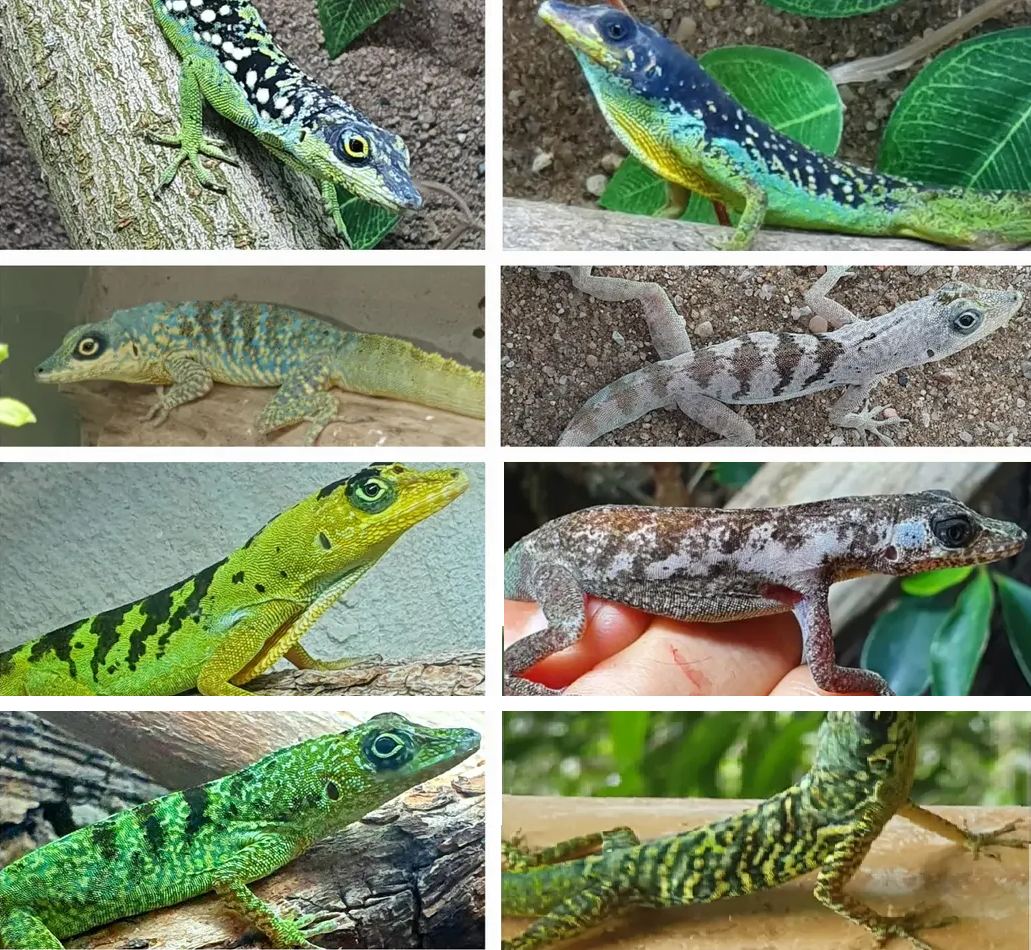
Iguanas · Difficulty: Beginner with some knowledge
Key facts and care guidance for Half-striped anole (Anolis semilineatus) (origin: Hispaniola (Haiti and the Dominican Republic) as well as Île de la Tortue, Île Grande Cayemite, Île à Cabrit and Isla Catalina; grass, ferns, low scrub, field margins, mangroves and pine forest from sea level up to about 1700 m). Adult size around 10–13 cm. Life expectancy 4–8 years. The values below are carefully researched guidance.
Short answers
Half-striped anole: How big does the enclosure need to be?
60×50×60 cm for a pair — wider and deeper rather than tall, densely fitted with grasses, ferns, thin twigs and leaf litter in the lower level. A narrow, tall enclosure takes away exactly the floor space this grass-dwelling species relies on.
Half-striped anole: What temperature does it need?
Daytime 25–30 °C, basking spot Basking spot 32–35 °C, at night 19–22 °C.
Half-striped anole: Does it need UVB lighting?
UVB: Essential (UVB 5.0).
Half-striped anole: How long do they live?
Life expectancy: 4–8 years.
Half-striped anole: Is it suitable for beginners?
Partly – manageable with some prior knowledge (difficulty: Beginner with some knowledge).
Climate
- Daytime temperature
- 25–30 °C
- Night temperature
- 19–22 °C
- Basking spot
- Basking spot 32–35 °C
- Humidity
- 65–85 %, mist in the morning
- UVB
- Essential (UVB 5.0)
Enclosure
- Minimum size
- 60×50×60 cm for a pair — wider and deeper rather than tall, densely fitted with grasses, ferns, thin twigs and leaf litter in the lower level. A narrow, tall enclosure takes away exactly the floor space this grass-dwelling species relies on.
- Substrate
- Forest-floor substrate with live plants, plus thin branches and bamboo at all heights
Feeding
- Food
- Very small feeder insects: fruit flies, micro-crickets, small firebrats, springtails and seed beetles, dusted regularly with calcium and vitamins
- Feeding interval
- adults 3–4×/week
Key facts
- Adult size
- 10–13 cm
- Life expectancy
- 4–8 years
- Origin
- Hispaniola (Haiti and the Dominican Republic) as well as Île de la Tortue, Île Grande Cayemite, Île à Cabrit and Isla Catalina; grass, ferns, low scrub, field margins, mangroves and pine forest from sea level up to about 1700 m
- Protection status
- Not listed under CITES
- Brumation
- No winter rest; somewhat cooler in winter with a shorter photoperiod
- Cohabitation
- Pairs (1.1) are the safest option; never keep males together — they fight until seriously injured. Females also defend their own, smaller territories: a second female is often harassed so much by the dominant one that she eats less and hides. One male with two females only works, if at all, in a considerably larger, densely structured enclosure and only with a spare enclosure ready.
Notes
A small grass species, very delicate. Fine food is needed.
Do you keep this species?
Add your animal to Reptoria – Reptoria reminds you about feeding and shedding. Add your animal for free →
Look for Half-striped anole (Anolis semilineatus) in the marketplace →
Related species
- Ghost anole (Anolis lemurinus) – Intermediate
- Ahl's anole (Anolis ahli) – Intermediate
- Aliniger anole (Anolis aliniger) – Beginner with some knowledge
- Allogus anole (Anolis allogus) – Beginner with some knowledge
- Bahaman green anole (Anolis smaragdinus) – Beginner
- Bahoruco anole (Anolis bahorucoensis) – Beginner with some knowledge
- Baleatus giant anole (Anolis baleatus) – Intermediate
- Baracoa giant anole (Anolis baracoae) – Intermediate
What you need to start
To keep Half-striped anole (Anolis semilineatus) you typically need: a suitable enclosure (60×50×60 cm for a pair — wider and deeper rather than tall, densely fitted with grasses, ferns, thin twigs and leaf litter in the lower level. A narrow, tall enclosure takes away exactly the floor space this grass-dwelling species relies on.), substrate (Forest-floor substrate with live plants, plus thin branches and bamboo at all heights), a heat source with a thermostat, UVB lighting, thermometer and hygrometer, a water dish and hides. You will find equipment in the Reptoria marketplace.
The complete, interactive care database is in the Reptoria app.
Last updated: 24 September 2026 · Editor: Reptoria editorial team · Sources include: anoleannals.org, zenodo.org (Williams & Rand 1961), reptile-database.reptarium.cz, eol.org, Wikipedia EN
All values are non-binding guidance and do not replace expert advice. Research thoroughly from several sources before acquiring and keeping an animal, and observe the applicable law (species and animal protection in particular).