Hispaniolan green anole (Anolis chlorocyanus)
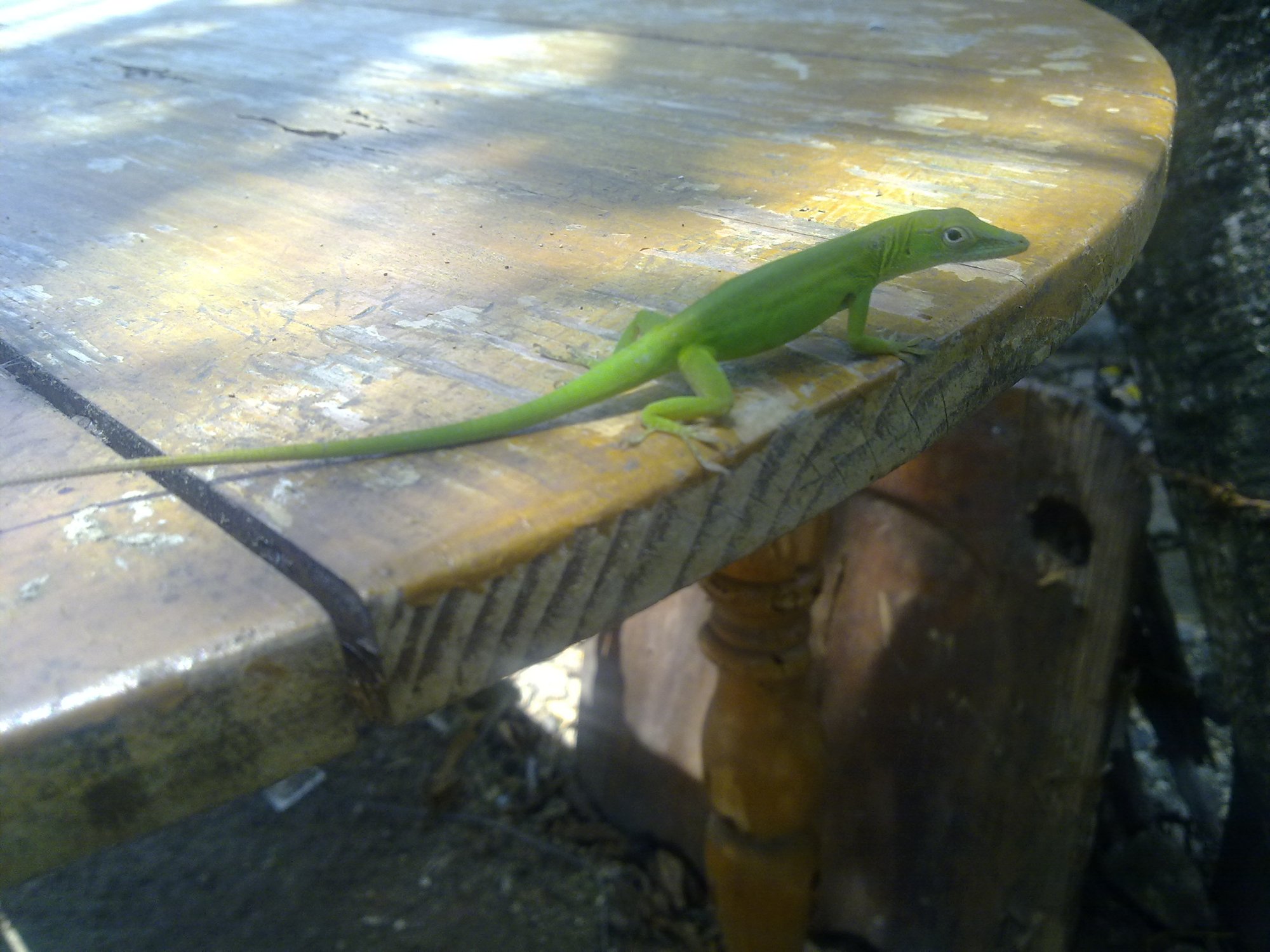
Iguanas · Difficulty: Beginner
Key facts and care guidance for Hispaniolan green anole (Anolis chlorocyanus) (origin: Hispaniola. The currently valid name Anolis chlorocyanus refers only to the animals from the Tiburón Peninsula in southwest Haiti (type locality near Jérémie); the widespread green anoles from the Dominican Republic have been classed as the separate species Anolis callainus since 2020. Introduced populations exist in southern Florida and Suriname.). Adult size around 15–20 cm total length (of which 6–7 cm is snout–vent length, the rest tail). Life expectancy 5–8 years. The values below are carefully researched guidance.
Short answers
Hispaniolan green anole: How big does the enclosure need to be?
80×50×80 cm (L×D×H) for a pair or trio; per the enclosure formula in the expert report (6 x 6 x 8 times snout–vent length), the official minimum would be 42×42×56 cm, but experienced keepers set the bar markedly higher.
Hispaniolan green anole: What temperature does it need?
Daytime 25–30 °C, basking spot Up to 35 °C local basking spot, at night 20–24 °C.
Hispaniolan green anole: Does it need UVB lighting?
UVB: Essential (UVB 5.0).
Hispaniolan green anole: How long do they live?
Life expectancy: 5–8 years.
Hispaniolan green anole: Is it suitable for beginners?
Yes – it is considered suitable for beginners (difficulty: Beginner).
Climate
- Daytime temperature
- 25–30 °C
- Night temperature
- 20–24 °C
- Basking spot
- Up to 35 °C local basking spot
- Humidity
- 60–80 %, mist once or twice daily
- UVB
- Essential (UVB 5.0)
Enclosure
- Minimum size
- 80×50×80 cm (L×D×H) for a pair or trio; per the enclosure formula in the expert report (6 x 6 x 8 times snout–vent length), the official minimum would be 42×42×56 cm, but experienced keepers set the bar markedly higher
- Substrate
- Coco humus, dense planting, thin branches
Feeding
- Food
- House crickets, crickets, flies, wax moths
- Feeding interval
- daily to every other day
Key facts
- Adult size
- 15–20 cm total length (of which 6–7 cm is snout–vent length, the rest tail)
- Life expectancy
- 5–8 years
- Origin
- Hispaniola. The currently valid name Anolis chlorocyanus refers only to the animals from the Tiburón Peninsula in southwest Haiti (type locality near Jérémie); the widespread green anoles from the Dominican Republic have been classed as the separate species Anolis callainus since 2020. Introduced populations exist in southern Florida and Suriname.
- Protection status
- Not listed under CITES
- Brumation
- None
- Cohabitation
- Pairs (1.1) are the least stressful. One male with two females (1.2) is possible, but: the subordinate female often eats less and hides — this only works with visual barriers, dense planting and several basking spots, and you must be able to separate her if needed. Never keep males together; they fight over territory and basking spots.
Notes
Green with a dark blue to black dewlap. Requirements and robustness as for the green anole – a good starting point with a little more colour.
Do you keep this species?
Add your animal to Reptoria – Reptoria reminds you about feeding and shedding. Add your animal for free →
Look for Hispaniolan green anole (Anolis chlorocyanus) in the marketplace →
Related species
- Ghost anole (Anolis lemurinus) – Intermediate
- Ahl's anole (Anolis ahli) – Intermediate
- Aliniger anole (Anolis aliniger) – Beginner with some knowledge
- Allogus anole (Anolis allogus) – Beginner with some knowledge
- Bahaman green anole (Anolis smaragdinus) – Beginner
- Bahoruco anole (Anolis bahorucoensis) – Beginner with some knowledge
- Baleatus giant anole (Anolis baleatus) – Intermediate
- Baracoa giant anole (Anolis baracoae) – Intermediate
What you need to start
To keep Hispaniolan green anole (Anolis chlorocyanus) you typically need: a suitable enclosure (80×50×80 cm (L×D×H) for a pair or trio; per the enclosure formula in the expert report (6 x 6 x 8 times snout–vent length), the official minimum would be 42×42×56 cm, but experienced keepers set the bar markedly higher), substrate (Coco humus, dense planting, thin branches), a heat source with a thermostat, UVB lighting, thermometer and hygrometer, a water dish and hides. You will find equipment in the Reptoria marketplace.
The complete, interactive care database is in the Reptoria app.
Last updated: 9 October 2026 · Editor: Reptoria editorial team · Sources include: caribbeanherpetology.org, Wikipedia EN, reptile-database.reptarium.cz, BML-Gutachten Reptilien 1997 (gutachten.txt lokal), EUR-Lex VO (EU) 2026/1383
All values are non-binding guidance and do not replace expert advice. Research thoroughly from several sources before acquiring and keeping an animal, and observe the applicable law (species and animal protection in particular).