Jamaican stripefoot anole (Anolis lineatopus)
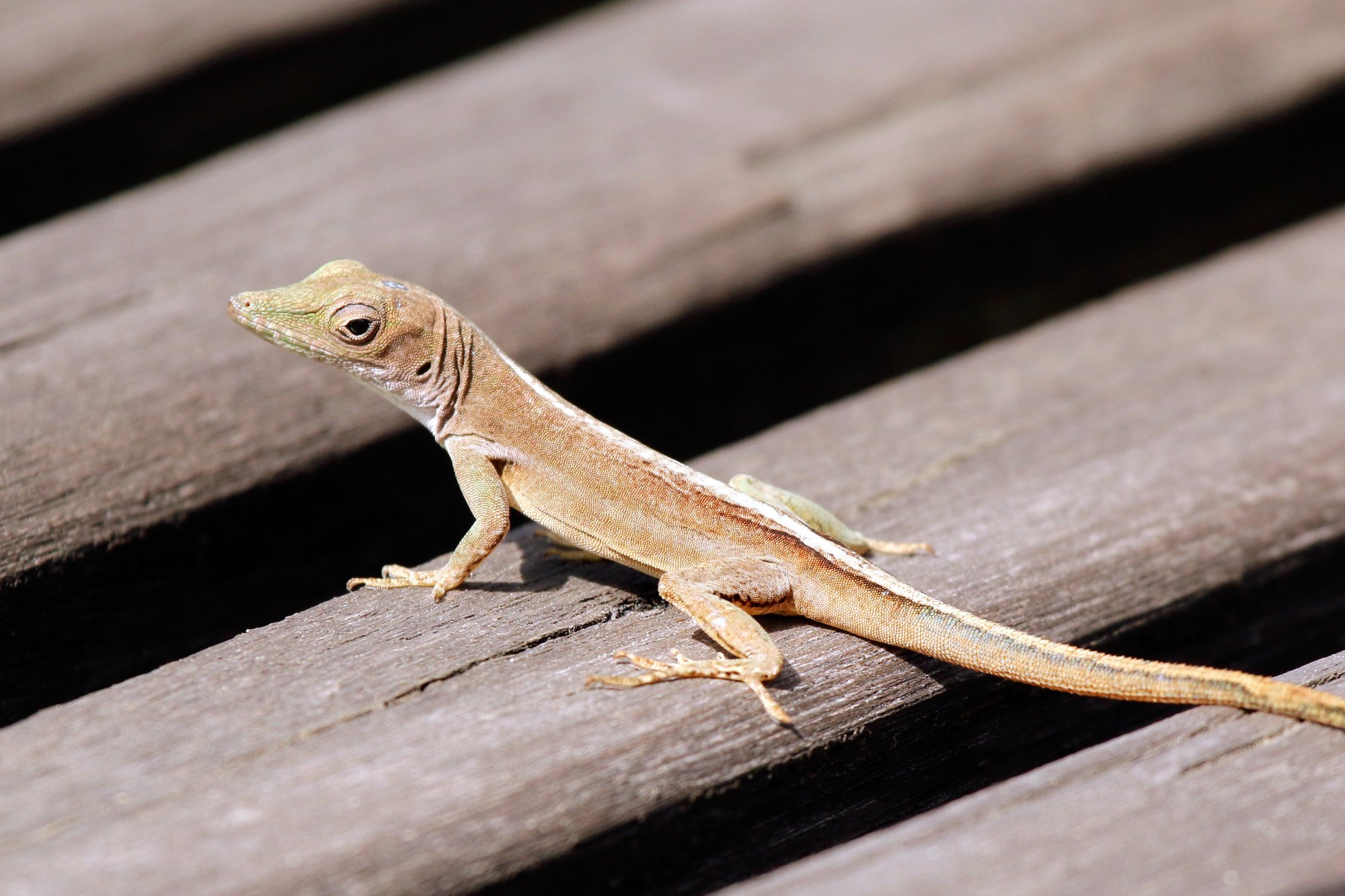
Iguanas · Difficulty: Intermediate
Key facts and care guidance for Jamaican stripefoot anole (Anolis lineatopus) (origin: Endemic to Jamaica, distributed across the island in four subspecies; a trunk-ground dweller that sits close to the ground on trunks, rocks and walls, competing there for habitat with Anolis grahami). Adult size around medium: approx. 15–18 cm total length (SVL up to ~7 cm; figures vary). Life expectancy approx. 4–6 years in captivity. The values below are carefully researched guidance.
Short answers
Jamaican stripefoot anole: How big does the enclosure need to be?
60x60x60 cm for a pair, floor area matters more than height. Pieces of trunk, cork tubes and stone slabs close to the ground, a leaf litter layer, plus a few low climbing branches and visual barriers.
Jamaican stripefoot anole: What temperature does it need?
Daytime 26–30 °C in the warm area, with a cooler side around 24 °C, basking spot 32–35 °C, at night 20–23 °C.
Jamaican stripefoot anole: Does it need UVB lighting?
UVB: UVB needed (Ferguson zone 2–3, UV index 3–4).
Jamaican stripefoot anole: How long do they live?
Life expectancy: approx. 4–6 years in captivity.
Jamaican stripefoot anole: Is it suitable for beginners?
Rather not – it is considered an intermediate species (difficulty: Intermediate).
Climate
- Daytime temperature
- 26–30 °C in the warm area, with a cooler side around 24 °C
- Night temperature
- 20–23 °C
- Basking spot
- 32–35 °C
- Humidity
- 60–80 %
- UVB
- UVB needed (Ferguson zone 2–3, UV index 3–4)
Enclosure
- Minimum size
- 60x60x60 cm for a pair, floor area matters more than height. Pieces of trunk, cork tubes and stone slabs close to the ground, a leaf litter layer, plus a few low climbing branches and visual barriers.
- Substrate
- Coco humus or forest floor with leaf litter, bark, climbing branches, planting
Feeding
- Food
- Insects: house crickets, crickets, flies, small roaches; calcium and vitamins
- Feeding interval
- adults 3–4×/week, juveniles daily
Key facts
- Adult size
- medium: approx. 15–18 cm total length (SVL up to ~7 cm; figures vary)
- Life expectancy
- approx. 4–6 years in captivity
- Origin
- Endemic to Jamaica, distributed across the island in four subspecies; a trunk-ground dweller that sits close to the ground on trunks, rocks and walls, competing there for habitat with Anolis grahami
- Protection status
- No CITES or EU regulation protection; not specially protected.
- Brumation
- None
- Cohabitation
- Territorial. Keep them singly or as one male plus one female in a large enclosure with floor and climbing structure as well as visual barriers. NEVER keep males together.
Notes
A trunk-and-ground anole – it needs both floor area and low climbing branches. The final-size figures in the sources contradict each other (SVL values vary) → treat them as a guide. Little targeted husbandry literature.
Do you keep this species?
Add your animal to Reptoria – Reptoria reminds you about feeding and shedding. Add your animal for free →
Look for Jamaican stripefoot anole (Anolis lineatopus) in the marketplace →
Related species
- Ghost anole (Anolis lemurinus) – Intermediate
- Ahl's anole (Anolis ahli) – Intermediate
- Aliniger anole (Anolis aliniger) – Beginner with some knowledge
- Allogus anole (Anolis allogus) – Beginner with some knowledge
- Bahaman green anole (Anolis smaragdinus) – Beginner
- Bahoruco anole (Anolis bahorucoensis) – Beginner with some knowledge
- Baleatus giant anole (Anolis baleatus) – Intermediate
- Baracoa giant anole (Anolis baracoae) – Intermediate
What you need to start
To keep Jamaican stripefoot anole (Anolis lineatopus) you typically need: a suitable enclosure (60x60x60 cm for a pair, floor area matters more than height. Pieces of trunk, cork tubes and stone slabs close to the ground, a leaf litter layer, plus a few low climbing branches and visual barriers.), substrate (Coco humus or forest floor with leaf litter, bark, climbing branches, planting), a heat source with a thermostat, UVB lighting, thermometer and hygrometer, a water dish and hides. You will find equipment in the Reptoria marketplace.
The complete, interactive care database is in the Reptoria app.
Last updated: 9 October 2026 · Editor: Reptoria editorial team · Sources include: academic.oup.com (Biological Journal of the Linnean Society), anoleannals.org, reptile-database.reptarium.cz, Wikipedia EN, academic.oup.com (Biological Journal of the Linnean Society, Jamaika-Anolis)
All values are non-binding guidance and do not replace expert advice. Research thoroughly from several sources before acquiring and keeping an animal, and observe the applicable law (species and animal protection in particular).