Jamaican twig anole (Anolis valencienni)
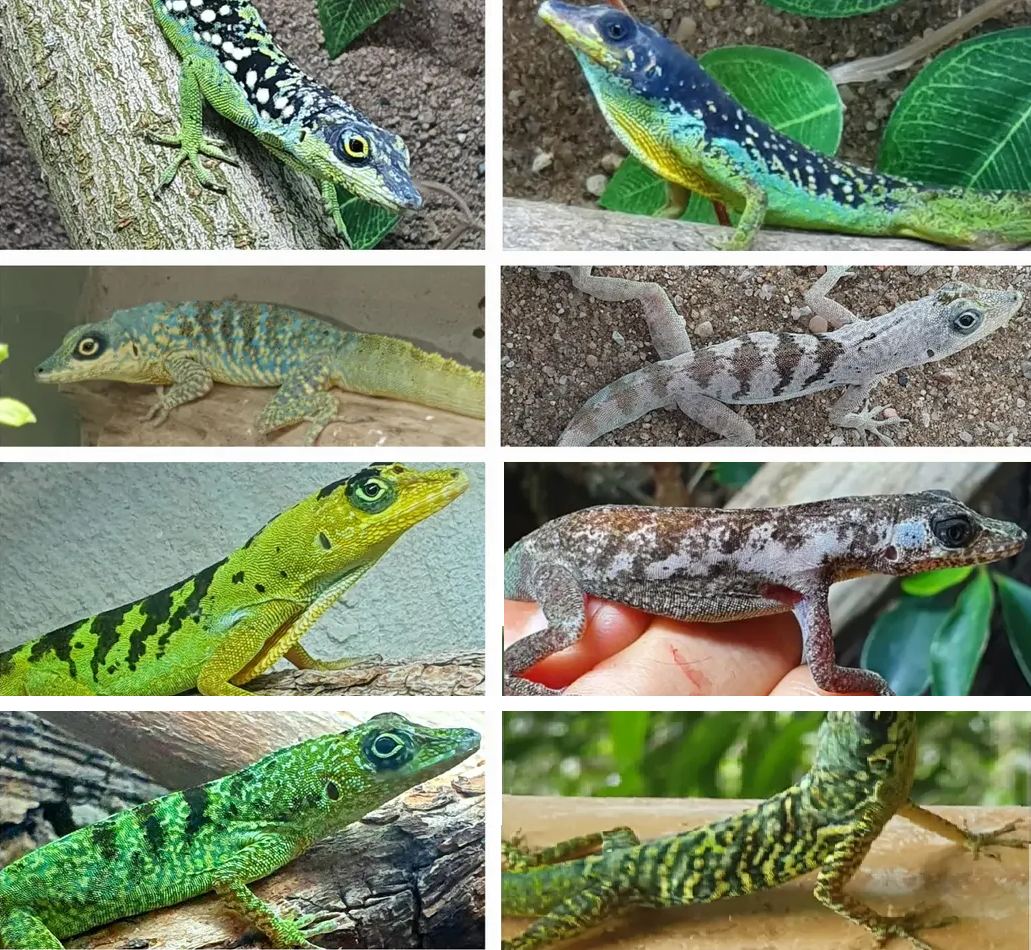
Iguanas · Difficulty: Intermediate
Key facts and care guidance for Jamaican twig anole (Anolis valencienni) (origin: Jamaica (endemic)). Adult size around ~18–20 cm total length (SVL ~7–8 cm). Life expectancy ~5–7 years. The values below are carefully researched guidance.
Short answers
Jamaican twig anole: How big does the enclosure need to be?
A pair ~60×50×80 cm, with plenty of horizontal branches.
Jamaican twig anole: What temperature does it need?
Daytime 26–29 °C, basking spot Small warm spot ~30 °C, at night 20–23 °C.
Jamaican twig anole: Does it need UVB lighting?
UVB: Recommended.
Jamaican twig anole: How long do they live?
Life expectancy: ~5–7 years.
Jamaican twig anole: Is it suitable for beginners?
Rather not – it is considered an intermediate species (difficulty: Intermediate).
Climate
- Daytime temperature
- 26–29 °C
- Night temperature
- 20–23 °C
- Basking spot
- Small warm spot ~30 °C
- Humidity
- 60–80 %
- UVB
- Recommended
Enclosure
- Minimum size
- a pair ~60×50×80 cm, with plenty of horizontal branches
- Substrate
- Forest-floor substrate with bark and leaf litter, planted; what matters most above it is a dense tangle of very thin, mostly horizontal twigs at all heights, plus a cork tube or hollow as an egg-laying site
Feeding
- Food
- Insects (including slow-moving prey)
- Feeding interval
- Several times a week
Key facts
- Adult size
- ~18–20 cm total length (SVL ~7–8 cm)
- Life expectancy
- ~5–7 years
- Origin
- Jamaica (endemic)
- Protection status
- —
- Brumation
- None
- Cohabitation
- In pairs (1.1), with some experience also 1.2 in a larger enclosure. This species is unusually little territorial among anoles: males barely defend fixed territories, the mating system is considered only weakly polygynous, and in the wild females lay together in the same tree hollows. Even so, only one male belongs in an enclosure, and every new grouping needs to be watched.
Notes
A bark and twig anole, slow and camouflaged. Offer plenty of horizontal climbing branches. The figures are derived from general anole husbandry.
Do you keep this species?
Add your animal to Reptoria – Reptoria reminds you about feeding and shedding. Add your animal for free →
Look for Jamaican twig anole (Anolis valencienni) in the marketplace →
Related species
- Ghost anole (Anolis lemurinus) – Intermediate
- Ahl's anole (Anolis ahli) – Intermediate
- Aliniger anole (Anolis aliniger) – Beginner with some knowledge
- Allogus anole (Anolis allogus) – Beginner with some knowledge
- Bahaman green anole (Anolis smaragdinus) – Beginner
- Bahoruco anole (Anolis bahorucoensis) – Beginner with some knowledge
- Baleatus giant anole (Anolis baleatus) – Intermediate
- Baracoa giant anole (Anolis baracoae) – Intermediate
What you need to start
To keep Jamaican twig anole (Anolis valencienni) you typically need: a suitable enclosure (a pair ~60×50×80 cm, with plenty of horizontal branches), substrate (Forest-floor substrate with bark and leaf litter, planted; what matters most above it is a dense tangle of very thin, mostly horizontal twigs at all heights, plus a cork tube or hollow as an egg-laying site), a heat source with a thermostat, UVB lighting, thermometer and hygrometer, a water dish and hides. You will find equipment in the Reptoria marketplace.
The complete, interactive care database is in the Reptoria app.
Last updated: 23 September 2026 · Editor: Reptoria editorial team · Sources include: Wikipedia EN, anoleannals.org, caribbeanherpetology.org (Hedges 2019, Checkliste), eu_annex.txt (lokal, VO (EU) 2026/1383), gutachten.txt (lokal, BML 1997)
All values are non-binding guidance and do not replace expert advice. Research thoroughly from several sources before acquiring and keeping an animal, and observe the applicable law (species and animal protection in particular).