Little Cayman anole (Anolis maynardi)
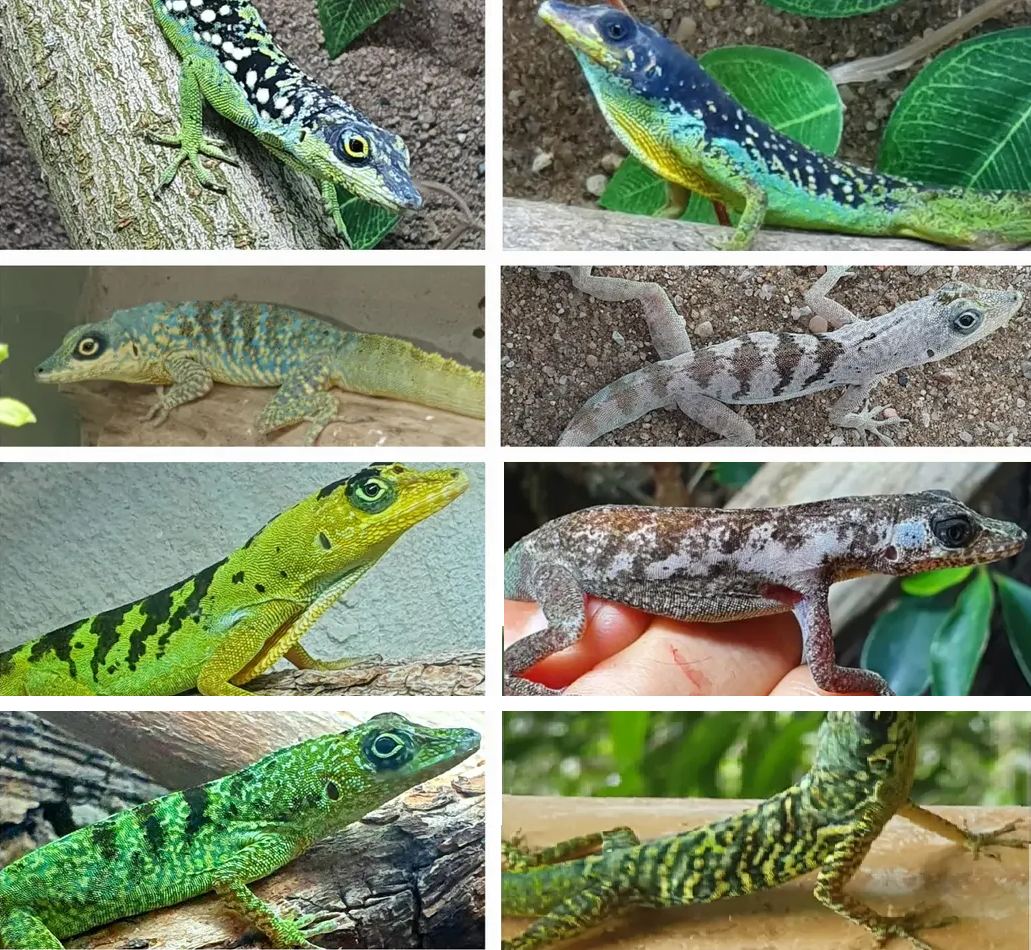
Iguanas · Difficulty: Intermediate
Key facts and care guidance for Little Cayman anole (Anolis maynardi) (origin: Little Cayman (endemisch, rund 28 km²); seit den 1980er-Jahren auch auf Cayman Brac, dort vermutlich eingeschleppt). Adult size around 18–23 cm total length. Life expectancy 5–8 years. The values below are carefully researched guidance.
Short answers
Little Cayman anole: How big does the enclosure need to be?
From 40×40×55 cm for one animal; for a pair from 40×40×55 cm (1997 expert report, at 6,8 cm SVL).
Little Cayman anole: What temperature does it need?
Daytime 25–31 °C, basking spot 35 °C, at night 19–22 °C.
Little Cayman anole: Does it need UVB lighting?
UVB: Essential (UVB 5.0–10.0).
Little Cayman anole: How long do they live?
Life expectancy: 5–8 years.
Little Cayman anole: Is it suitable for beginners?
Rather not – it is considered an intermediate species (difficulty: Intermediate).
Climate
- Daytime temperature
- 25–31 °C
- Night temperature
- 19–22 °C
- Basking spot
- 35 °C
- Humidity
- 55–70 %
- UVB
- Essential (UVB 5.0–10.0)
Enclosure
- Minimum size
- from 40×40×55 cm for one animal; for a pair from 40×40×55 cm (1997 expert report, at 6,8 cm SVL)
- Substrate
- Coco humus, planting, thin branches, a rain system
Feeding
- Food
- House crickets, field crickets, flies and small roaches as the main food, plus regular soft fruit or nectar substitute; dusted with calcium and vitamins
- Feeding interval
- daily to every other day
Key facts
- Adult size
- 18–23 cm total length
- Life expectancy
- 5–8 years
- Origin
- Little Cayman (endemisch, rund 28 km²); seit den 1980er-Jahren auch auf Cayman Brac, dort vermutlich eingeschleppt
- Protection status
- Not listed under CITES; a very small island range
- Brumation
- None
- Cohabitation
- Pairs (1.1) are the safest option. Never keep males together: they display at each other with head-bobbing and dewlap and attack until one sits permanently in a corner and loses weight. 1.2 is at most possible in a suitably large, richly structured enclosure with several basking spots and perches at different heights; even then a lower-ranking female can be pushed aside, eat less and hide.
Notes
A strikingly long, pointed snout and yellow-green colouration. An endemic of a tiny island – in Europe from only a few breeding lines; document the bloodlines.
Do you keep this species?
Add your animal to Reptoria – Reptoria reminds you about feeding and shedding. Add your animal for free →
Look for Little Cayman anole (Anolis maynardi) in the marketplace →
Related species
- Ghost anole (Anolis lemurinus) – Intermediate
- Ahl's anole (Anolis ahli) – Intermediate
- Aliniger anole (Anolis aliniger) – Beginner with some knowledge
- Allogus anole (Anolis allogus) – Beginner with some knowledge
- Bahaman green anole (Anolis smaragdinus) – Beginner
- Bahoruco anole (Anolis bahorucoensis) – Beginner with some knowledge
- Baleatus giant anole (Anolis baleatus) – Intermediate
- Baracoa giant anole (Anolis baracoae) – Intermediate
What you need to start
To keep Little Cayman anole (Anolis maynardi) you typically need: a suitable enclosure (from 40×40×55 cm for one animal; for a pair from 40×40×55 cm (1997 expert report, at 6,8 cm SVL)), substrate (Coco humus, planting, thin branches, a rain system), a heat source with a thermostat, UVB lighting, thermometer and hygrometer, a water dish and hides. You will find equipment in the Reptoria marketplace.
The complete, interactive care database is in the Reptoria app.
Last updated: 24 September 2026 · Editor: Reptoria editorial team · Sources include: anoleannals.org, caymanwildlife.org, bioone.org, iucngisd.org, bioone.org (Breviora 522, Ökomorphologie von Anolis maynardi)
All values are non-binding guidance and do not replace expert advice. Research thoroughly from several sources before acquiring and keeping an animal, and observe the applicable law (species and animal protection in particular).