Loy's anole (Anolis loysianus)
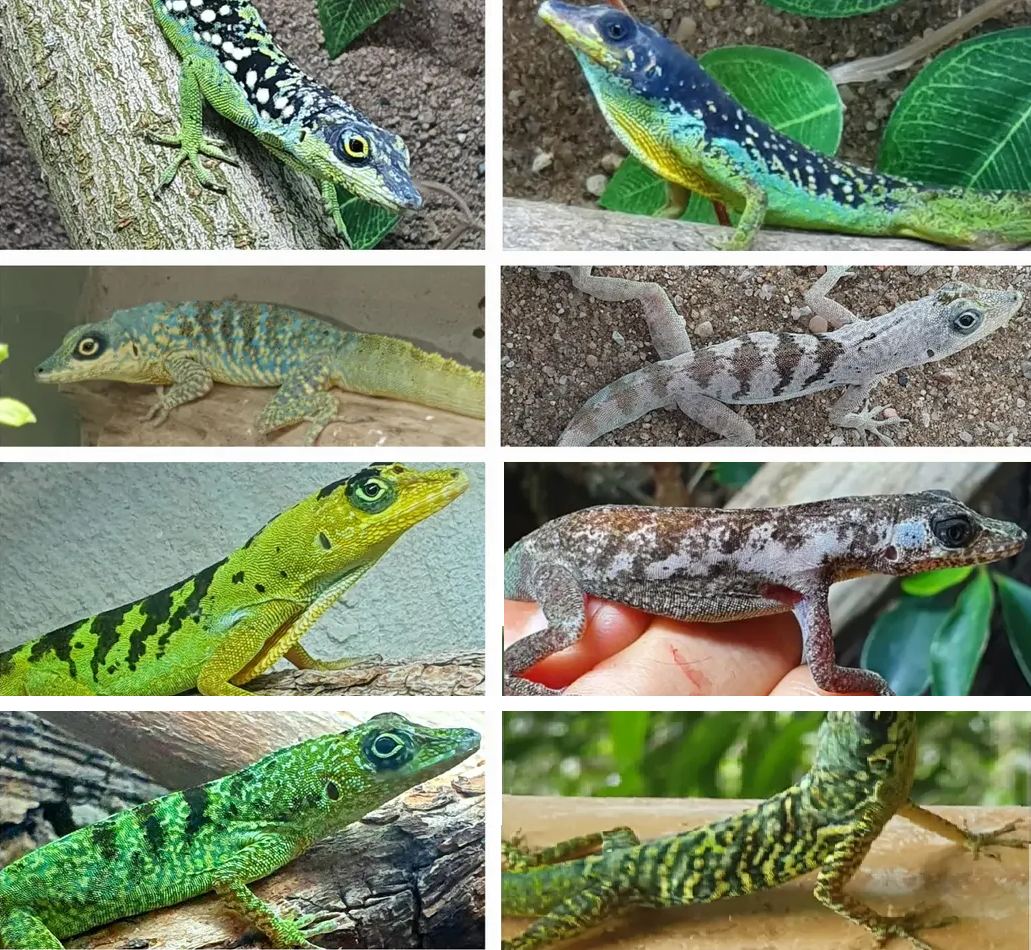
Iguanas · Difficulty: Intermediate
Key facts and care guidance for Loy's anole (Anolis loysianus) (origin: Cuba, endemic; a trunk dweller in well-preserved, shady forests, often in the upper trunk regions). Adult size around 9–12 cm. Life expectancy 4–8 years. The values below are carefully researched guidance.
Short answers
Loy's anole: How big does the enclosure need to be?
50×50×80 cm for a pair, with wide cork tubes and vertical bark surfaces up to just below the ceiling and a shaded, dark background — this species lives on the trunk, not in the branches. The official minimum size under the 1997 expert report (anoles, tree- and shrub-dwellers, 6 × 6 × 8 times the snout–vent length) works out at 30×30×40 cm.
Loy's anole: What temperature does it need?
Daytime 25–30 °C, basking spot Basking spot 32–35 °C, at night 19–22 °C.
Loy's anole: Does it need UVB lighting?
UVB: Essential (UVB 5.0).
Loy's anole: How long do they live?
Life expectancy: 4–8 years.
Loy's anole: Is it suitable for beginners?
Rather not – it is considered an intermediate species (difficulty: Intermediate).
Climate
- Daytime temperature
- 25–30 °C
- Night temperature
- 19–22 °C
- Basking spot
- Basking spot 32–35 °C
- Humidity
- 65–85 %, mist in the morning
- UVB
- Essential (UVB 5.0)
Enclosure
- Minimum size
- 50×50×80 cm for a pair, with wide cork tubes and vertical bark surfaces up to just below the ceiling and a shaded, dark background — this species lives on the trunk, not in the branches. The official minimum size under the 1997 expert report (anoles, tree- and shrub-dwellers, 6 × 6 × 8 times the snout–vent length) works out at 30×30×40 cm.
- Substrate
- Forest-floor substrate with live plants and leaf litter, plus wide cork tubes and vertical cork bark as the main structure; thin branches only as a supplement
Feeding
- Food
- Small feeder insects: micro-crickets, fruit flies, firebrats, aphids and small servings of meadow plankton, dusted regularly with calcium and vitamins. Wax moths only as a rare addition.
- Feeding interval
- adults 3–4×/week
Key facts
- Adult size
- 9–12 cm
- Life expectancy
- 4–8 years
- Origin
- Cuba, endemic; a trunk dweller in well-preserved, shady forests, often in the upper trunk regions
- Protection status
- Not listed under CITES
- Brumation
- No winter rest; somewhat cooler in winter with a shorter photoperiod
- Cohabitation
- Pairs (1.1) are the safest option; never keep males together — they fight until seriously injured. Females also defend their own, smaller territories: a second female is often harassed so much by the dominant one that she eats less and hides. One male with two females only works, if at all, in a considerably larger, densely structured enclosure and only with a spare enclosure ready.
Notes
A twig dweller with lichen-like markings.
Do you keep this species?
Add your animal to Reptoria – Reptoria reminds you about feeding and shedding. Add your animal for free →
Look for Loy's anole (Anolis loysianus) in the marketplace →
Related species
- Ghost anole (Anolis lemurinus) – Intermediate
- Ahl's anole (Anolis ahli) – Intermediate
- Aliniger anole (Anolis aliniger) – Beginner with some knowledge
- Allogus anole (Anolis allogus) – Beginner with some knowledge
- Bahaman green anole (Anolis smaragdinus) – Beginner
- Bahoruco anole (Anolis bahorucoensis) – Beginner with some knowledge
- Baleatus giant anole (Anolis baleatus) – Intermediate
- Baracoa giant anole (Anolis baracoae) – Intermediate
What you need to start
To keep Loy's anole (Anolis loysianus) you typically need: a suitable enclosure (50×50×80 cm for a pair, with wide cork tubes and vertical bark surfaces up to just below the ceiling and a shaded, dark background — this species lives on the trunk, not in the branches. The official minimum size under the 1997 expert report (anoles, tree- and shrub-dwellers, 6 × 6 × 8 times the snout–vent length) works out at 30×30×40 cm.), substrate (Forest-floor substrate with live plants and leaf litter, plus wide cork tubes and vertical cork bark as the main structure; thin branches only as a supplement), a heat source with a thermostat, UVB lighting, thermometer and hygrometer, a water dish and hides. You will find equipment in the Reptoria marketplace.
The complete, interactive care database is in the Reptoria app.
Last updated: 24 September 2026 · Editor: Reptoria editorial team · Sources include: anoleannals.org (Losos 2009, Kapitel 3), einrichtungsbeispiele.de, Wikipedia EN, ucmp.berkeley.edu, Wikipedia EN (Anolis loysiana)
All values are non-binding guidance and do not replace expert advice. Research thoroughly from several sources before acquiring and keeping an animal, and observe the applicable law (species and animal protection in particular).