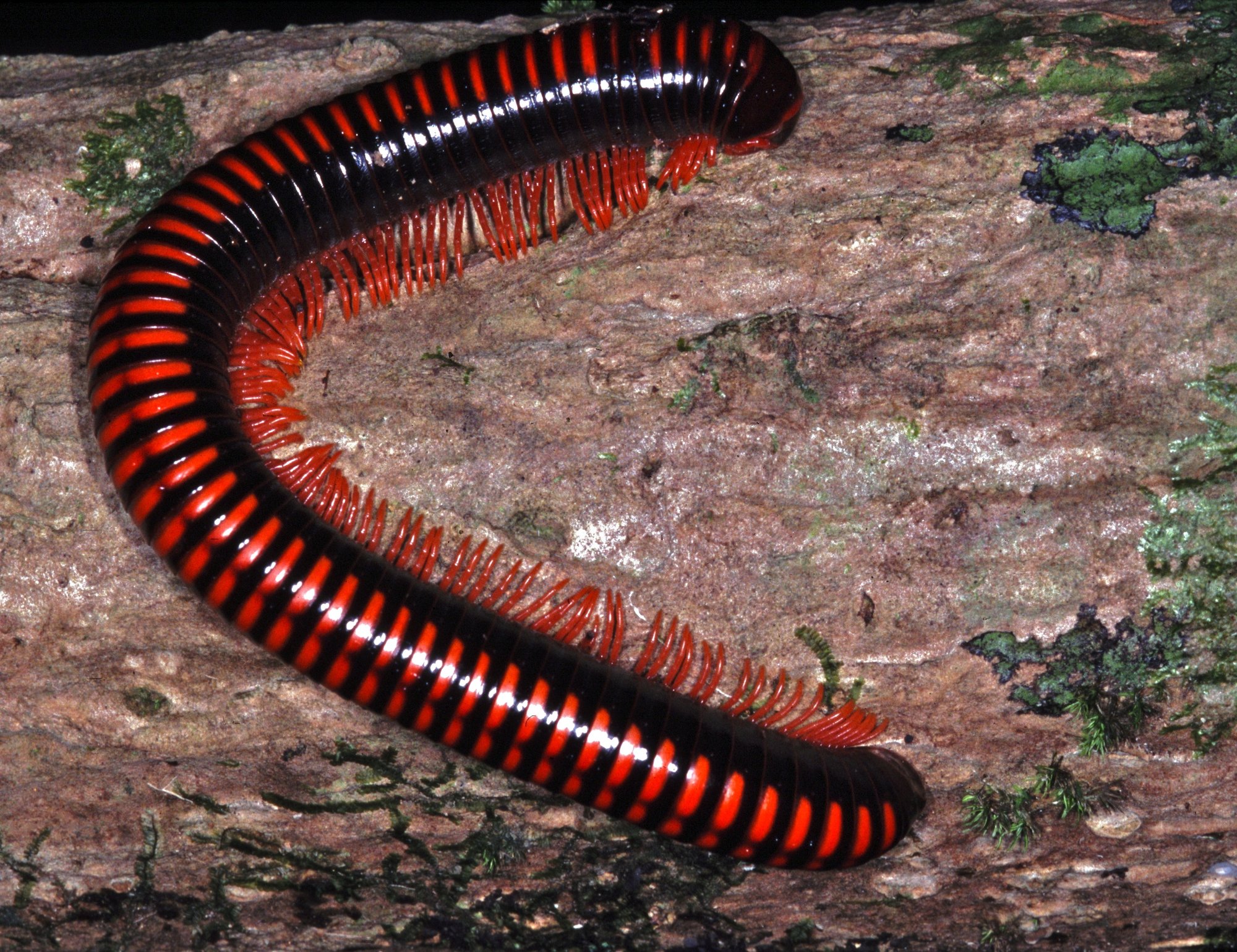
Madagascar fire millipede (Aphistogoniulus corallipes)
Invertebrates · Difficulty: Beginner
Key facts and care guidance for Madagascar fire millipede (Aphistogoniulus corallipes) (origin: Madagascar (tropical forests)). Adult size around approx. 11–12 cm (the genus reaches ~18 cm). Life expectancy approx. 5 years. The values below are carefully researched guidance.
Short answers
Madagascar fire millipede: How big does the enclosure need to be?
60×30×30 cm for a small group; offer climbing branches (part of the genus is arboreal).
Madagascar fire millipede: What temperature does it need?
Daytime 20–26 °C, at night 20–22 °C.
Madagascar fire millipede: Does it need UVB lighting?
UVB: No UVB needed.
Madagascar fire millipede: How long do they live?
Life expectancy: approx. 5 years.
Madagascar fire millipede: Is it suitable for beginners?
Yes – it is considered suitable for beginners (difficulty: Beginner).
Climate
- Daytime temperature
- 20–26 °C
- Night temperature
- 20–22 °C
- Basking spot
- —
- Humidity
- 70–80 %
- UVB
- No UVB needed
Enclosure
- Minimum size
- 60×30×30 cm for a small group; offer climbing branches (part of the genus is arboreal)
- Substrate
- 10–15 cm of forest humus plus white-rotted wood and fallen leaves; a calcium source
Feeding
- Food
- Rotting leaves and white-rotted wood as the base, fruit and vegetables to supplement, calcium
- Feeding interval
- leaf litter and wood always available; fruit and vegetables occasionally in small amounts
Key facts
- Adult size
- approx. 11–12 cm (the genus reaches ~18 cm)
- Life expectancy
- approx. 5 years
- Origin
- Madagascar (tropical forests)
- Protection status
- No CITES; a Madagascan endemic – wild-caught animals are problematic, prefer captive-bred ones
- Brumation
- None
- Cohabitation
- Group housing possible (sociable). A group is an option, not a necessity: kept singly, these animals lack nothing. Anyone housing them together needs a large enclosure, its own hiding place for every animal, and plenty of food — otherwise the group becomes one.
Notes
Striking red-black or orange warning colouration (aposematic), with a defensive secretion when disturbed – wash your hands. Species-specific husbandry data are thin, and some are derived by analogy from the genus.
Do you keep this species?
Add your animal to Reptoria – Reptoria reminds you about feeding and shedding. Add your animal for free →
Look for Madagascar fire millipede (Aphistogoniulus corallipes) in the marketplace →
Related species
- Giant African millipede (Archispirostreptus gigas) – Beginner
- American giant millipede (Narceus americanus) – Beginner
- Bumblebee millipede (Anadenobolus monilicornis) – Beginner
- Fire millipede (Centrobolus splendidus) – Beginner
- Ghana giant millipede (Ophistreptus guineensis) – Beginner
- Ghana black-foot millipede (Spirostreptus gregorius) – Beginner
- Green millipede (Telodeinopus aoutii) – Beginner
- Mozambique giant millipede (Centrobolus sp. Mosambik) – Beginner
What you need to start
To keep Madagascar fire millipede (Aphistogoniulus corallipes) you typically need: a suitable enclosure (60×30×30 cm for a small group; offer climbing branches (part of the genus is arboreal)), substrate (10–15 cm of forest humus plus white-rotted wood and fallen leaves; a calcium source), a heat source with a thermostat, UVB lighting, thermometer and hygrometer, a water dish and hides. You will find equipment in the Reptoria marketplace.
The complete, interactive care database is in the Reptoria app.
Last updated: 9 October 2026 · Editor: Reptoria editorial team · Sources include: Wikipedia (EN) Millipede - young hatch after a few weeks – https://en.wikipedia.org/wiki/Millipede, Wikipedia (EN) Narceus americanus - hatch several weeks later (Verwandtenwert) – https://en.wikipedia.org/wiki/Narceus_americanus
All values are non-binding guidance and do not replace expert advice. Research thoroughly from several sources before acquiring and keeping an animal, and observe the applicable law (species and animal protection in particular).