Madagascar giant day gecko (Phelsuma madagascariensis)
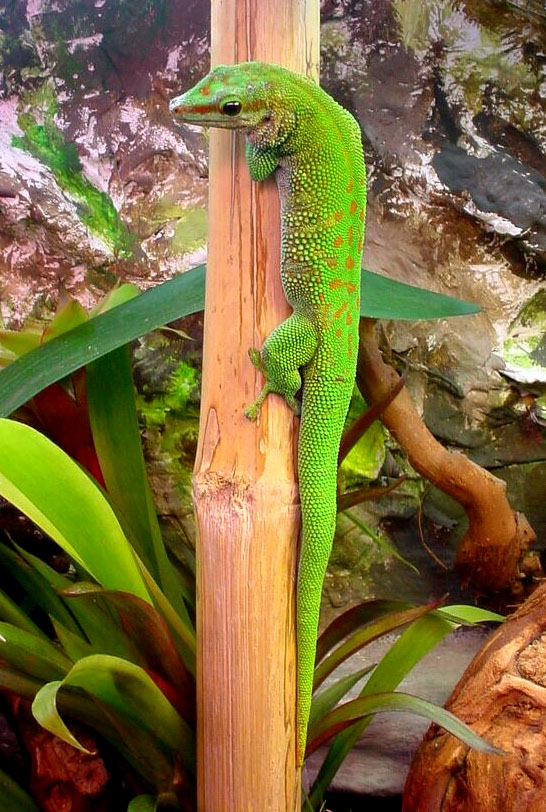
Geckos · Difficulty: Intermediate
Key facts and care guidance for Madagascar giant day gecko (Phelsuma madagascariensis) (origin: Northern and north-eastern Madagascar). Adult size around ~20–25 cm total length. Life expectancy up to ~15–20 years (the nominate form can reach a great age). The values below are carefully researched guidance.
Short answers
Madagascar giant day gecko: How big does the enclosure need to be?
A tall enclosure from ~60×45×80 cm for one animal; a pair ~80×50×100 cm.
Madagascar giant day gecko: What temperature does it need?
Daytime 25–30 °C, basking spot 32–35 °C (locally up to ~40 °C), at night ~20 °C.
Madagascar giant day gecko: Does it need UVB lighting?
UVB: UVB needed (Ferguson zone 2–3, UV index 3–4; 5–10 % UVB); diurnal.
Madagascar giant day gecko: How long do they live?
Life expectancy: up to ~15–20 years (the nominate form can reach a great age).
Madagascar giant day gecko: Is it suitable for beginners?
Rather not – it is considered an intermediate species (difficulty: Intermediate).
Climate
- Daytime temperature
- 25–30 °C
- Night temperature
- ~20 °C
- Basking spot
- 32–35 °C (locally up to ~40 °C)
- Humidity
- 50–60 % by day, up to ~80 % at night
- UVB
- UVB needed (Ferguson zone 2–3, UV index 3–4; 5–10 % UVB); diurnal
Enclosure
- Minimum size
- a tall enclosure from ~60×45×80 cm for one animal; a pair ~80×50×100 cm
- Substrate
- Coco or humus soil, live large-leaved plants, smooth branches, hollow bamboo tubes, a little bark
Feeding
- Food
- Insects plus fruit purée or nectar; calcium
- Feeding interval
- adults 3–4×/week plus fruit purée, juveniles daily
Key facts
- Adult size
- ~20–25 cm total length
- Life expectancy
- up to ~15–20 years (the nominate form can reach a great age)
- Origin
- Northern and north-eastern Madagascar
- Protection status
- CITES Appendix II / EU Regulation Annex B (Phelsuma spp.); proof of origin plus registration required
- Brumation
- No real winter rest; a slight seasonal drop is possible
- Cohabitation
- Keeping it singly is the least stressful solution, especially outside breeding. In pairs (one male, one female) works in a large enclosure – drawback: some males become very aggressive towards the female during the breeding season, so keep the pair separated from about May to October and have a spare enclosure ready. Never keep two males together.
Notes
The nominate form of the former Phelsuma madagascariensis complex (grandis is a species of its own today). Bamboo tubes as a retreat matter. UVB and calcium are essential against MBD. Do not touch it (delicate skin).
Do you keep this species?
Add your animal to Reptoria – Reptoria reminds you about feeding and shedding. Add your animal for free →
Madagascar giant day gecko (Phelsuma madagascariensis) currently offered
- Madagaskar Taggecko 19 cm, 1 Jahr alt – Mahlow · 52 €
Related species
- Abbott's day gecko (Phelsuma abbotti) – Intermediate
- Barbour's day gecko (Phelsuma barbouri) – Intermediate
- Blue-tailed day gecko (Phelsuma cepediana) – Intermediate
- Lined day gecko (Phelsuma lineata) – Beginner
- Gold dust day gecko (Phelsuma laticauda) – Beginner to intermediate
- Giant day gecko (Phelsuma grandis) – Beginner
- Seychelles giant day gecko (Phelsuma sundbergi) – Intermediate
- Comoros day gecko (Phelsuma v-nigra) – Intermediate
What you need to start
To keep Madagascar giant day gecko (Phelsuma madagascariensis) you typically need: a suitable enclosure (a tall enclosure from ~60×45×80 cm for one animal; a pair ~80×50×100 cm), substrate (Coco or humus soil, live large-leaved plants, smooth branches, hollow bamboo tubes, a little bark), a heat source with a thermostat, UVB lighting, thermometer and hygrometer, a water dish and hides. You will find equipment in the Reptoria marketplace.
The complete, interactive care database is in the Reptoria app.
Last updated: 9 October 2026 · Editor: Reptoria editorial team · Sources include: http://www.ig-phelsuma.de/?page_id=367, https://en.wikipedia.org/wiki/Phelsuma_madagascariensis, https://reptifiles.com/gold-dust-day-gecko-care-sheet/, https://reptile-database.reptarium.cz/species?genus=Phelsuma&species=madagascariensis, https://taggecko.ch/die-arten/steckbrief-der-arten/
All values are non-binding guidance and do not replace expert advice. Research thoroughly from several sources before acquiring and keeping an animal, and observe the applicable law (species and animal protection in particular).