Martinique anole (Anolis roquet)
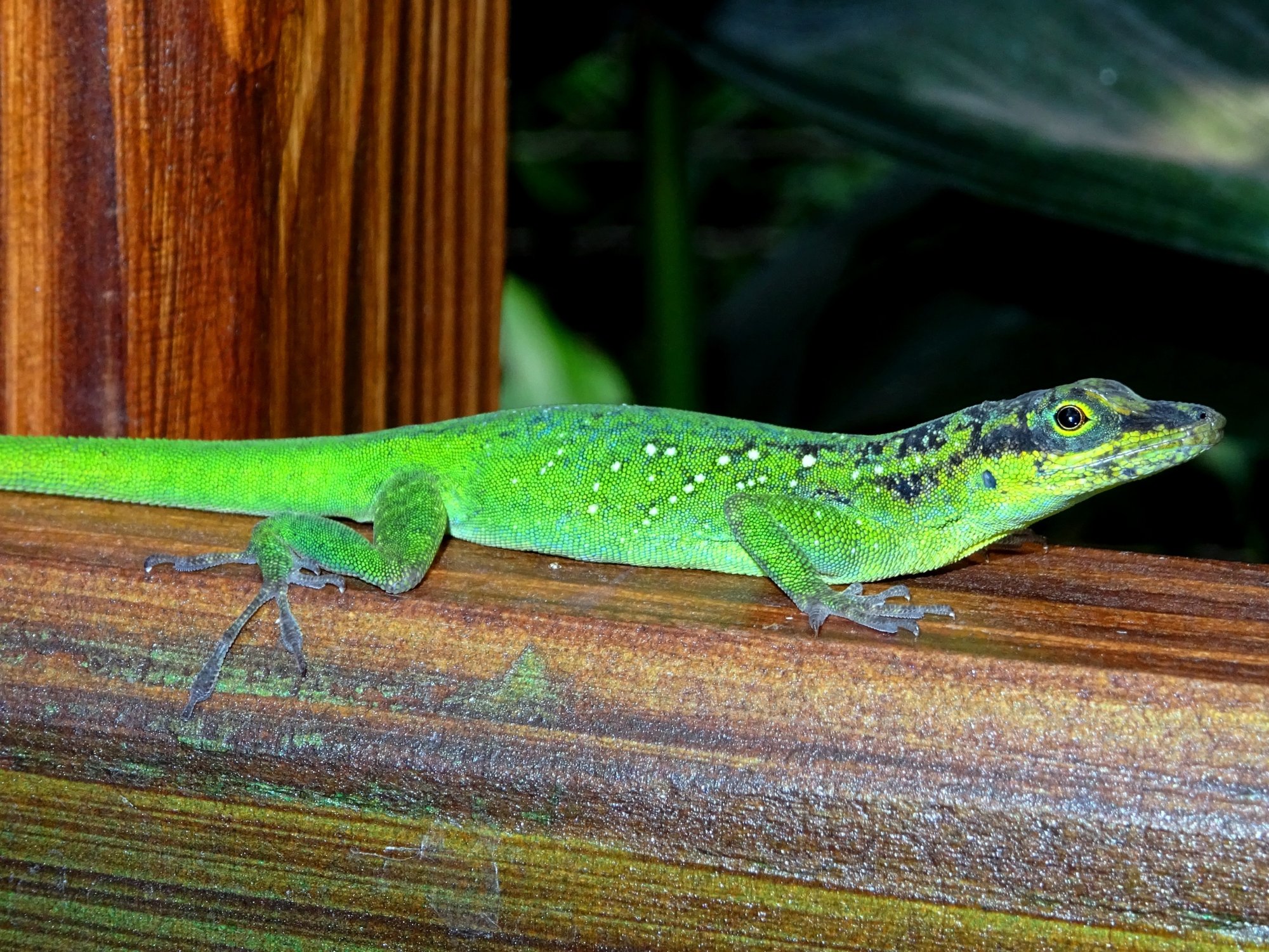
Iguanas · Difficulty: Intermediate
Key facts and care guidance for Martinique anole (Anolis roquet) (origin: Martinique (endemic, the Lesser Antilles); central lowland forest). Adult size around Medium-sized, total length ~15–20 cm (hatchlings under 5 cm). Life expectancy 5–8 years, well-cared-for individuals up to about 10 years. The values below are carefully researched guidance.
Short answers
Martinique anole: How big does the enclosure need to be?
From 45×45×60 cm for one animal; for a pair from 45×45×60 cm (1997 expert report, at 7,25 cm SVL).
Martinique anole: What temperature does it need?
Daytime 22–28 °C in the terrarium, up to 30 °C in the upper area, basking spot 35–40 °C locally at the basking spot, at night 20–22 °C.
Martinique anole: Does it need UVB lighting?
UVB: UVB needed (Ferguson zone 2–3, UV index 2–4).
Martinique anole: How long do they live?
Life expectancy: 5–8 years, well-cared-for individuals up to about 10 years.
Martinique anole: Is it suitable for beginners?
Rather not – it is considered an intermediate species (difficulty: Intermediate).
Climate
- Daytime temperature
- 22–28 °C in the terrarium, up to 30 °C in the upper area
- Night temperature
- 20–22 °C
- Basking spot
- 35–40 °C locally at the basking spot
- Humidity
- 65–85 %, around 80 % during the day, higher at night; after misting, part of the terrarium must dry out again
- UVB
- UVB needed (Ferguson zone 2–3, UV index 2–4)
Enclosure
- Minimum size
- from 45×45×60 cm for one animal; for a pair from 45×45×60 cm (1997 expert report, at 7,25 cm SVL)
- Substrate
- Bioactive damp tropical substrate with leaf litter (for egg-laying); plus dry, well-draining resting and basking spots
Feeding
- Food
- Insects (crickets of all kinds); fruit flies for juveniles plus small feeders (grain beetles, aphids)
- Feeding interval
- adults 2–3×/week, juveniles daily
Key facts
- Adult size
- Medium-sized, total length ~15–20 cm (hatchlings under 5 cm)
- Life expectancy
- 5–8 years, well-cared-for individuals up to about 10 years
- Origin
- Martinique (endemic, the Lesser Antilles); central lowland forest
- Protection status
- Not listed under CITES; no German registration duty as a non-native species; prefer captive-bred animals
- Brumation
- No real winter rest (tropical); keep to cool nights (16–18 °C)
- Cohabitation
- Pairs (1.1) are the safest option. Territorial, never keep males together. One male with 2–3 females is sometimes kept in a large, planted enclosure, but often does not work in the long run: a lower-ranking female is pushed aside, eats less and hides.
Notes
Despite high humidity it needs dry zones plus mist-free hours before nightfall, otherwise fungal and skin infections follow. Do not put plants against the heat lamp (a fire risk); loose crickets can harm the animals and the plants. A very well studied and socially interesting species.
Do you keep this species?
Add your animal to Reptoria – Reptoria reminds you about feeding and shedding. Add your animal for free →
Martinique anole (Anolis roquet) currently offered
- Anolis roquet verschiedene Unterarten – Macouba, Mapu, Le Diamant, salinei, summus, roquet · Fredersdorf-Vogelsdorf · 200 €
Related species
- Ghost anole (Anolis lemurinus) – Intermediate
- Ahl's anole (Anolis ahli) – Intermediate
- Aliniger anole (Anolis aliniger) – Beginner with some knowledge
- Allogus anole (Anolis allogus) – Beginner with some knowledge
- Bahaman green anole (Anolis smaragdinus) – Beginner
- Bahoruco anole (Anolis bahorucoensis) – Beginner with some knowledge
- Baleatus giant anole (Anolis baleatus) – Intermediate
- Baracoa giant anole (Anolis baracoae) – Intermediate
What you need to start
To keep Martinique anole (Anolis roquet) you typically need: a suitable enclosure (from 45×45×60 cm for one animal; for a pair from 45×45×60 cm (1997 expert report, at 7,25 cm SVL)), substrate (Bioactive damp tropical substrate with leaf litter (for egg-laying); plus dry, well-draining resting and basking spots), a heat source with a thermostat, UVB lighting, thermometer and hygrometer, a water dish and hides. You will find equipment in the Reptoria marketplace.
The complete, interactive care database is in the Reptoria app.
Last updated: 2 November 2026 · Editor: Reptoria editorial team · Sources include: DGHT-Landesgruppe Schweiz, Mindestanforderungen Reptilien, Wikipedia EN, eu_annex.txt (lokal, VO (EU) 2026/1383), gutachten.txt (BML-Gutachten Reptilien 1997), karibische-anolis.de
All values are non-binding guidance and do not replace expert advice. Research thoroughly from several sources before acquiring and keeping an animal, and observe the applicable law (species and animal protection in particular).