Namaqua chameleon (Chamaeleo namaquensis)
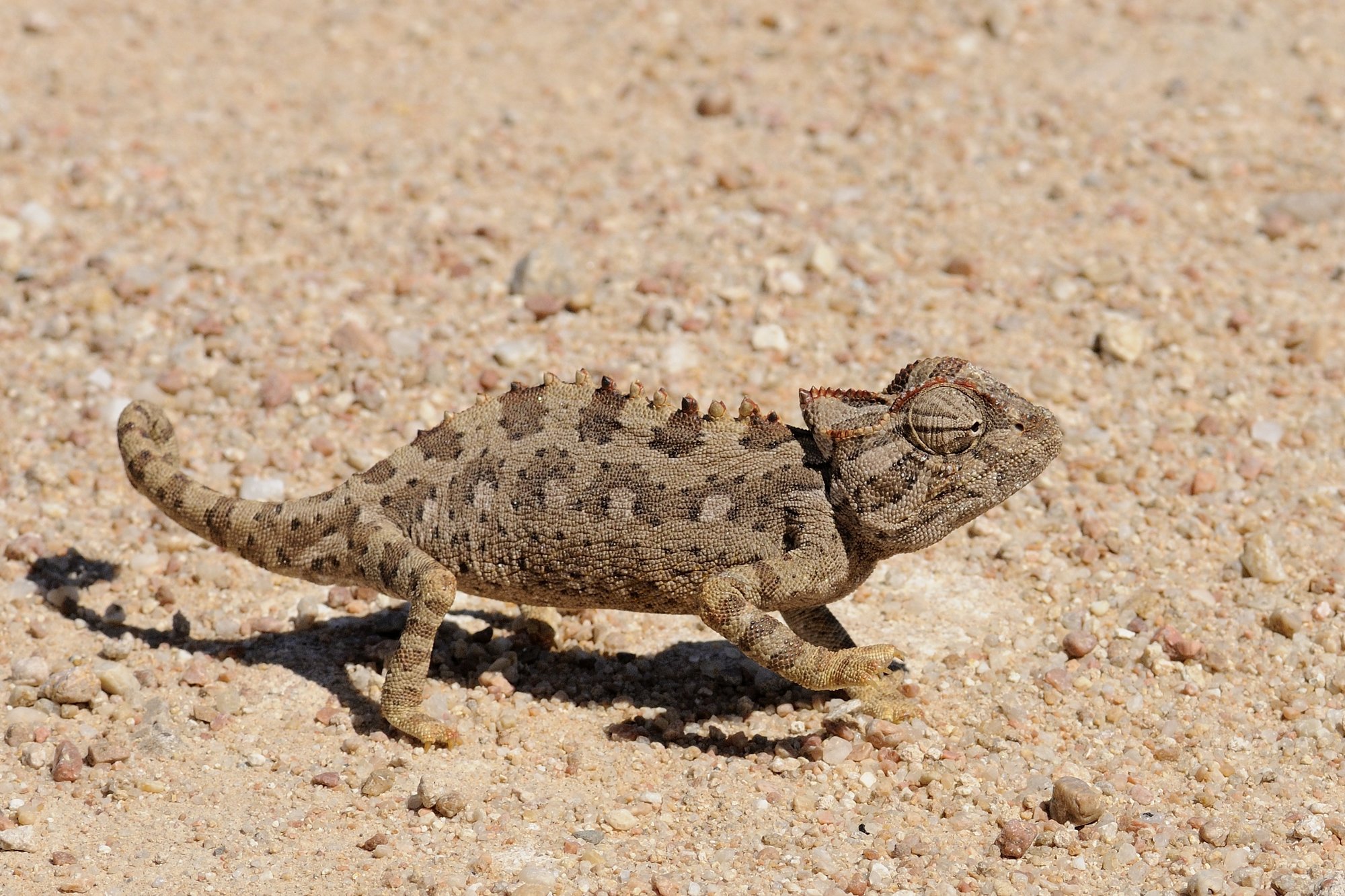
Chameleons · Difficulty: Expert
Key facts and care guidance for Namaqua chameleon (Chamaeleo namaquensis) (origin: The deserts of south-western Africa (the Namib: Namibia, western South Africa, southern Angola)). Adult size around up to ~25 cm (one of the largest South African species). Life expectancy ~5–8 years (hard to reach in captivity). The values below are carefully researched guidance.
Short answers
Namaqua chameleon: How big does the enclosure need to be?
Very large and ground-oriented: at least 200×80×80 cm (a ground-dweller, does not climb, runs fast).
Namaqua chameleon: What temperature does it need?
Daytime 28–35 °C (desert; locally very hot during the day), basking spot 40–45 °C, at night 10–18 °C (strong night-time drop).
Namaqua chameleon: Does it need UVB lighting?
UVB: High UVB needed (Ferguson zone 4, UV index 4–6; full desert sun).
Namaqua chameleon: How long do they live?
Life expectancy: ~5–8 years (hard to reach in captivity).
Namaqua chameleon: Is it suitable for beginners?
No – better suited to experienced keepers (difficulty: Expert).
Climate
- Daytime temperature
- 28–35 °C (desert; locally very hot during the day)
- Night temperature
- 10–18 °C (strong night-time drop)
- Basking spot
- 40–45 °C
- Humidity
- 20–40 % by day (dry), higher at night through fog and dew; water comes from dew or fine mist
- UVB
- High UVB needed (Ferguson zone 4, UV index 4–6; full desert sun)
Enclosure
- Minimum size
- very large and ground-oriented: at least 200×80×80 cm (a ground-dweller, does not climb, runs fast)
- Substrate
- Desert sand or sand-loam, diggable and deep
Feeding
- Food
- Large insects: beetles (tenebrionids), locusts; a voracious feeder that occasionally takes small vertebrates
- Feeding interval
- adults generously, daily to every other day (a high metabolism)
Key facts
- Adult size
- up to ~25 cm (one of the largest South African species)
- Life expectancy
- ~5–8 years (hard to reach in captivity)
- Origin
- The deserts of south-western Africa (the Namib: Namibia, western South Africa, southern Angola)
- Protection status
- CITES Appendix II; nationally protected in South Africa and Namibia; practically no legal imports
- Brumation
- No winter rest; recreate a strong day–night and seasonal temperature range
- Cohabitation
- Single housing – territorial loner. Chameleons are pronounced loners, and mere visual contact with a conspecific already means constant stress — an animal that is always threatening or fleeing eats less and becomes ill. So keep even neighbouring enclosures visually screened from each other.
Notes
An extremely demanding desert ground species: an enormous amount of floor space, a large temperature amplitude, and a very high food and water requirement (it drinks dew and fog and can take up water through skin capillaries). It cannot climb, and runs fast. Barely available legally – for specialists only.
Do you keep this species?
Add your animal to Reptoria – Reptoria reminds you about feeding and shedding. Add your animal for free →
Look for Namaqua chameleon (Chamaeleo namaquensis) in the marketplace →
Related species
- African chameleon (Chamaeleo africanus) – Intermediate
- Anchieta's chameleon (Chamaeleo anchietae) – Intermediate
- Arabian chameleon (Chamaeleo arabicus) – Intermediate
- Graceful chameleon (Chamaeleo gracilis) – Intermediate
- Common chameleon (Chamaeleo chamaeleon) – Intermediate
- Smooth chameleon (Chamaeleo laevigatus) – Intermediate
- Indian chameleon (Chamaeleo zeylanicus) – Intermediate
- Veiled chameleon (Chamaeleo calyptratus) – Intermediate
What you need to start
To keep Namaqua chameleon (Chamaeleo namaquensis) you typically need: a suitable enclosure (very large and ground-oriented: at least 200×80×80 cm (a ground-dweller, does not climb, runs fast)), substrate (Desert sand or sand-loam, diggable and deep), a heat source with a thermostat, UVB lighting, thermometer and hygrometer, a water dish and hides. You will find equipment in the Reptoria marketplace.
The complete, interactive care database is in the Reptoria app.
Last updated: 9 October 2026 · Editor: Reptoria editorial team · Sources include: https://en.wikipedia.org/wiki/Namaqua_chameleon, https://reptile-database.reptarium.cz/species?genus=Chamaeleo&species=namaquensis
All values are non-binding guidance and do not replace expert advice. Research thoroughly from several sources before acquiring and keeping an animal, and observe the applicable law (species and animal protection in particular).