Nano-chameleon (Brookesia nana)
Chameleons · Difficulty: Expert
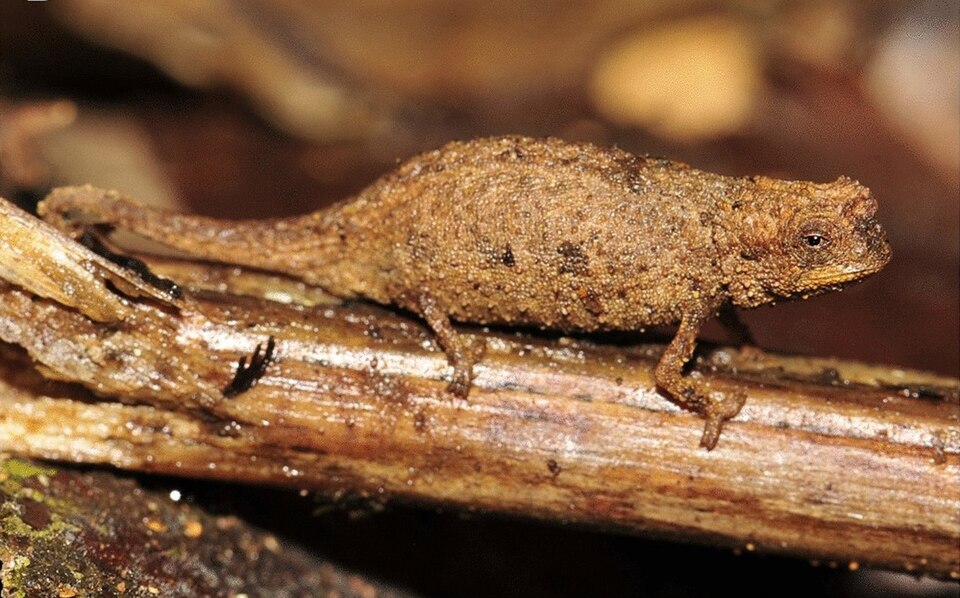
Key facts and care guidance for Nano-chameleon (Brookesia nana) (origin: The Sorata massif, northern Madagascar, montane rainforest). Adult size around ~22 mm (males), ~29 mm (females) – the smallest known reptile. Life expectancy unknown (not established in captivity). The values below are carefully researched guidance.
Short answers
Nano-chameleon: How big does the enclosure need to be?
A small bioactive humid enclosure (~30×30×30 cm) – in practice they are hardly ever kept.
Nano-chameleon: What temperature does it need?
Daytime 18–23 °C (montane cloud forest of northern Madagascar), at night 14–18 °C.
Nano-chameleon: Does it need UVB lighting?
UVB: Very low UVB (shaded forest floor); not essential, weak UVB recommended.
Nano-chameleon: How long do they live?
Life expectancy: unknown (not established in captivity).
Nano-chameleon: Is it suitable for beginners?
No – better suited to experienced keepers (difficulty: Expert).
Climate
- Daytime temperature
- 18–23 °C (montane cloud forest of northern Madagascar)
- Night temperature
- 14–18 °C
- Basking spot
- —
- Humidity
- 80–95 %
- UVB
- Very low UVB (shaded forest floor); not essential, weak UVB recommended
Enclosure
- Minimum size
- a small bioactive humid enclosure (~30×30×30 cm) – in practice they are hardly ever kept
- Substrate
- Damp leaf litter or moss with a springtail culture
Feeding
- Food
- The tiniest insects: springtails, mites, the smallest fruit flies
- Feeding interval
- daily, the smallest feeder insects
Key facts
- Adult size
- ~22 mm (males), ~29 mm (females) – the smallest known reptile
- Life expectancy
- unknown (not established in captivity)
- Origin
- The Sorata massif, northern Madagascar, montane rainforest
- Protection status
- CITES Appendix II; IUCN "Critically Endangered"; NO legal trade, and not present in the hobby
- Brumation
- Unknown (a montane climate, humid all year)
- Cohabitation
- Single housing would be the only defensible assumption, because there is no keeping experience with the species; related Brookesia often tolerate permanent contact badly. A pair only temporarily and only in professionally supervised breeding.
Notes
IMPORTANT: this species is NOT kept in herpetoculture – only a few wild specimens are known, it is strictly protected, and there is no legal import. All the figures are analogy estimates from its habitat and related montane Brookesia, and are NOT a real keeping recommendation.
Do you keep this species?
Add your animal to Reptoria – Reptoria reminds you about feeding and shedding. Add your animal for free →
Look for Nano-chameleon (Brookesia nana) in the marketplace →
Related species
- Betsch's leaf chameleon (Brookesia betschi) – Expert
- Brygoo's leaf chameleon (Brookesia brygooi) – Expert
- Decary's leaf chameleon (Brookesia decaryi) – Intermediate
- Ebenau's leaf chameleon (Brookesia ebenaui) – Expert
- Armoured leaf chameleon (Brookesia perarmata) – Expert
- Griveaud's leaf chameleon (Brookesia griveaudi) – Expert
- Karche's leaf chameleon (Brookesia karchei) – Expert
- Minute leaf chameleon (Brookesia minima) – Expert
What you need to start
To keep Nano-chameleon (Brookesia nana) you typically need: a suitable enclosure (a small bioactive humid enclosure (~30×30×30 cm) – in practice they are hardly ever kept), substrate (Damp leaf litter or moss with a springtail culture), a heat source with a thermostat, UVB lighting, thermometer and hygrometer, a water dish and hides. You will find equipment in the Reptoria marketplace.
The complete, interactive care database is in the Reptoria app.
Last updated: 7 November 2026 · Editor: Reptoria editorial team · Sources include: Wikipedia/Erstbeschreibung Brookesia nana: kleinste bekannte Reptilienart (Nasobem-Region Madagaskar) – https://en.wikipedia.org/wiki/Brookesia_nana, Wikipedia Brookesia stumpffi: Gelege 3-5 Eier, Schlupf nach 60-70 Tagen bei 23°C – https://en.wikipedia.org/wiki/Brookesia_stumpffi, https://en.wikipedia.org/wiki/Brookesia, https://en.wikipedia.org/wiki/Brookesia_nana, https://reptile-database.reptarium.cz/species?genus=Brookesia&species=nana
All values are non-binding guidance and do not replace expert advice. Research thoroughly from several sources before acquiring and keeping an animal, and observe the applicable law (species and animal protection in particular).