Neotropical green anole (Anolis biporcatus)
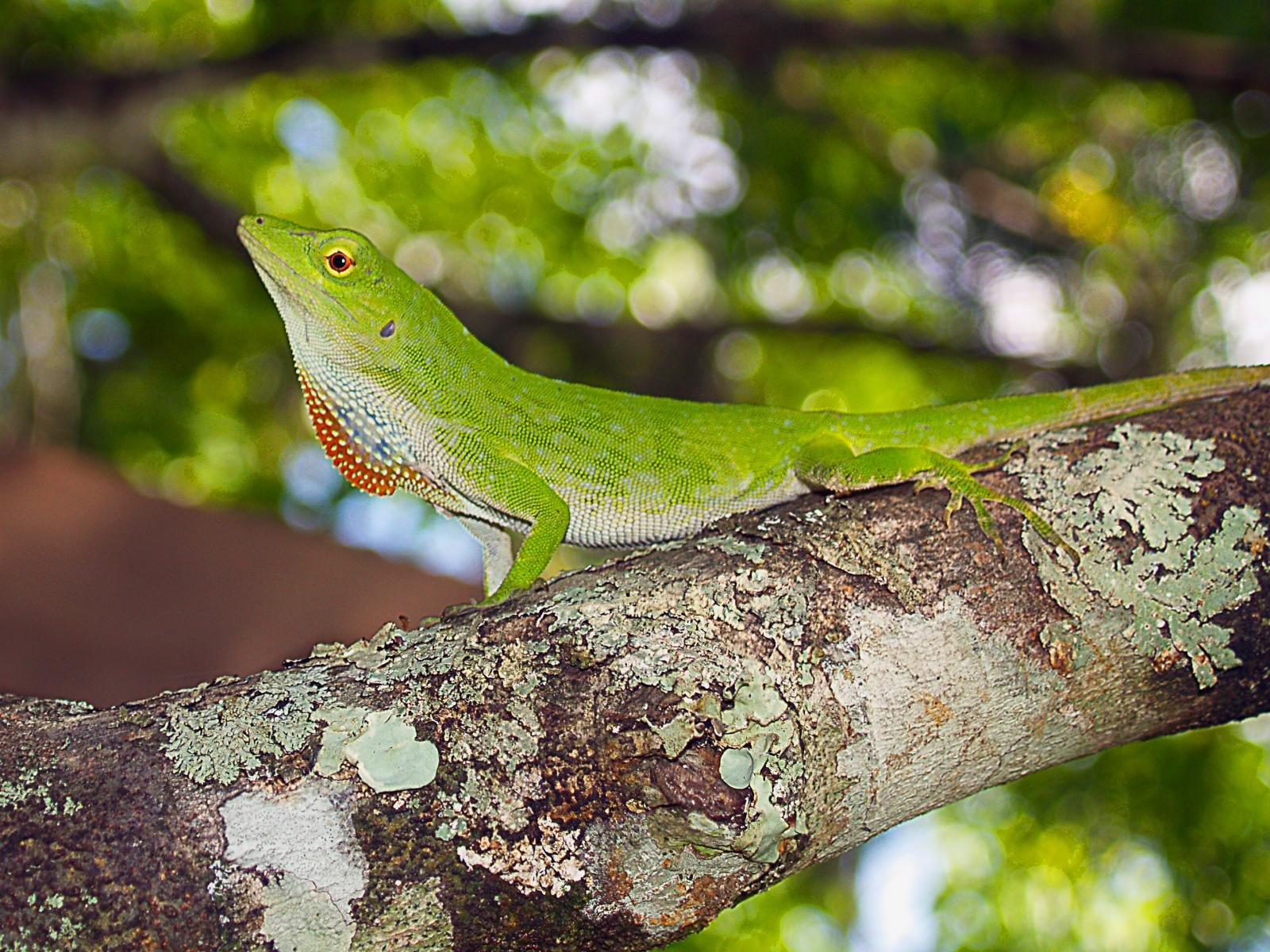
Iguanas · Difficulty: Intermediate
Key facts and care guidance for Neotropical green anole (Anolis biporcatus) (origin: Southern Mexico through Central America (Guatemala to Panama) to north-western South America; tropical rainforest, arboreal). Adult size around total length about 21–31 cm; snout–vent length 7–10.5 cm, the tail is about twice as long as the body. Life expectancy approx. 5–7 years in captivity. The values below are carefully researched guidance.
Short answers
Neotropical green anole: How big does the enclosure need to be?
From 65×65×85 cm for one animal; for a pair from 65×65×85 cm (German 1997 expert report, based on 10.5 cm SVL).
Neotropical green anole: What temperature does it need?
Daytime 24–28 °C in the terrarium; animals from montane forest habitats may be kept cooler — the official expert report sets only 18–25 °C ambient temperature for continental rainforest and montane forest anoles, basking spot 32–35 °C locally at the basking spot, at night 20–22 °C.
Neotropical green anole: Does it need UVB lighting?
UVB: UVB needed (Ferguson zone 1–2, UV index 2–3; a forest dweller).
Neotropical green anole: How long do they live?
Life expectancy: approx. 5–7 years in captivity.
Neotropical green anole: Is it suitable for beginners?
Rather not – it is considered an intermediate species (difficulty: Intermediate).
Climate
- Daytime temperature
- 24–28 °C in the terrarium; animals from montane forest habitats may be kept cooler — the official expert report sets only 18–25 °C ambient temperature for continental rainforest and montane forest anoles
- Night temperature
- 20–22 °C
- Basking spot
- 32–35 °C locally at the basking spot
- Humidity
- 70–80 %
- UVB
- UVB needed (Ferguson zone 1–2, UV index 2–3; a forest dweller)
Enclosure
- Minimum size
- from 65×65×85 cm for one animal; for a pair from 65×65×85 cm (German 1997 expert report, based on 10.5 cm SVL)
- Substrate
- Forest floor or coco humus with leaf litter, dense live planting, plenty of branches and lianas
Feeding
- Food
- Insects: crickets, house crickets, roaches, flies, wax moths; calcium and vitamins
- Feeding interval
- adults 3×/week, juveniles daily
Key facts
- Adult size
- total length about 21–31 cm; snout–vent length 7–10.5 cm, the tail is about twice as long as the body
- Life expectancy
- approx. 5–7 years in captivity
- Origin
- Southern Mexico through Central America (Guatemala to Panama) to north-western South America; tropical rainforest, arboreal
- Protection status
- No CITES or EU regulation protection; not specially protected. Prefer captive breeding or a legal source.
- Brumation
- None (tropical); only a slight rainy/dry season variation, possibly to encourage breeding
- Cohabitation
- Territorial. Keep them singly or as 1.1 (a male plus a female) in a large, well-planted enclosure. NEVER keep males together.
Notes
Humidity-loving; it needs plenty of height and dense planting. Common mistakes: too dry, too small. Good data (several care sheets in agreement).
Do you keep this species?
Add your animal to Reptoria – Reptoria reminds you about feeding and shedding. Add your animal for free →
Look for Neotropical green anole (Anolis biporcatus) in the marketplace →
Related species
- Ghost anole (Anolis lemurinus) – Intermediate
- Ahl's anole (Anolis ahli) – Intermediate
- Aliniger anole (Anolis aliniger) – Beginner with some knowledge
- Allogus anole (Anolis allogus) – Beginner with some knowledge
- Bahaman green anole (Anolis smaragdinus) – Beginner
- Bahoruco anole (Anolis bahorucoensis) – Beginner with some knowledge
- Baleatus giant anole (Anolis baleatus) – Intermediate
- Baracoa giant anole (Anolis baracoae) – Intermediate
What you need to start
To keep Neotropical green anole (Anolis biporcatus) you typically need: a suitable enclosure (from 65×65×85 cm for one animal; for a pair from 65×65×85 cm (German 1997 expert report, based on 10.5 cm SVL)), substrate (Forest floor or coco humus with leaf litter, dense live planting, plenty of branches and lianas), a heat source with a thermostat, UVB lighting, thermometer and hygrometer, a water dish and hides. You will find equipment in the Reptoria marketplace.
The complete, interactive care database is in the Reptoria app.
Last updated: 9 October 2026 · Editor: Reptoria editorial team · Sources include: DGHT-Landesgruppe Schweiz, Mindestanforderungen Reptilien, Wikipedia EN, einrichtungsbeispiele.de, eu_annex.txt (lokal, VO (EU) 2026/1383), gutachten.txt (BML-Gutachten Reptilien 1997)
All values are non-binding guidance and do not replace expert advice. Research thoroughly from several sources before acquiring and keeping an animal, and observe the applicable law (species and animal protection in particular).