Ocellated lizard (Timon lepidus)
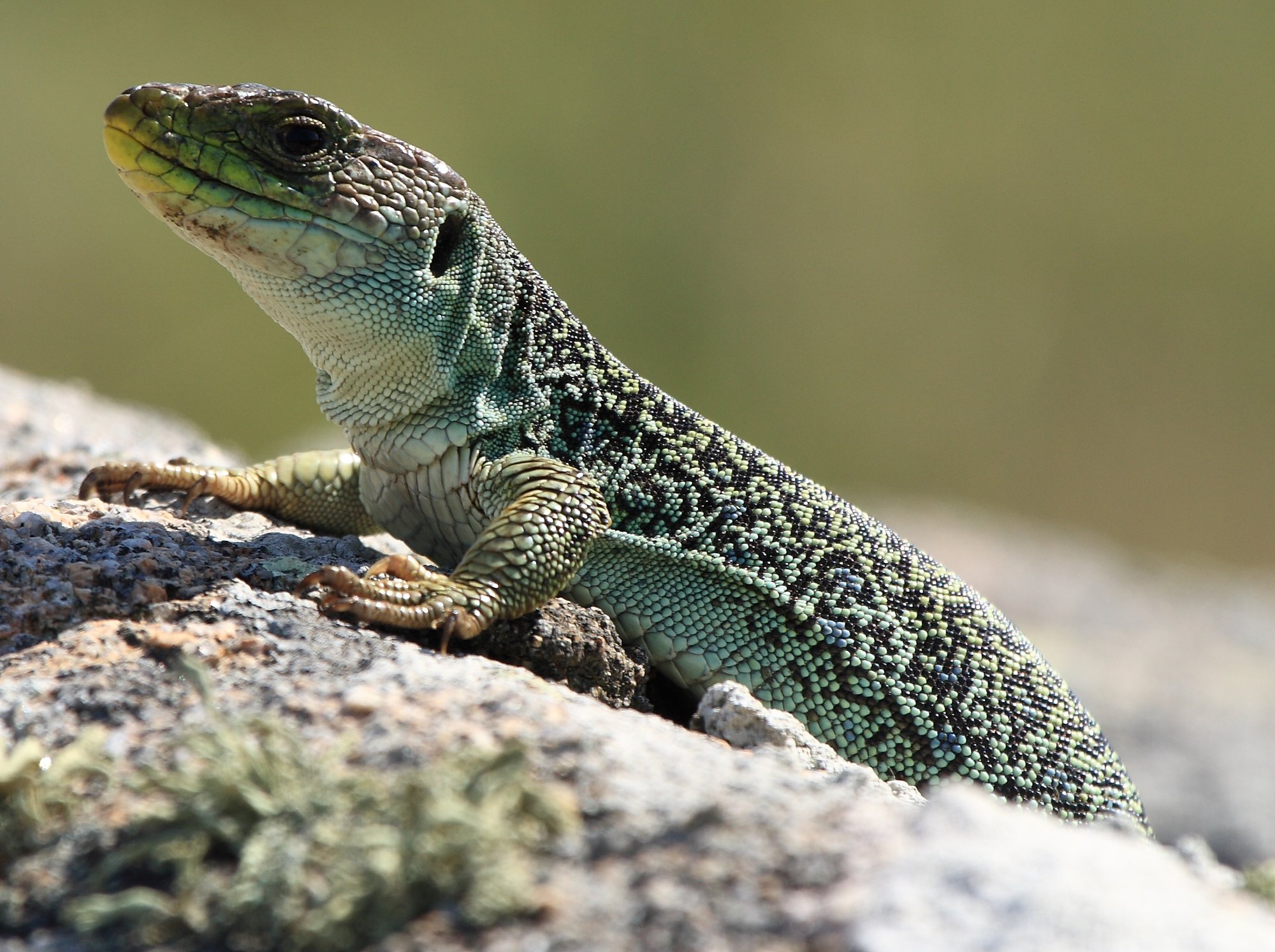
Lizards · Difficulty: Intermediate
Key facts and care guidance for Ocellated lizard (Timon lepidus) (origin: South-western Europe: the Iberian Peninsula, southern France, north-western Italy). Adult size around 50–70 cm total length, large males over 80 cm (SVL 21–26 cm). Life expectancy 10–15 years (up to ~20). The values below are carefully researched guidance.
Short answers
Ocellated lizard: How big does the enclosure need to be?
150×80×80 cm for one animal; a pair from 180×100×100 cm, a group over 250×150×150 cm (a ground-dweller, floor area is what counts).
Ocellated lizard: What temperature does it need?
Daytime 23–28 °C (ambient), warmer locally, basking spot 40–45 °C, at night 16–20 °C.
Ocellated lizard: Does it need UVB lighting?
UVB: UVB is essential (approx. 30 % UVA / 10 % UVB; Ferguson zone 3, UV index 3–5 at the basking spot).
Ocellated lizard: How long do they live?
Life expectancy: 10–15 years (up to ~20).
Ocellated lizard: Is it suitable for beginners?
Rather not – it is considered an intermediate species (difficulty: Intermediate).
Climate
- Daytime temperature
- 23–28 °C (ambient), warmer locally
- Night temperature
- 16–20 °C
- Basking spot
- 40–45 °C
- Humidity
- 50–70 %
- UVB
- UVB is essential (approx. 30 % UVA / 10 % UVB; Ferguson zone 3, UV index 3–5 at the basking spot)
Enclosure
- Minimum size
- 150×80×80 cm for one animal; a pair from 180×100×100 cm, a group over 250×150×150 cm (a ground-dweller, floor area is what counts)
- Substrate
- A deep, diggable sand-loam mix with caves, rock structures, roots and dry plants
Feeding
- Food
- Large insects (house crickets, locusts, roaches, wax moth caterpillars), worms; occasionally nestling mice and a little ripe fruit or egg
- Feeding interval
- adults 2×/week in larger portions, juveniles (almost) daily
Key facts
- Adult size
- 50–70 cm total length, large males over 80 cm (SVL 21–26 cm)
- Life expectancy
- 10–15 years (up to ~20)
- Origin
- South-western Europe: the Iberian Peninsula, southern France, north-western Italy
- Protection status
- Berner Konvention Anhang II. Nicht in den EU-Anhängen A–D und nicht im FFH-Anhang IV (beides am 20.09.2026 am Rechtstext geprüft). Ob die Art über Anlage 1 der BArtSchV besonders geschützt ist, ist noch offen — vor Kauf oder Abgabe bei der Naturschutzbehörde oder über WISIA nachfragen.
- Brumation
- Yes: a winter rest of 2–3 months at about 6–11 °C
- Cohabitation
- A pair or a harem (one male with 3-4 females) in a very large, structured enclosure with sight barriers - never two males together. Do not house with smaller reptiles, which end up as prey. Wikipedia describes the species as quarrelsome, defending its territory fiercely against conspecifics.
Notes
Europe's largest lizard, with a high space, warmth and digging requirement; a powerful bite. It eats small animals – do not house it with smaller species.
Do you keep this species?
Add your animal to Reptoria – Reptoria reminds you about feeding and shedding. Add your animal for free →
Look for Ocellated lizard (Timon lepidus) in the marketplace →
Related species
- Nevada ocellated lizard (Timon nevadensis) – Intermediate
- Moroccan ocellated lizard (Timon pater) – Intermediate
- Atlas ocellated lizard (Timon tangitanus) – Intermediate
- Zagros ocellated lizard (Timon princeps) – Intermediate
- Erhard's wall lizard (Podarcis erhardii) – Beginner to intermediate
- Large psammodromus (Psammodromus algirus) – Intermediate
- Pamphylian green lizard (Lacerta pamphylica) – Intermediate
- Lilford's wall lizard (Podarcis lilfordi) – Expert
What you need to start
To keep Ocellated lizard (Timon lepidus) you typically need: a suitable enclosure (150×80×80 cm for one animal; a pair from 180×100×100 cm, a group over 250×150×150 cm (a ground-dweller, floor area is what counts)), substrate (A deep, diggable sand-loam mix with caves, rock structures, roots and dry plants), a heat source with a thermostat, UVB lighting, thermometer and hygrometer, a water dish and hides. You will find equipment in the Reptoria marketplace.
The complete, interactive care database is in the Reptoria app.
Last updated: 9 October 2026 · Editor: Reptoria editorial team · Sources include: https://de.wikipedia.org/wiki/Perleidechse, https://reptile-database.reptarium.cz/species?genus=Timon&species=lepidus
All values are non-binding guidance and do not replace expert advice. Research thoroughly from several sources before acquiring and keeping an animal, and observe the applicable law (species and animal protection in particular).