Pantropical jumping spider (Plexippus paykulli)
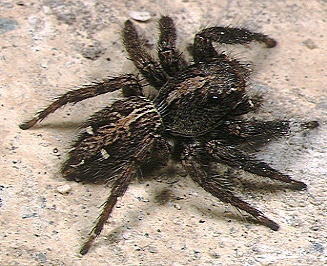
Invertebrates · Difficulty: Beginner
Key facts and care guidance for Pantropical jumping spider (Plexippus paykulli) (origin: Originally South-East Asia, today pantropical and introduced worldwide; synanthropic, often on buildings and around lights). Adult size around approx. 10–15 mm body length (females somewhat larger). Life expectancy approx. 1–2 years, sometimes longer with good care. The values below are carefully researched guidance.
Short answers
Pantropical jumping spider: How big does the enclosure need to be?
12×12×20 cm (tall, well ventilated).
Pantropical jumping spider: What temperature does it need?
Daytime 23–28 °C, at night 19–22 °C.
Pantropical jumping spider: Does it need UVB lighting?
UVB: No UVB needed; bright daytime lighting recommended.
Pantropical jumping spider: How long do they live?
Life expectancy: approx. 1–2 years, sometimes longer with good care.
Pantropical jumping spider: Is it suitable for beginners?
Yes – it is considered suitable for beginners (difficulty: Beginner).
Climate
- Daytime temperature
- 23–28 °C
- Night temperature
- 19–22 °C
- Basking spot
- —
- Humidity
- 50–70 %
- UVB
- No UVB needed; bright daytime lighting recommended
Enclosure
- Minimum size
- 12×12×20 cm (tall, well ventilated)
- Substrate
- Coco humus, slightly damp on one side; climbing and hiding structures of bark and plants
Feeding
- Food
- Fruit flies, micro crickets; as adults small flies and small house crickets
- Feeding interval
- adults 2–3×/week, juveniles every 1–2 days
Key facts
- Adult size
- approx. 10–15 mm body length (females somewhat larger)
- Life expectancy
- approx. 1–2 years, sometimes longer with good care
- Origin
- Originally South-East Asia, today pantropical and introduced worldwide; synanthropic, often on buildings and around lights
- Protection status
- No CITES or special protection
- Brumation
- None (a warm tropical species)
- Cohabitation
- Keep them singly. Solitary and territorial, with cannibalism – no pairs or groups.
Notes
An active, easy-care, warmth-tolerant species (22–28 °C). Mist one side for drinking water; good ventilation. Warmth-loving and good for beginners.
Do you keep this species?
Add your animal to Reptoria – Reptoria reminds you about feeding and shedding. Add your animal for free →
Look for Pantropical jumping spider (Plexippus paykulli) in the marketplace →
Related species
- Peters' jumping spider (Plexippus petersi) – Beginner
- Algerian jumping spider (Cyrba algerina) – Intermediate
- Arched jumping spider (Evarcha arcuata) – Intermediate
- Bronze jumping spider (Hyllus semicupreus) – Beginner
- Peacock jumping spider (Saitis barbipes) – Intermediate
- Diard's jumping spider (Hyllus diardi) – Beginner
- Three-spotted jumping spider (Pellenes tripunctatus) – Intermediate
- Canopy jumping spider (Phidippus otiosus) – Beginner
What you need to start
To keep Pantropical jumping spider (Plexippus paykulli) you typically need: a suitable enclosure (12×12×20 cm (tall, well ventilated)), substrate (Coco humus, slightly damp on one side; climbing and hiding structures of bark and plants), a heat source with a thermostat, UVB lighting, thermometer and hygrometer, a water dish and hides. You will find equipment in the Reptoria marketplace.
The complete, interactive care database is in the Reptoria app.
Last updated: 9 October 2026 · Editor: Reptoria editorial team · Sources include: https://en.wikipedia.org/wiki/Plexippus_paykulli, https://species.wikimedia.org/wiki/Plexippus_paykulli
All values are non-binding guidance and do not replace expert advice. Research thoroughly from several sources before acquiring and keeping an animal, and observe the applicable law (species and animal protection in particular).