Pasteur's day gecko (Phelsuma v-nigra pasteuri)
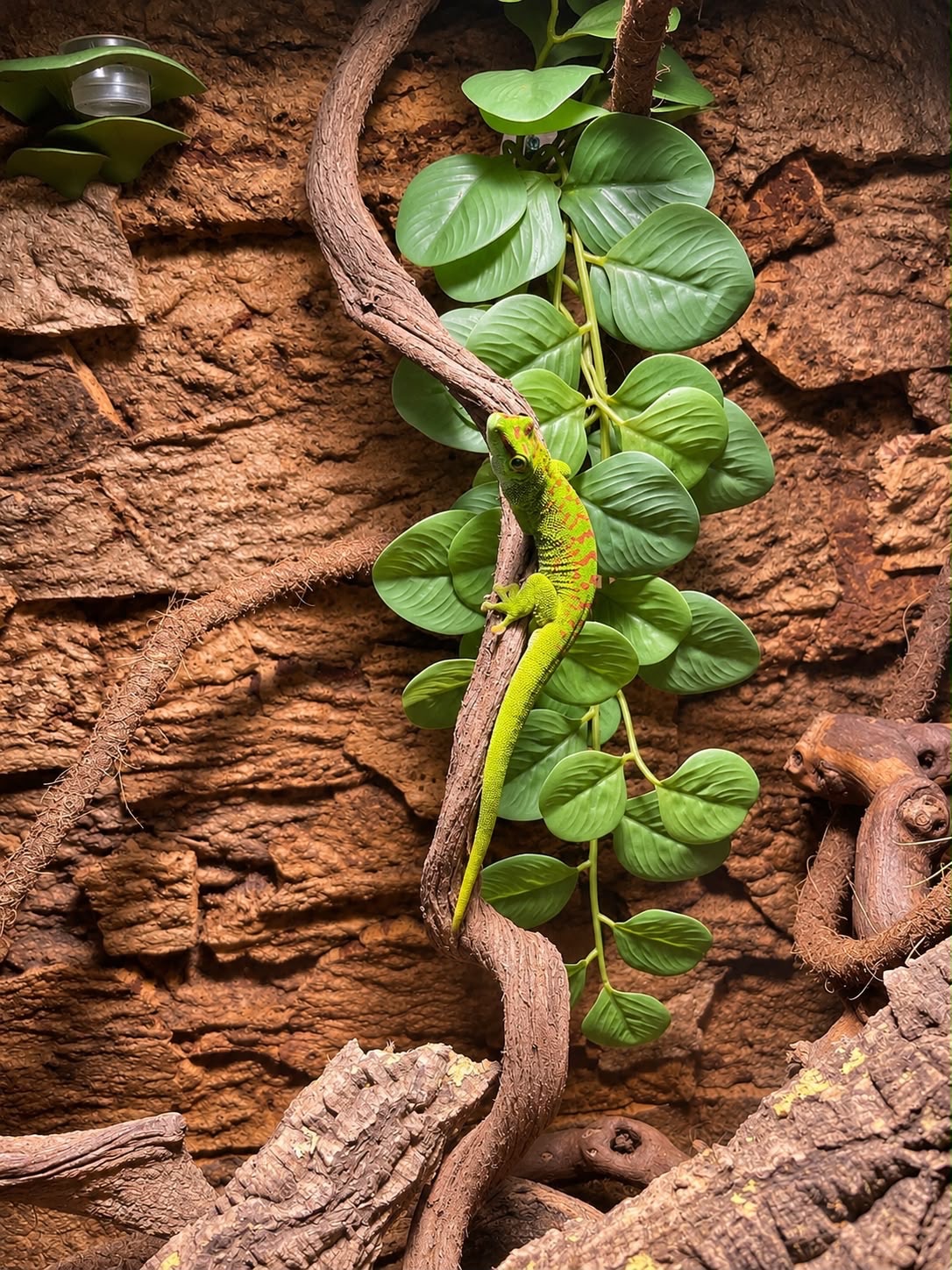
Geckos · Difficulty: Intermediate
Key facts and care guidance for Pasteur's day gecko (Phelsuma v-nigra pasteuri) (origin: Mayotte (the Comoros)). Adult size around up to approx. 11 cm total length. Life expectancy 6–10 years. The values below are carefully researched guidance.
Short answers
Pasteur's day gecko: How big does the enclosure need to be?
From 40×40×80 cm for a pair (vertical, densely planted).
Pasteur's day gecko: What temperature does it need?
Daytime 28–30 °C (cooler zone ~25 °C), basking spot 30–32 °C, at night 20–23 °C.
Pasteur's day gecko: Does it need UVB lighting?
UVB: Essential (UVB 5.0).
Pasteur's day gecko: How long do they live?
Life expectancy: 6–10 years.
Pasteur's day gecko: Is it suitable for beginners?
Rather not – it is considered an intermediate species (difficulty: Intermediate).
Climate
- Daytime temperature
- 28–30 °C (cooler zone ~25 °C)
- Night temperature
- 20–23 °C
- Basking spot
- 30–32 °C
- Humidity
- 60–75 %
- UVB
- Essential (UVB 5.0)
Enclosure
- Minimum size
- from 40×40×80 cm for a pair (vertical, densely planted)
- Substrate
- Coco humus, bamboo tubes, planting
Feeding
- Food
- Small insects (Drosophila, micro-crickets), fruit purée, nectar; calcium
- Feeding interval
- 3×/week
Key facts
- Adult size
- up to approx. 11 cm total length
- Life expectancy
- 6–10 years
- Origin
- Mayotte (the Comoros)
- Protection status
- CITES Appendix II / EU Regulation Annex B (Phelsuma spp.); proof of origin plus registration required
- Brumation
- A cooler period over two months: about 25 °C in the daytime, about 20 °C at night
- Cohabitation
- Pair (1.1). Two males do not work together — they fight over territory and basking spots until one is seriously injured or sits permanently in a corner. One male with several females is only possible in a large, richly structured enclosure, but: females also compete for the best basking spots, and a subordinate animal then eats less — observe and separate if necessary. Several basking and hiding spots are important so subordinate animals can get out of the way, and feed separately as soon as the animals differ in size.
Notes
A subspecies of the lesser Comoro day gecko found only on Mayotte. One of the smallest day geckos of all — needs correspondingly fine food. The two-month cooler phase is a fixed part of this subspecies' annual cycle, not just a breeding trigger.
Do you keep this species?
Add your animal to Reptoria – Reptoria reminds you about feeding and shedding. Add your animal for free →
Look for Pasteur's day gecko (Phelsuma v-nigra pasteuri) in the marketplace →
Related species
- Abbott's day gecko (Phelsuma abbotti) – Intermediate
- Barbour's day gecko (Phelsuma barbouri) – Intermediate
- Blue-tailed day gecko (Phelsuma cepediana) – Intermediate
- Lined day gecko (Phelsuma lineata) – Beginner
- Gold dust day gecko (Phelsuma laticauda) – Beginner to intermediate
- Giant day gecko (Phelsuma grandis) – Beginner
- Seychelles giant day gecko (Phelsuma sundbergi) – Intermediate
- Comoros day gecko (Phelsuma v-nigra) – Intermediate
What you need to start
To keep Pasteur's day gecko (Phelsuma v-nigra pasteuri) you typically need: a suitable enclosure (from 40×40×80 cm for a pair (vertical, densely planted)), substrate (Coco humus, bamboo tubes, planting), a heat source with a thermostat, UVB lighting, thermometer and hygrometer, a water dish and hides. You will find equipment in the Reptoria marketplace.
The complete, interactive care database is in the Reptoria app.
Last updated: 24 September 2026 · Editor: Reptoria editorial team · Sources include: bmleh.de, de.wikipedia.org, ig-phelsuma.de, interaquaristik.de, IG Phelsuma – Phelsuma pasteuri (Schlupf nach ca. 46–51 Tagen) – https://www.ig-phelsuma.de/phelsumen/alle-arten-2/phelsuma-pasteuri/
All values are non-binding guidance and do not replace expert advice. Research thoroughly from several sources before acquiring and keeping an animal, and observe the applicable law (species and animal protection in particular).