Puerto Rican crested anole (Anolis cristatellus)
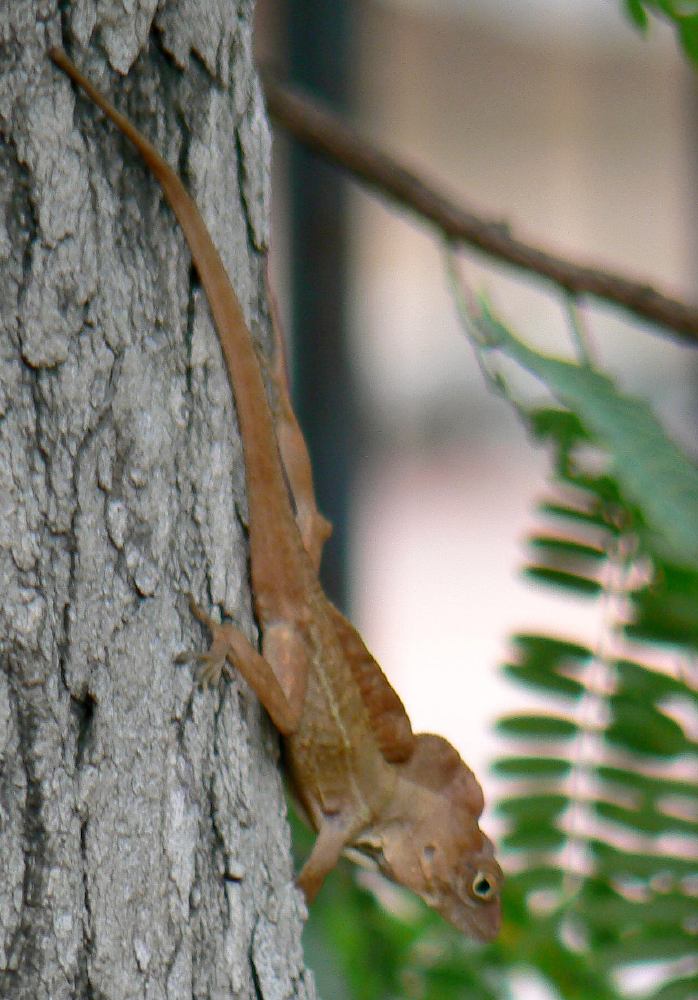
Iguanas · Difficulty: Intermediate
Key facts and care guidance for Puerto Rican crested anole (Anolis cristatellus) (origin: Puerto Rico and the surrounding area (naturalised in Florida and the Dominican Republic); a trunk-ground ecomorph that perches low). Adult size around 10–20.5 cm total length (males SVL up to 7.5 cm, females up to 5.7 cm). Life expectancy approx. 4–7 years in captivity. The values below are carefully researched guidance.
Short answers
Puerto Rican crested anole: How big does the enclosure need to be?
60×60×60 cm for 1 animal, 15% more floor area for each additional animal; floor space and vertical climbing surfaces in equal measure.
Puerto Rican crested anole: What temperature does it need?
Daytime 27–32 °C (top), 24–29 °C at the bottom, basking spot 33–35 °C, at night 20–24 °C.
Puerto Rican crested anole: Does it need UVB lighting?
UVB: UVB needed (Ferguson zone 2–3, UV index 3–4; sun-exposed).
Puerto Rican crested anole: How long do they live?
Life expectancy: approx. 4–7 years in captivity.
Puerto Rican crested anole: Is it suitable for beginners?
Rather not – it is considered an intermediate species (difficulty: Intermediate).
Climate
- Daytime temperature
- 27–32 °C (top), 24–29 °C at the bottom
- Night temperature
- 20–24 °C
- Basking spot
- 33–35 °C
- Humidity
- 60–80 %
- UVB
- UVB needed (Ferguson zone 2–3, UV index 3–4; sun-exposed)
Enclosure
- Minimum size
- 60×60×60 cm for 1 animal, 15% more floor area for each additional animal; floor space and vertical climbing surfaces in equal measure
- Substrate
- Coco humus or forest floor with leaf litter, bark, climbing branches, planting
Feeding
- Food
- Insects: house crickets, crickets, flies, small roaches; calcium and vitamins
- Feeding interval
- adults 3–4×/week, juveniles daily
Key facts
- Adult size
- 10–20.5 cm total length (males SVL up to 7.5 cm, females up to 5.7 cm)
- Life expectancy
- approx. 4–7 years in captivity
- Origin
- Puerto Rico and the surrounding area (naturalised in Florida and the Dominican Republic); a trunk-ground ecomorph that perches low
- Protection status
- No CITES or EU regulation protection; not specially protected.
- Brumation
- No real winter rest; only a slight seasonal variation
- Cohabitation
- Territorial. Keeping them singly is the standard; at most one male plus one female in a large enclosure with visual barriers. NEVER keep males together. Housing several animals together is not recommended.
Notes
A robust, sun-loving trunk-and-ground anole; it needs both floor area and climbing structure. Common mistakes: too little UVB or basking, and overstocking.
Do you keep this species?
Add your animal to Reptoria – Reptoria reminds you about feeding and shedding. Add your animal for free →
Look for Puerto Rican crested anole (Anolis cristatellus) in the marketplace →
Related species
- Ghost anole (Anolis lemurinus) – Intermediate
- Ahl's anole (Anolis ahli) – Intermediate
- Aliniger anole (Anolis aliniger) – Beginner with some knowledge
- Allogus anole (Anolis allogus) – Beginner with some knowledge
- Bahaman green anole (Anolis smaragdinus) – Beginner
- Bahoruco anole (Anolis bahorucoensis) – Beginner with some knowledge
- Baleatus giant anole (Anolis baleatus) – Intermediate
- Baracoa giant anole (Anolis baracoae) – Intermediate
What you need to start
To keep Puerto Rican crested anole (Anolis cristatellus) you typically need: a suitable enclosure (60×60×60 cm for 1 animal, 15% more floor area for each additional animal; floor space and vertical climbing surfaces in equal measure), substrate (Coco humus or forest floor with leaf litter, bark, climbing branches, planting), a heat source with a thermostat, UVB lighting, thermometer and hygrometer, a water dish and hides. You will find equipment in the Reptoria marketplace.
The complete, interactive care database is in the Reptoria app.
Last updated: 9 October 2026 · Editor: Reptoria editorial team · Sources include: animaldiversity.org, Wikipedia EN, eu_annex.txt (lokal, VO (EU) 2026/1383), gutachten.txt (lokal, BML 1997), karibische-anolis.de
All values are non-binding guidance and do not replace expert advice. Research thoroughly from several sources before acquiring and keeping an animal, and observe the applicable law (species and animal protection in particular).