Red-eared slider (Trachemys scripta elegans)
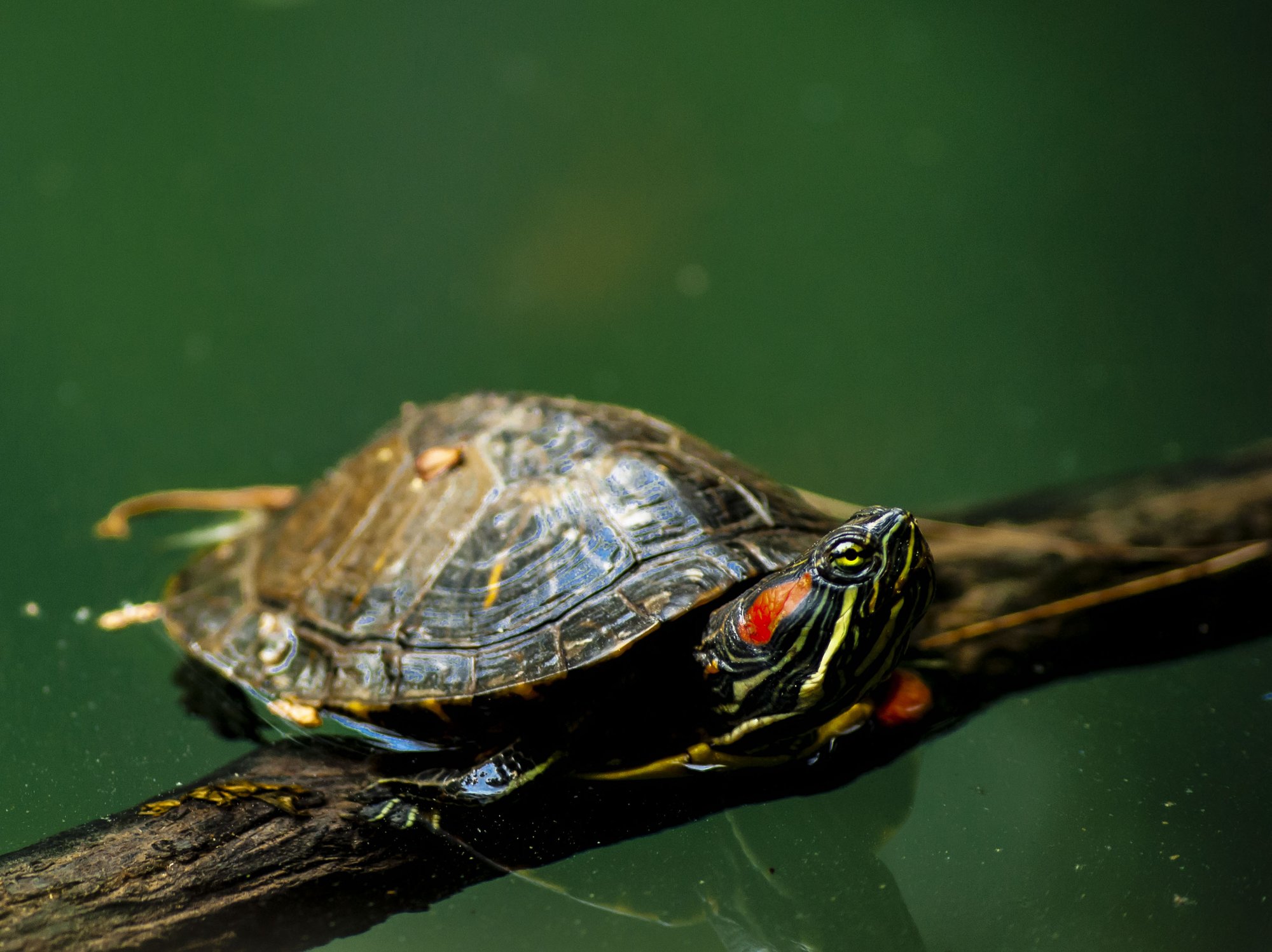
Turtles & tortoises · Difficulty: Beginner to intermediate
Key facts and care guidance for Red-eared slider (Trachemys scripta elegans) (origin: The central and south-eastern USA (the Mississippi valley)). Adult size around females 20–30 cm, males 15–25 cm carapace length. Life expectancy 30–40+ years. The values below are carefully researched guidance.
Short answers
Red-eared slider: How big does the enclosure need to be?
Aqua-terrarium from 150 × 75 cm for a female (1997 expert report: length 5 × shell length, width half the length), water depth 40+ cm; a garden pond is better.
Red-eared slider: What temperature does it need?
Daytime water 24–26 °C, basking spot 35–40 °C (basking spot), at night 18–22 °C.
Red-eared slider: Does it need UVB lighting?
UVB: Essential.
Red-eared slider: How long do they live?
Life expectancy: 30–40+ years.
Red-eared slider: Is it suitable for beginners?
Partly – manageable with some prior knowledge (difficulty: Beginner to intermediate).
Climate
- Daytime temperature
- water 24–26 °C
- Night temperature
- 18–22 °C
- Basking spot
- 35–40 °C (basking spot)
- Humidity
- —
- UVB
- Essential
Enclosure
- Minimum size
- Aqua-terrarium from 150 × 75 cm for a female (1997 expert report: length 5 × shell length, width half the length), water depth 40+ cm; a garden pond is better
- Substrate
- Bare-bottomed or sand; a large dry land section
Feeding
- Food
- Omnivorous: juveniles are carnivorous, adults increasingly plant-eating (water plants)
- Feeding interval
- juveniles daily, adults 2–3×/week
Key facts
- Adult size
- females 20–30 cm, males 15–25 cm carapace length
- Life expectancy
- 30–40+ years
- Origin
- The central and south-eastern USA (the Mississippi valley)
- Protection status
- On the EU list of invasive species (since 3 August 2016): trade, breeding and new acquisitions are prohibited – animals already held may be kept
- Brumation
- Brumation from December to February (4–8 °C)
- Cohabitation
- Keeping them singly is the least stressful option; they do not need company. Groups only work with plenty of space: one male to several females, or females only, and plan for a way to separate them. Two males harass each other and the females; under constant courtship a female visibly loses weight.
Notes
Invasive in the EU – no trade, no breeding, no release. The commonest animal handed in at rescue centres; a large basking spot plus a filter are essential.
Do you keep this species?
Add your animal to Reptoria – Reptoria reminds you about feeding and shedding. Add your animal for free →
Look for Red-eared slider (Trachemys scripta elegans) in the marketplace →
Related species
- Cumberland slider (Trachemys scripta troostii) – Intermediate
- D'Orbigny's slider (Trachemys dorbigni) – Intermediate
- Yellow-bellied slider (Trachemys scripta scripta) – Beginner to intermediate
- Mexican slider (Trachemys cataspila) – Intermediate
- Mesoamerican slider (Trachemys venusta) – Intermediate
- Alabama map turtle (Graptemys pulchra) – Intermediate
- Barbour's map turtle (Graptemys barbouri) – Intermediate
- False map turtle (Graptemys pseudogeographica) – Intermediate
What you need to start
To keep Red-eared slider (Trachemys scripta elegans) you typically need: a suitable enclosure (Aqua-terrarium from 150 × 75 cm for a female (1997 expert report: length 5 × shell length, width half the length), water depth 40+ cm; a garden pond is better), substrate (Bare-bottomed or sand; a large dry land section), a heat source with a thermostat, UVB lighting, thermometer and hygrometer, a water dish and hides. You will find equipment in the Reptoria marketplace.
The complete, interactive care database is in the Reptoria app.
Last updated: 9 October 2026 · Editor: Reptoria editorial team · Sources include: Wikipedia DE, bfn.de, bmleh.de, einrichtungsbeispiele.de, umwelt-online.de
All values are non-binding guidance and do not replace expert advice. Research thoroughly from several sources before acquiring and keeping an animal, and observe the applicable law (species and animal protection in particular).