Red-footed tortoise (Chelonoidis carbonaria)
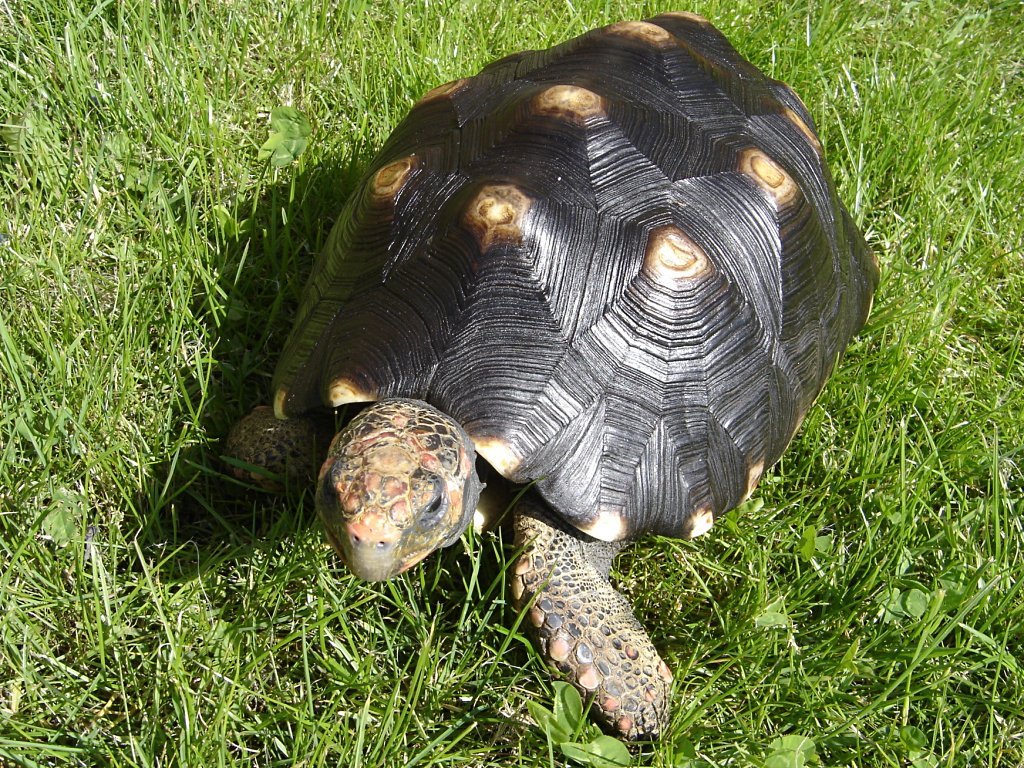
Turtles & tortoises · Difficulty: Intermediate
Key facts and care guidance for Red-footed tortoise (Chelonoidis carbonaria) (origin: Northern and central South America (tropical)). Adult size around 30–40 cm (up to 50 cm). Life expectancy 40–80 years. The values below are carefully researched guidance.
Short answers
Red-footed tortoise: How big does the enclosure need to be?
A heated indoor enclosure or greenhouse, at least 3 m² per adult animal; for a group, the Munich reptile rescue centre gives 15–20 m². In summer, an additional secure outdoor enclosure with a heatable shelter house.
Red-footed tortoise: What temperature does it need?
Daytime 26–30 °C, basking spot 32–36 °C, at night 22–24 °C.
Red-footed tortoise: Does it need UVB lighting?
UVB: Essential.
Red-footed tortoise: How long do they live?
Life expectancy: 40–80 years.
Red-footed tortoise: Is it suitable for beginners?
Rather not – it is considered an intermediate species (difficulty: Intermediate).
Climate
- Daytime temperature
- 26–30 °C
- Night temperature
- 22–24 °C
- Basking spot
- 32–36 °C
- Humidity
- 60–80 % (higher at night; keep juveniles permanently humid)
- UVB
- Essential
Enclosure
- Minimum size
- a heated indoor enclosure or greenhouse, at least 3 m² per adult animal; for a group, the Munich reptile rescue centre gives 15–20 m². In summer, an additional secure outdoor enclosure with a heatable shelter house.
- Substrate
- A damp forest-floor or coco and pine-bark mix with leaf litter
Feeding
- Food
- Omnivorous: wild herbs, vegetables, a fruit share, a little animal food (snails, insects, occasionally wet food)
- Feeding interval
- juveniles daily, adults 3–4×/week mostly plant-based
Key facts
- Adult size
- 30–40 cm (up to 50 cm)
- Life expectancy
- 40–80 years
- Origin
- Northern and central South America (tropical)
- Protection status
- CITES Appendix II / EU Annex B – registration and proof of origin required
- Brumation
- None (a tropical species, warm and active all year)
- Cohabitation
- Groups are possible; a bathing basin is essential. Two males harass each other and the females; under constant courtship a female visibly loses condition. One male to several females, and plan for a way to separate them.
Notes
A tropical species – high humidity and a bathing option are essential, otherwise pyramiding follows. Unlike strict herbivores it needs some animal protein.
Do you keep this species?
Add your animal to Reptoria – Reptoria reminds you about feeding and shedding. Add your animal for free →
Look for Red-footed tortoise (Chelonoidis carbonaria) in the marketplace →
Related species
- Chaco tortoise (Chelonoidis chilensis) – Intermediate
- Yellow-footed tortoise (Chelonoidis denticulata) – Intermediate
- Aldabra giant tortoise (Aldabrachelys gigantea) – Expert
- Asian forest tortoise (Manouria emys) – Intermediate to expert
- Burmese star tortoise (Geochelone platynota) – Intermediate
- Forsten's tortoise (Indotestudo forstenii) – Expert
- Elongated tortoise (Indotestudo elongata) – Intermediate
- Gopher tortoise (Gopherus polyphemus) – Expert
What you need to start
To keep Red-footed tortoise (Chelonoidis carbonaria) you typically need: a suitable enclosure (a heated indoor enclosure or greenhouse, at least 3 m² per adult animal; for a group, the Munich reptile rescue centre gives 15–20 m². In summer, an additional secure outdoor enclosure with a heatable shelter house.), substrate (A damp forest-floor or coco and pine-bark mix with leaf litter), a heat source with a thermostat, UVB lighting, thermometer and hygrometer, a water dish and hides. You will find equipment in the Reptoria marketplace.
The complete, interactive care database is in the Reptoria app.
Last updated: 2 November 2026 · Editor: Reptoria editorial team · Sources include: Wikipedia EN, reptiles.swelluk.com, reptilienauffangstation.de, schildkroeten-schutz.de, Wikipedia: Red-footed tortoise – Inkubation 105–202 Tage (Median 150) – https://en.wikipedia.org/wiki/Red-footed_tortoise
All values are non-binding guidance and do not replace expert advice. Research thoroughly from several sources before acquiring and keeping an animal, and observe the applicable law (species and animal protection in particular).