Yellow-footed tortoise (Chelonoidis denticulata)
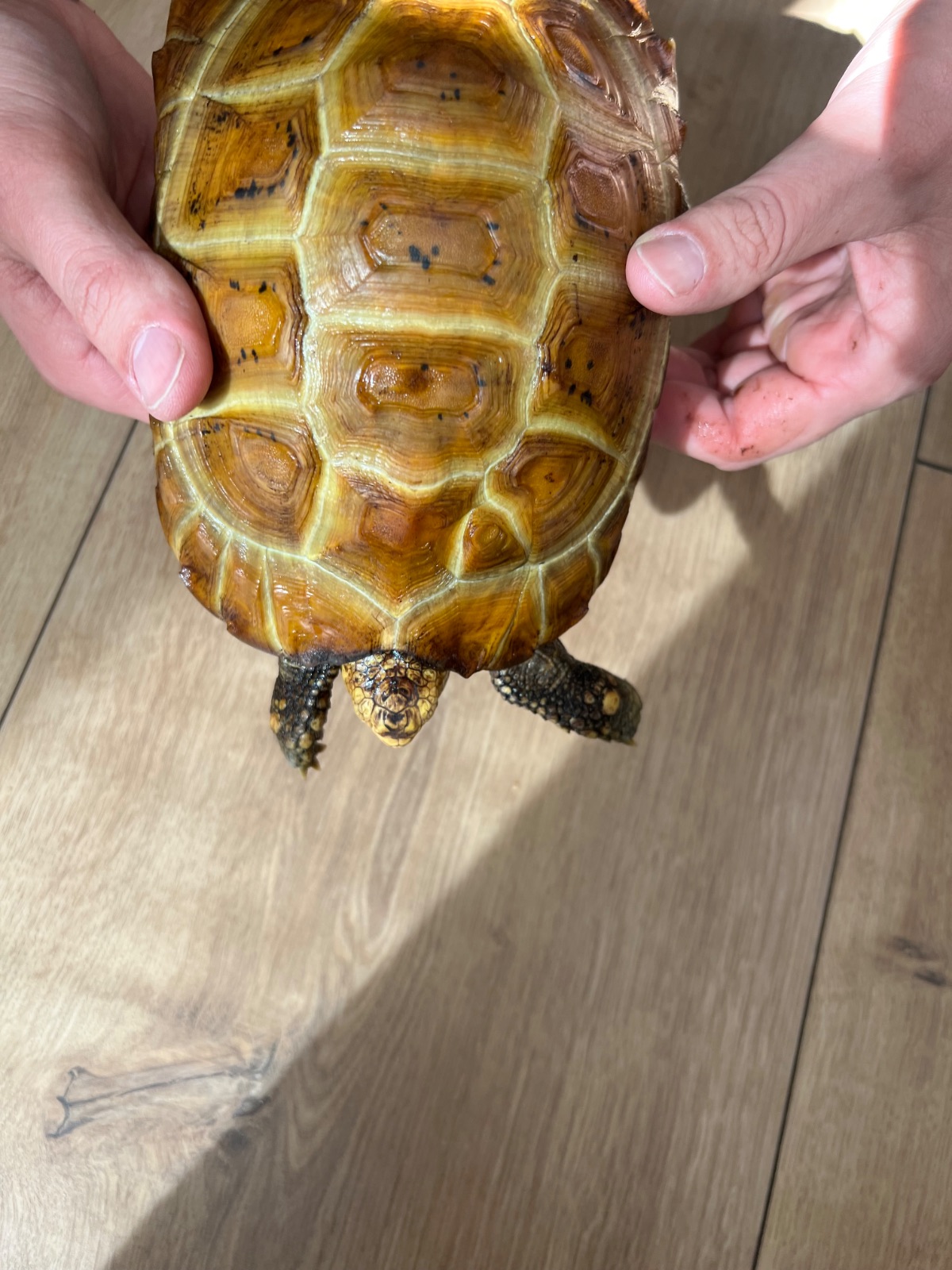
Turtles & tortoises · Difficulty: Intermediate
Key facts and care guidance for Yellow-footed tortoise (Chelonoidis denticulata) (origin: Northern South America, the Amazon rainforest (Brazil, the Guianas, Venezuela, Ecuador, Peru among others)). Adult size around 40–70 cm (regionally variable; usually ~40 cm, large specimens considerably bigger). Life expectancy 50–80 years. The values below are carefully researched guidance.
Short answers
Yellow-footed tortoise: How big does the enclosure need to be?
From 400×200 cm floor space for one animal; for a pair from 460×200 cm (15 % more floor space per additional animal, as in the 1997 expert report).
Yellow-footed tortoise: What temperature does it need?
Daytime 25–30 °C, basking spot 35–38 °C, at night 22–25 °C.
Yellow-footed tortoise: Does it need UVB lighting?
UVB: UVB needed, moderate (a forest species, Ferguson zone 2).
Yellow-footed tortoise: How long do they live?
Life expectancy: 50–80 years.
Yellow-footed tortoise: Is it suitable for beginners?
Rather not – it is considered an intermediate species (difficulty: Intermediate).
Climate
- Daytime temperature
- 25–30 °C
- Night temperature
- 22–25 °C
- Basking spot
- 35–38 °C
- Humidity
- 70–90 % (tropical rainforest)
- UVB
- UVB needed, moderate (a forest species, Ferguson zone 2)
Enclosure
- Minimum size
- from 400×200 cm floor space for one animal; for a pair from 460×200 cm (15 % more floor space per additional animal, as in the 1997 expert report)
- Substrate
- Damp forest floor, coco, leaf litter and bark with hides
Feeding
- Food
- Omnivorous with a plant focus: greens, windfall fruit plus occasional animal food (carrion, snails, insects)
- Feeding interval
- adults plant food 3–4×/week, animal food only rarely
Key facts
- Adult size
- 40–70 cm (regionally variable; usually ~40 cm, large specimens considerably bigger)
- Life expectancy
- 50–80 years
- Origin
- Northern South America, the Amazon rainforest (Brazil, the Guianas, Venezuela, Ecuador, Peru among others)
- Protection status
- CITES Appendix II, EU Regulation Annex B; proof of origin required
- Brumation
- None (tropical, warm and humid all year)
- Cohabitation
- Keep them singly; the males perform ritual fights. One male plus females only with a great deal of space; never two males
Notes
The final size and life expectancy are often underestimated → not a beginner's species. Keepable only with a large, permanently warm and humid heated enclosure or greenhouse.
Do you keep this species?
Add your animal to Reptoria – Reptoria reminds you about feeding and shedding. Add your animal for free →
Look for Yellow-footed tortoise (Chelonoidis denticulata) in the marketplace →
Related species
- Chaco tortoise (Chelonoidis chilensis) – Intermediate
- Red-footed tortoise (Chelonoidis carbonaria) – Intermediate
- Aldabra giant tortoise (Aldabrachelys gigantea) – Expert
- Asian forest tortoise (Manouria emys) – Intermediate to expert
- Burmese star tortoise (Geochelone platynota) – Intermediate
- Forsten's tortoise (Indotestudo forstenii) – Expert
- Elongated tortoise (Indotestudo elongata) – Intermediate
- Gopher tortoise (Gopherus polyphemus) – Expert
What you need to start
To keep Yellow-footed tortoise (Chelonoidis denticulata) you typically need: a suitable enclosure (from 400×200 cm floor space for one animal; for a pair from 460×200 cm (15 % more floor space per additional animal, as in the 1997 expert report)), substrate (Damp forest floor, coco, leaf litter and bark with hides), a heat source with a thermostat, UVB lighting, thermometer and hygrometer, a water dish and hides. You will find equipment in the Reptoria marketplace.
The complete, interactive care database is in the Reptoria app.
Last updated: 30 October 2026 · Editor: Reptoria editorial team · Sources include: https://en.wikipedia.org/wiki/South_American_yellow-footed_tortoise, https://reptile-database.reptarium.cz/species?genus=Chelonoidis&species=denticulata
All values are non-binding guidance and do not replace expert advice. Research thoroughly from several sources before acquiring and keeping an animal, and observe the applicable law (species and animal protection in particular).