Regal jumping spider (Phidippus regius)
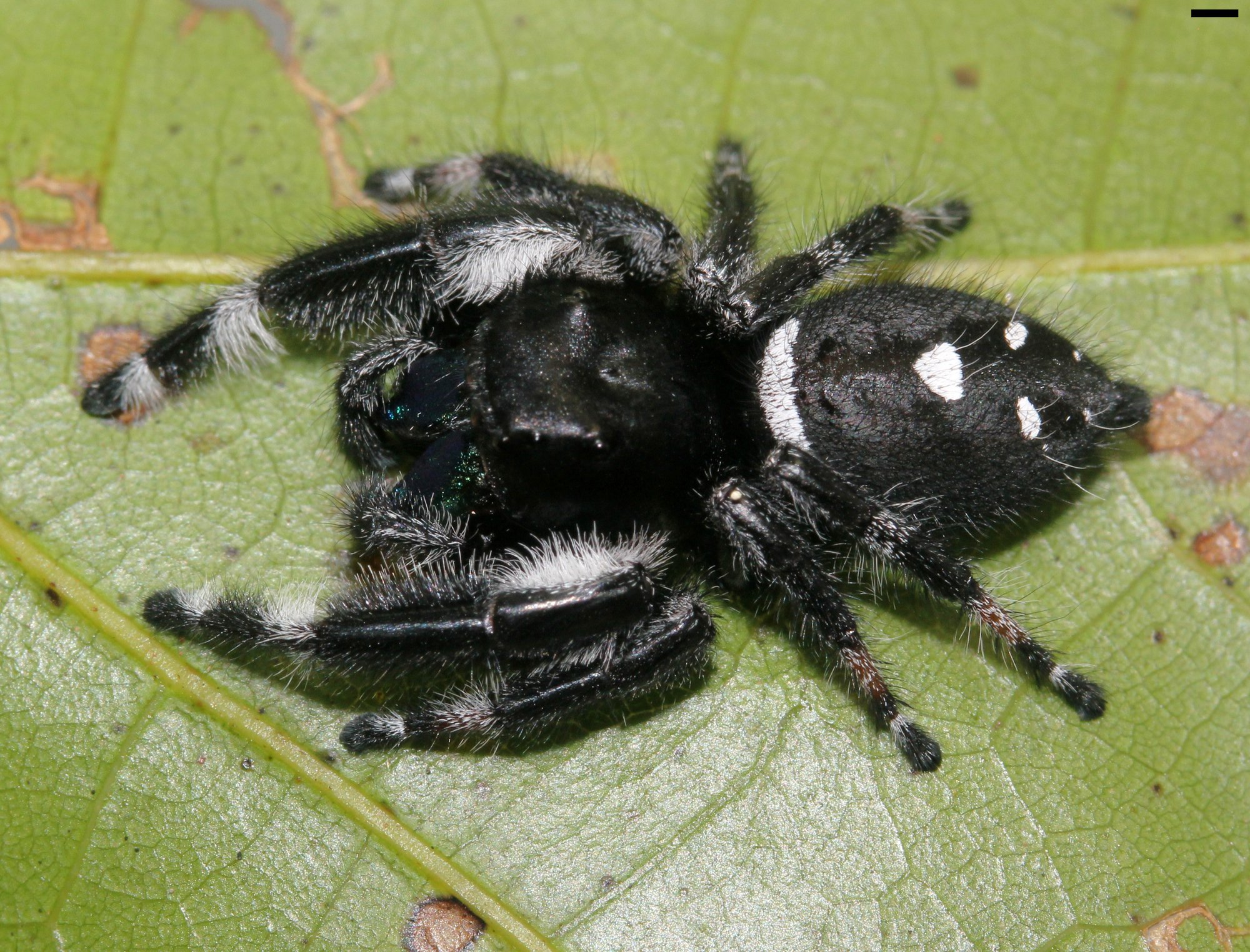
Invertebrates · Difficulty: Beginner
Key facts and care guidance for Regal jumping spider (Phidippus regius) (origin: The south-east of the USA, Cuba, the Bahamas, the West Indies; several local forms (the Bahamas, Florida, Soroa, Apalachicola)). Adult size around females approx. 15–22 mm, males approx. 12–18 mm body length (one of the largest jumping spiders). Life expectancy females approx. 1.5–2 years, males approx. 1 year (after the maturing moult). The values below are carefully researched guidance.
Short answers
Regal jumping spider: How big does the enclosure need to be?
At least 20×20×30 cm (tall, well ventilated) — more height is welcome.
Regal jumping spider: What temperature does it need?
Daytime 24–28 °C (gradient: ~28–30 °C at the top, ~23–25 °C at the bottom), at night 20–23 °C.
Regal jumping spider: Does it need UVB lighting?
UVB: No UVB needed; bright daytime lighting (daylight spectrum) recommended.
Regal jumping spider: How long do they live?
Life expectancy: females approx. 1.5–2 years, males approx. 1 year (after the maturing moult).
Regal jumping spider: Is it suitable for beginners?
Yes – it is considered suitable for beginners (difficulty: Beginner).
Climate
- Daytime temperature
- 24–28 °C (gradient: ~28–30 °C at the top, ~23–25 °C at the bottom)
- Night temperature
- 20–23 °C
- Basking spot
- —
- Humidity
- 50–70 %
- UVB
- No UVB needed; bright daytime lighting (daylight spectrum) recommended
Enclosure
- Minimum size
- at least 20×20×30 cm (tall, well ventilated) — more height is welcome
- Substrate
- Coco humus or potting soil, possibly with sphagnum; slightly damp on one side, plenty of climbing and hiding structure above
Feeding
- Food
- Fruit flies, micro crickets, small flies; as adults house flies, small house crickets and roaches (suitably sized)
- Feeding interval
- adults 2–3×/week, juveniles daily to every other day
Key facts
- Adult size
- females approx. 15–22 mm, males approx. 12–18 mm body length (one of the largest jumping spiders)
- Life expectancy
- females approx. 1.5–2 years, males approx. 1 year (after the maturing moult)
- Origin
- The south-east of the USA, Cuba, the Bahamas, the West Indies; several local forms (the Bahamas, Florida, Soroa, Apalachicola)
- Protection status
- No CITES or German protection; mostly available captive-bred
- Brumation
- None
- Cohabitation
- Keep them singly. Solitary and territorial, with pronounced cannibalism – put them together only briefly for supervised breeding. No permanent pairs or groups.
Notes
An ideal beginner's jumping spider: robust, large, curious and easy to handle (never grab it, just let it walk onto your hand). Do not disturb or feed it before or after a moult (it makes a resting cocoon high in the terrarium) – the moult takes a few days. Good ventilation matters against mould.
Do you keep this species?
Add your animal to Reptoria – Reptoria reminds you about feeding and shedding. Add your animal for free →
Look for Regal jumping spider (Phidippus regius) in the marketplace →
Related species
- Canopy jumping spider (Phidippus otiosus) – Beginner
- Bold jumping spider (Phidippus audax) – Beginner
- Red-backed jumping spider (Phidippus johnsoni) – Beginner
- Algerian jumping spider (Cyrba algerina) – Intermediate
- Arched jumping spider (Evarcha arcuata) – Intermediate
- Bronze jumping spider (Hyllus semicupreus) – Beginner
- Peacock jumping spider (Saitis barbipes) – Intermediate
- Diard's jumping spider (Hyllus diardi) – Beginner
What you need to start
To keep Regal jumping spider (Phidippus regius) you typically need: a suitable enclosure (at least 20×20×30 cm (tall, well ventilated) — more height is welcome), substrate (Coco humus or potting soil, possibly with sphagnum; slightly damp on one side, plenty of climbing and hiding structure above), a heat source with a thermostat, UVB lighting, thermometer and hygrometer, a water dish and hides. You will find equipment in the Reptoria marketplace.
The complete, interactive care database is in the Reptoria app.
Last updated: 9 October 2026 · Editor: Reptoria editorial team · Sources include: Wikipedia EN, drta-archiv.de, einrichtungsbeispiele.de, exotische-tierwelt.de
All values are non-binding guidance and do not replace expert advice. Research thoroughly from several sources before acquiring and keeping an animal, and observe the applicable law (species and animal protection in particular).