Robinson's angle-headed lizard (Gonocephalus robinsonii)
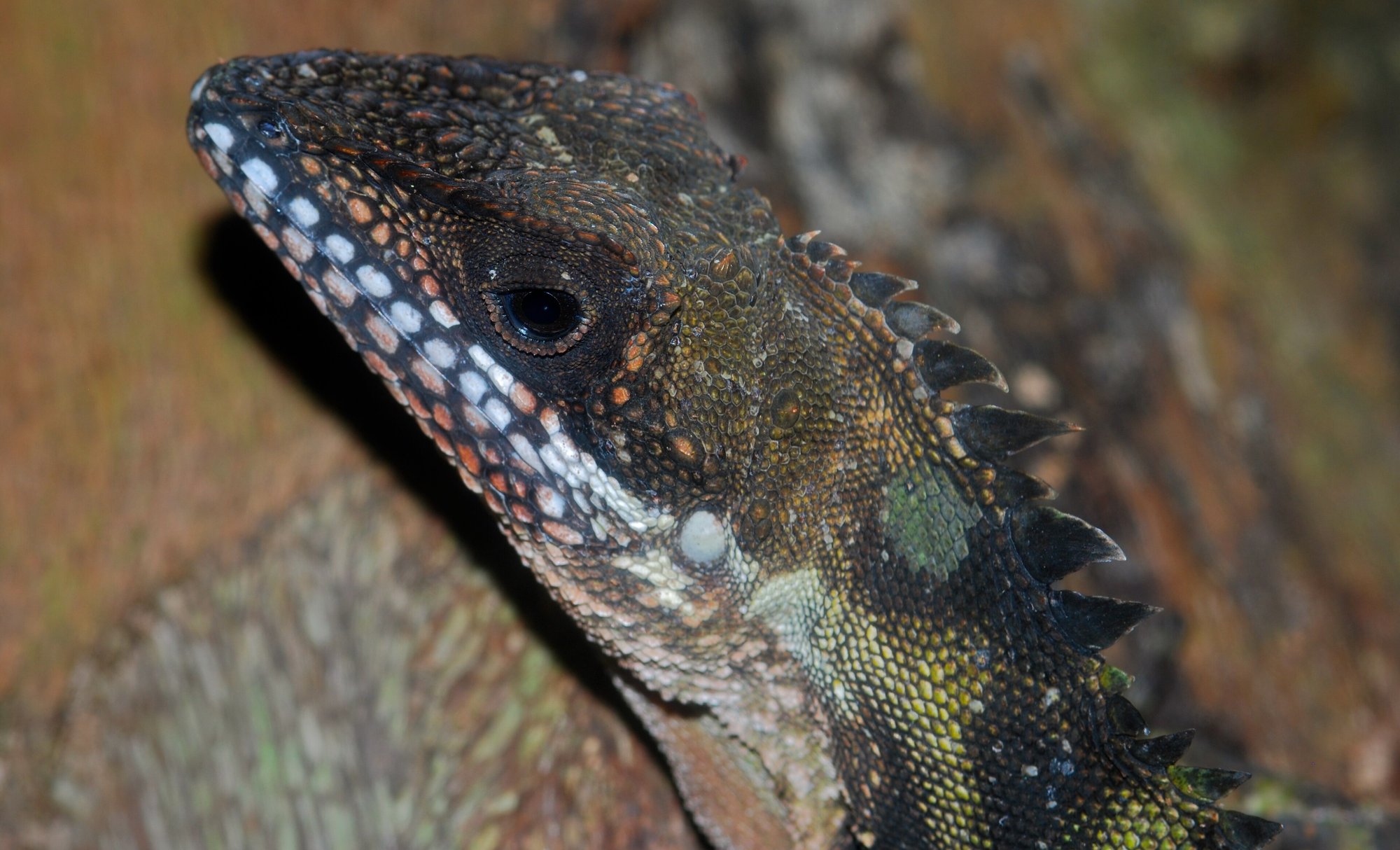
Agamas · Difficulty: Expert
Key facts and care guidance for Robinson's angle-headed lizard (Gonocephalus robinsonii) (origin: Western Malaysia (montane forest 600–1,600 m), endemic). Adult size around approx. 25–35 cm including the tail (an estimate). Life expectancy uncertain, estimated at 6–10 years. The values below are carefully researched guidance.
Short answers
Robinson's angle-headed lizard: How big does the enclosure need to be?
80×60×120 cm (arboreal, tall).
Robinson's angle-headed lizard: What temperature does it need?
Daytime 23–28 °C, basking spot — (thermoconformer, no strong basking spot; spot-sized ~28–30 °C), at night 18–20 °C.
Robinson's angle-headed lizard: Does it need UVB lighting?
UVB: UVB recommended (Ferguson zone 1–2, UV index 1–3; the shaded light of a montane forest).
Robinson's angle-headed lizard: How long do they live?
Life expectancy: uncertain, estimated at 6–10 years.
Robinson's angle-headed lizard: Is it suitable for beginners?
No – better suited to experienced keepers (difficulty: Expert).
Climate
- Daytime temperature
- 23–28 °C
- Night temperature
- 18–20 °C
- Basking spot
- — (thermoconformer, no strong basking spot; spot-sized ~28–30 °C)
- Humidity
- 75–90 %
- UVB
- UVB recommended (Ferguson zone 1–2, UV index 1–3; the shaded light of a montane forest)
Enclosure
- Minimum size
- 80×60×120 cm (arboreal, tall)
- Substrate
- Forest floor or coco humus with moss and leaf litter, permanently damp
Feeding
- Food
- Insects (crickets, house crickets, roaches, locusts)
- Feeding interval
- adults 2–3×/week, juveniles daily
Key facts
- Adult size
- approx. 25–35 cm including the tail (an estimate)
- Life expectancy
- uncertain, estimated at 6–10 years
- Origin
- Western Malaysia (montane forest 600–1,600 m), endemic
- Protection status
- No CITES; proof of origin recommended. Taxonomically it is now usually treated as Malayodracon robinsonii (its own genus)
- Brumation
- None as such; a slight seasonal drop is possible as a climate simulation
- Cohabitation
- Keep them singly. A pair (1.1) only in a large, structured enclosure with visual barriers; never keep males together (territorial)
Notes
A montane species – keep it cooler and less hot than the lowland forest dragons; heat above 30 °C is critical. Very rare in captivity, and the figures are derived from the genus and its origin. Moving drinking water (mist or droplets).
Do you keep this species?
Add your animal to Reptoria – Reptoria reminds you about feeding and shedding. Add your animal for free →
Look for Robinson's angle-headed lizard (Gonocephalus robinsonii) in the marketplace →
Related species
- Bell's angle-headed dragon (Gonocephalus bellii) – Intermediate to expert
- Borneo angle-headed lizard (Gonocephalus bornensis) – Expert
- Chameleon angle-headed lizard (Gonocephalus chamaeleontinus) – Expert
- Doria's angle-headed lizard (Gonocephalus doriae) – Intermediate
- Great angle-headed lizard (Gonocephalus grandis) – Expert
- Kuhl's angle-headed lizard (Gonocephalus kuhlii) – Expert
- Blue-eyed angle-headed lizard (Gonocephalus liogaster) – Intermediate
- Large-scaled angle-headed lizard (Gonocephalus megalepis) – Expert
What you need to start
To keep Robinson's angle-headed lizard (Gonocephalus robinsonii) you typically need: a suitable enclosure (80×60×120 cm (arboreal, tall)), substrate (Forest floor or coco humus with moss and leaf litter, permanently damp), a heat source with a thermostat, UVB lighting, thermometer and hygrometer, a water dish and hides. You will find equipment in the Reptoria marketplace.
The complete, interactive care database is in the Reptoria app.
Last updated: 9 October 2026 · Editor: Reptoria editorial team · Sources include: https://en.wikipedia.org/wiki/Gonocephalus_liogaster, https://en.wikipedia.org/wiki/Malayodracon_robinsonii
All values are non-binding guidance and do not replace expert advice. Research thoroughly from several sources before acquiring and keeping an animal, and observe the applicable law (species and animal protection in particular).