Rosy boa (Lichanura trivirgata)
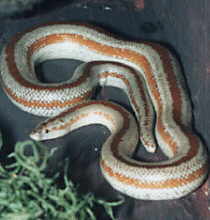
Snakes · Difficulty: Beginner
Key facts and care guidance for Rosy boa (Lichanura trivirgata) (origin: The south-west of the USA, Baja California and north-western Mexico (deserts and semi-deserts)). Adult size around 60–90 cm (a small, powerful constrictor). Life expectancy 18–25+ years (record ~30). The values below are carefully researched guidance.
Short answers
Rosy boa: How big does the enclosure need to be?
From 120×50×70 cm (minimum size according to the 1997 expert report, rosy boas); ground-dwelling.
Rosy boa: What temperature does it need?
Daytime 28–32 °C, basking spot 32 °C, at night 20–22 °C.
Rosy boa: Does it need UVB lighting?
UVB: UVB not essential, weak UVB (Ferguson zone 1–2) recommended.
Rosy boa: How long do they live?
Life expectancy: 18–25+ years (record ~30).
Rosy boa: Is it suitable for beginners?
Yes – it is considered suitable for beginners (difficulty: Beginner).
Climate
- Daytime temperature
- 28–32 °C
- Night temperature
- 20–22 °C
- Basking spot
- 32 °C
- Humidity
- 40–60 % (dry, desert species)
- UVB
- UVB not essential, weak UVB (Ferguson zone 1–2) recommended
Enclosure
- Minimum size
- from 120×50×70 cm (minimum size according to the 1997 expert report, rosy boas); ground-dwelling
- Substrate
- A sand and soil mix (dry), hides of cork bark and stones
Feeding
- Food
- Frozen mice of a suitable size
- Feeding interval
- adults every 7–14 days (do not overfeed), juveniles weekly
Key facts
- Adult size
- 60–90 cm (a small, powerful constrictor)
- Life expectancy
- 18–25+ years (record ~30)
- Origin
- The south-west of the USA, Baja California and north-western Mexico (deserts and semi-deserts)
- Protection status
- Protected: CITES Appendix II, EU Annex B - proof of origin required at purchase and resale. Predominantly captive-bred - local collecting regulations apply in California (trade is mostly captive-bred).
- Brumation
- Recommended – a winter rest or brumation of about 2–3 months at ~10–13 °C (for health and breeding; two weeks without food beforehand to empty the gut)
- Cohabitation
- Keep them singly – solitary; put them together only for supervised breeding, and never keep males together
Notes
A quiet, robust beginner's boa. Important: dry conditions, avoid low floor temperatures, and do not overfeed (a tendency to obesity). "Rosenboa" is the German-language trade name for the rosy boa.
Do you keep this species?
Add your animal to Reptoria – Reptoria reminds you about feeding and shedding. Add your animal for free →
Look for Rosy boa (Lichanura trivirgata) in the marketplace →
Related species
- Amazon tree boa (Corallus batesii) – Expert
- Argentine boa (Boa constrictor occidentalis) – Intermediate
- True red-tailed boa – Guyana (Boa constrictor constrictor) – Intermediate
- True red-tailed boa – Peru (Boa constrictor constrictor) – Intermediate
- True red-tailed boa – Suriname (Boa constrictor constrictor) – Intermediate
- True red-tailed boa (Boa constrictor constrictor) – Intermediate
- Bibron's bevel-nosed boa (Candoia bibroni) – Intermediate
- Amazon tree boa (Corallus hortulanus) – Intermediate
What you need to start
To keep Rosy boa (Lichanura trivirgata) you typically need: a suitable enclosure (from 120×50×70 cm (minimum size according to the 1997 expert report, rosy boas); ground-dwelling), substrate (A sand and soil mix (dry), hides of cork bark and stones), a heat source with a thermostat, UVB lighting, thermometer and hygrometer, a water dish and hides. You will find equipment in the Reptoria marketplace.
The complete, interactive care database is in the Reptoria app.
Last updated: 2 November 2026 · Editor: Reptoria editorial team · Sources include: https://en.wikipedia.org/wiki/Desert_rosy_boa, https://reptile-database.reptarium.cz/species?genus=Lichanura&species=trivirgata, https://reptilesmagazine.com/rosy-boa-care-sheet/, https://www.zillarules.com/information/care-sheets/rosy-boa
All values are non-binding guidance and do not replace expert advice. Research thoroughly from several sources before acquiring and keeping an animal, and observe the applicable law (species and animal protection in particular).