Rough woodlouse (Porcellio scaber)
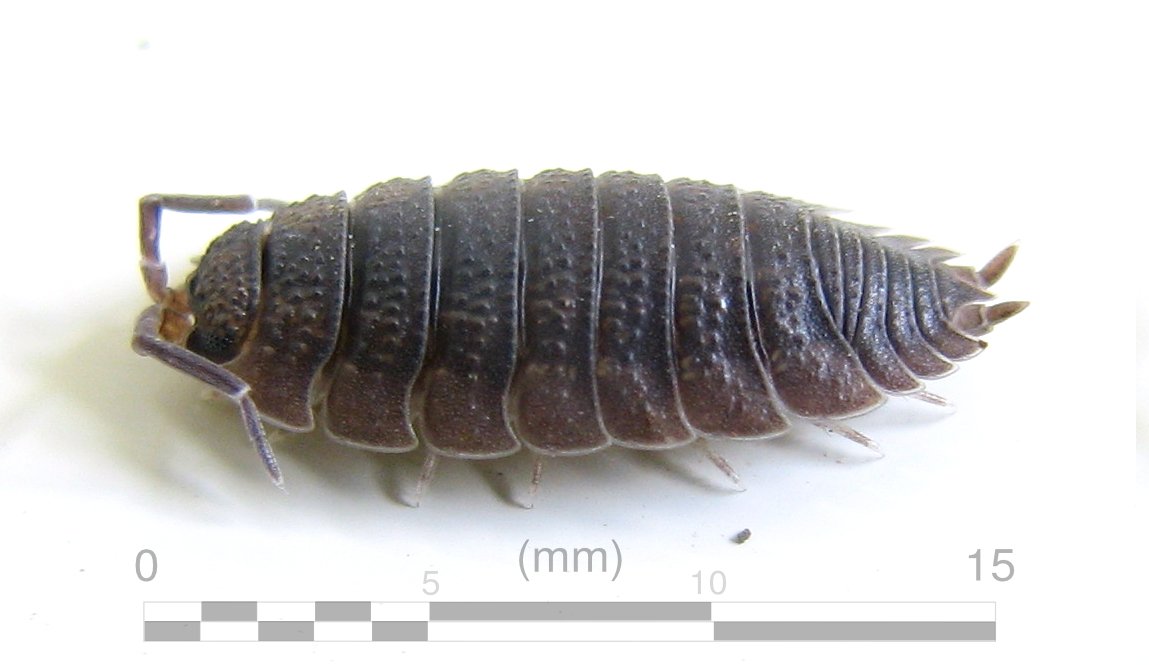
Invertebrates · Difficulty: Beginner
Key facts and care guidance for Rough woodlouse (Porcellio scaber) (origin: Europe, introduced worldwide). Adult size around approx. 1.0–1.8 cm. Life expectancy approx. 2–3 years (up to ~4). The values below are carefully researched guidance.
Short answers
Rough woodlouse: How big does the enclosure need to be?
A box from 20×15×15 cm for a starter colony; a colony animal.
Rough woodlouse: What temperature does it need?
Daytime 18–24 °C, at night 12–20 °C.
Rough woodlouse: Does it need UVB lighting?
UVB: No UVB needed.
Rough woodlouse: How long do they live?
Life expectancy: approx. 2–3 years (up to ~4).
Rough woodlouse: Is it suitable for beginners?
Yes – it is considered suitable for beginners (difficulty: Beginner).
Climate
- Daytime temperature
- 18–24 °C
- Night temperature
- 12–20 °C
- Basking spot
- —
- Humidity
- 65–80 % (humid, with drier zones)
- UVB
- No UVB needed
Enclosure
- Minimum size
- a box from 20×15×15 cm for a starter colony; a colony animal
- Substrate
- Forest humus or coco with sphagnum, leaf litter, rotten wood and bark; damp but well ventilated, never drying out completely
Feeding
- Food
- Fallen leaves, bark, rotten wood, fungi, vegetables; protein and calcium
- Feeding interval
- protein and vegetables 1–2×/week, leaf litter and wood always available
Key facts
- Adult size
- approx. 1.0–1.8 cm
- Life expectancy
- approx. 2–3 years (up to ~4)
- Origin
- Europe, introduced worldwide
- Protection status
- Not protected (no CITES, no German Federal Nature Conservation Act listing)
- Brumation
- None (a native species; a cooler overwintering is possible but not essential)
- Cohabitation
- Colony. The animals naturally form dense aggregations and are kept as a group – 10 to 20 animals to start. Only one species and one colour morph per tub: morphs interbreed back within two to three generations, and as a very prolific species it crowds out slower isopods.
Notes
The classic clean-up and feeder isopod for bioactive terrariums; crepuscular and nocturnal, very robust and undemanding. Numerous cultivated colour forms (orange, dalmatian, koi). A gill breather – it needs permanently damp areas.
Do you keep this species?
Add your animal to Reptoria – Reptoria reminds you about feeding and shedding. Add your animal for free →
Look for Rough woodlouse (Porcellio scaber) in the marketplace →
Related species
- Giant canyon isopod (Porcellio dilatatus) – Beginner
- Dairy cow isopod (Porcellio laevis) – Beginner
- Bolivar's isopod (Porcellio bolivari) – Intermediate
- Giant Spanish isopod (Porcellio expansus) – Beginner to intermediate
- Yellow-bordered woodlouse (Porcellio flavomarginatus) – Beginner
- Porcellio haasi isopod (Porcellio haasi) – Beginner to intermediate
- Orange isopod (Porcellio ornatus) – Beginner to intermediate
- Porcellio succinctus isopod (Porcellio succinctus) – Intermediate
What you need to start
To keep Rough woodlouse (Porcellio scaber) you typically need: a suitable enclosure (a box from 20×15×15 cm for a starter colony; a colony animal), substrate (Forest humus or coco with sphagnum, leaf litter, rotten wood and bark; damp but well ventilated, never drying out completely), a heat source with a thermostat, UVB lighting, thermometer and hygrometer, a water dish and hides. You will find equipment in the Reptoria marketplace.
The complete, interactive care database is in the Reptoria app.
Last updated: 9 October 2026 · Editor: Reptoria editorial team · Sources include: https://animaldiversity.org/accounts/Porcellio_scaber/, https://en.wikipedia.org/wiki/Invertebrate_iridescent_virus_31, https://en.wikipedia.org/wiki/Porcellio_scaber, https://postpods.co.uk/blogs/isopods-useful-articles/keeping-different-isopods-together, https://postpods.co.uk/blogs/isopods-useful-articles/porcellio-scaber-isopods
All values are non-binding guidance and do not replace expert advice. Research thoroughly from several sources before acquiring and keeping an animal, and observe the applicable law (species and animal protection in particular).