Savigny's agama (Trapelus savignii)
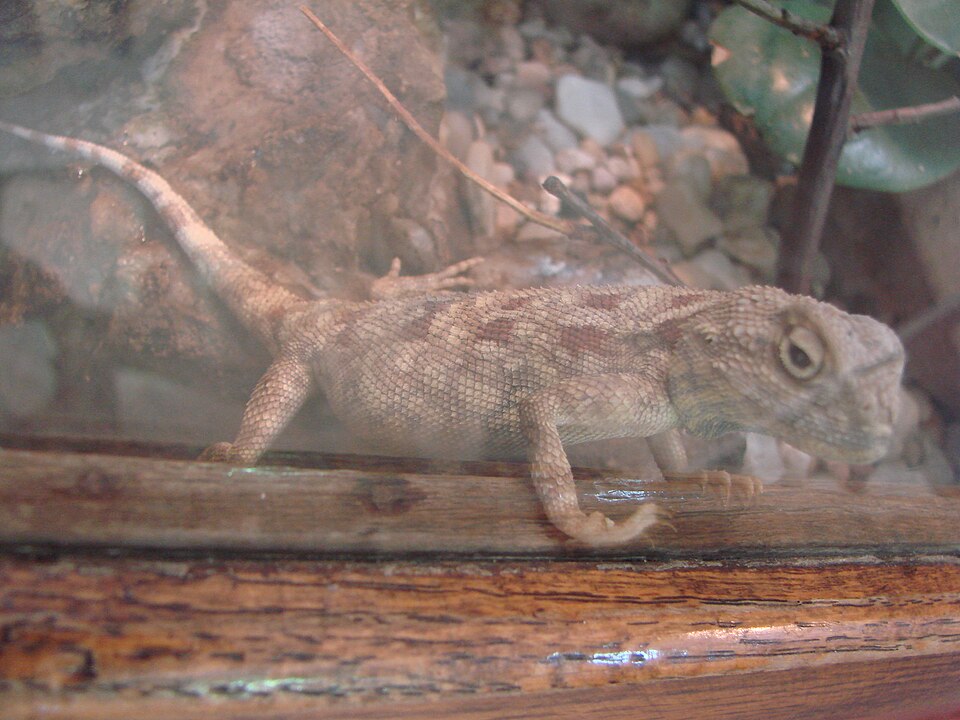
Agamas
Key facts and care guidance for Savigny's agama (Trapelus savignii) (origin: North-eastern Egypt (northern Eastern Desert, eastern edge of the Nile Delta), northern Sinai, western Negev in Israel and the Gaza Strip – lowland up to about 200 m; sand and gravel desert, stabilised valleys between dunes, steppe-like areas with vegetation cover). The values below are carefully researched guidance.
Enclosure
- Minimum size
- from 65×50×40 cm for one animal or a pair (the 1997 expert report does not list Trapelus; factor of the ground-dwelling agamas 5×4×3 of the snout–vent length at 12.3 cm SVL); for groups about 15 % more floor space, from 75×50×40 cm
Key facts
- Origin
- North-eastern Egypt (northern Eastern Desert, eastern edge of the Nile Delta), northern Sinai, western Negev in Israel and the Gaza Strip – lowland up to about 200 m; sand and gravel desert, stabilised valleys between dunes, steppe-like areas with vegetation cover
- Protection status
- Not listed under CITES
Notes
There is no species-specific husbandry information for this species so far – temperature, lighting, food and setup are therefore left empty. Please ask experienced keepers or consult specialist literature. Listed as Near Threatened on the IUCN Red List (2025 assessment); its habitat is shrinking sharply.
Do you keep this species?
Add your animal to Reptoria – Reptoria reminds you about feeding and shedding. Add your animal for free →
Savigny's agama (Trapelus savignii) currently offered
- Ägyptische Blaukehlagame – Wild Farbe · Taching am See · 50 €
Related species
- Steppe agama (Trapelus mutabilis) – Intermediate
- Steppe agama (Trapelus sanguinolentus) – Intermediate
- Pale agama (Trapelus pallidus) – Intermediate
- Oriental garden lizard (Calotes versicolor) – Intermediate
- Spotted butterfly lizard (Leiolepis guttata) – Intermediate
- Painted dragon (Ctenophorus pictus) – Intermediate
- Common flying dragon (Draco volans) – Expert
- Green crested lizard (Bronchocela cristatella) – Intermediate
What you need to start
To keep Savigny's agama (Trapelus savignii) you typically need: a suitable enclosure (from 65×50×40 cm for one animal or a pair (the 1997 expert report does not list Trapelus; factor of the ground-dwelling agamas 5×4×3 of the snout–vent length at 12.3 cm SVL); for groups about 15 % more floor space, from 75×50×40 cm), substrate, a heat source with a thermostat, thermometer and hygrometer, a water dish and hides. You will find equipment in the Reptoria marketplace.
The complete, interactive care database is in the Reptoria app.
Last updated: 15 November 2026 · Editor: Reptoria editorial team · Sources include: IUCN-Artzusammenfassung Trapelus savignii (2006, IUCN Mittelmeer) – Negev, Gaza, Nordsinai bis Nildelta, bis ca. 200 m; Sand-/Kieswüste, Dünentäler, Steppe mit Pflanzendeckung, nicht felsig; eierlegend; CITES nicht gelistet; Gefährdung durch Lebensraumverlust und Heimtierhandel – https://www.uicnmed.org/web2007/cd_rep_amp/materials/reptile_summery/trapelus_savignii.pdf, Reptile Database: Trapelus savignii (Duméril & Bibron 1837) – Ägypten inkl. Sinai, Israel; Neotypus El Arish (Wagner & Crochet 2009); KRL max. 123 mm (Anderson 1898); eierlegend; IUCN VU – https://reptile-database.reptarium.cz/species?genus=Trapelus&species=savignii, Wikipedia EN: Savigny's agama – fast endemisch in Ägypten, Nordsinai, westlicher Negev, Gaza; Sand- und Kieswüsten, Täler zwischen Dünen, Pflanzendeckung; KRL max. 12,3 cm; Männchen mit blauer Kehle; IUCN 2025 NT – https://en.wikipedia.org/wiki/Savigny%27s_agama, VO (EU) 2026/1383, Anhänge der VO (EG) 338/97; CITES-Anhänge, Gutachten 1997: Trapelus nicht genannt; Faktor bodenbewohnende Agamen (Pogona/Uromastyx) 5×4×3 der KRL; bei 12,3 cm ≈ 62×49×37 cm
All values are non-binding guidance and do not replace expert advice. Research thoroughly from several sources before acquiring and keeping an animal, and observe the applicable law (species and animal protection in particular).