Sawtail lizard (Holaspis guentheri)
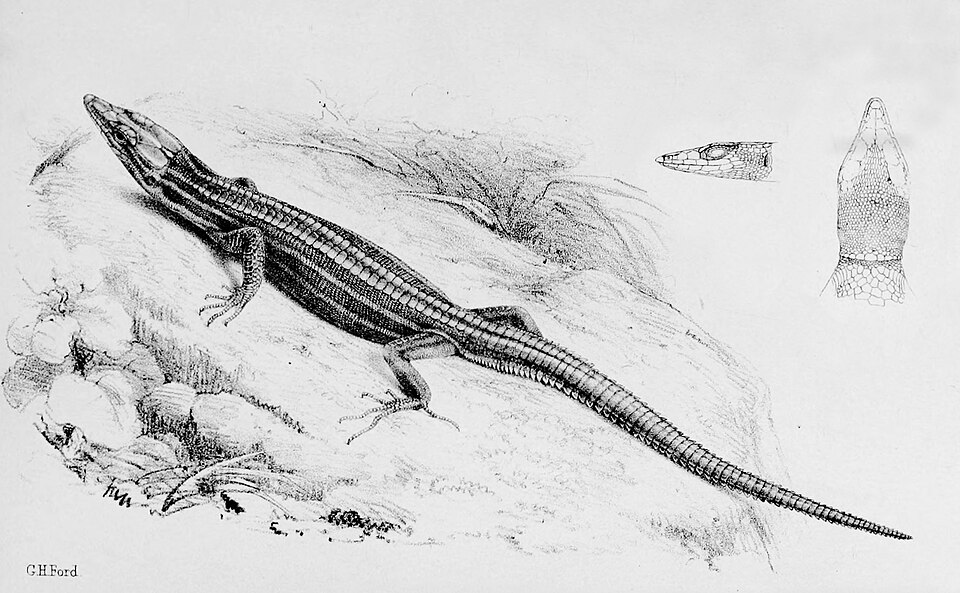
Lizards · Difficulty: Intermediate
Key facts and care guidance for Sawtail lizard (Holaspis guentheri) (origin: West and Central Africa, from Sierra Leone through Ghana and Nigeria to Tanzania, Mozambique and Angola). Adult size around 12–15 cm total length (snout-vent about 6 cm). Life expectancy 7–8 years. The values below are carefully researched guidance.
Short answers
Sawtail lizard: How big does the enclosure need to be?
60×40×50 cm.
Sawtail lizard: What temperature does it need?
Daytime 26–30 °C, basking spot 33–35 °C at the basking spot, at night 18–22 °C.
Sawtail lizard: Does it need UVB lighting?
UVB: Recommended (UVB 5.0).
Sawtail lizard: How long do they live?
Life expectancy: 7–8 years.
Sawtail lizard: Is it suitable for beginners?
Rather not – it is considered an intermediate species (difficulty: Intermediate).
Climate
- Daytime temperature
- 26–30 °C
- Night temperature
- 18–22 °C
- Basking spot
- 33–35 °C at the basking spot
- Humidity
- 60–80 %
- UVB
- Recommended (UVB 5.0)
Enclosure
- Minimum size
- 60×40×50 cm
- Substrate
- Sand-soil mixture, at least 5 cm deep, with moss and pieces of bark; cork tubes and branches for climbing
Feeding
- Food
- Small insects up to about 1 cm: crickets, house crickets, roaches, flies, Drosophila, aphids, small stick insects, occasionally a small mealworm; predominantly ants in the wild
- Feeding interval
- Adults 2–3× per week, juveniles more often; all feeder insects under 1 cm and regularly dusted with mineral powder.
Key facts
- Adult size
- 12–15 cm total length (snout-vent about 6 cm)
- Life expectancy
- 7–8 years
- Origin
- West and Central Africa, from Sierra Leone through Ghana and Nigeria to Tanzania, Mozambique and Angola
- Protection status
- Not listed under CITES
- Brumation
- No winter rest
- Cohabitation
- Pair (1.1), in large and densely structured enclosures also 1.2 or 1.3. The reason: several females become aggressive towards each other over egg-laying, which can only be managed with many separate laying and basking spots. Always keep males separate.
Notes
The species glides up to half a metre from branch to branch — height and plenty of horizontal and vertical climbing routes are worth far more here than floor space. The size given is the calculated minimum from the source, which explicitly recommends considerably more. Second point: these lizards can flatten themselves extremely and slip through gaps as narrow as 2 mm — the enclosure must be completely sealed.
Do you keep this species?
Add your animal to Reptoria – Reptoria reminds you about feeding and shedding. Add your animal for free →
Look for Sawtail lizard (Holaspis guentheri) in the marketplace →
Related species
- Erhard's wall lizard (Podarcis erhardii) – Beginner to intermediate
- Large psammodromus (Psammodromus algirus) – Intermediate
- Pamphylian green lizard (Lacerta pamphylica) – Intermediate
- Lilford's wall lizard (Podarcis lilfordi) – Expert
- Balkan green lizard (Lacerta trilineata) – Intermediate
- Bosk's fringe-fingered lizard (Acanthodactylus boskianus) – Intermediate
- Spiny-footed lizard (Acanthodactylus erythrurus) – Intermediate
- Gran Canaria giant lizard (Gallotia stehlini) – Intermediate
What you need to start
To keep Sawtail lizard (Holaspis guentheri) you typically need: a suitable enclosure (60×40×50 cm), substrate (Sand-soil mixture, at least 5 cm deep, with moss and pieces of bark; cork tubes and branches for climbing), a heat source with a thermostat, UVB lighting, thermometer and hygrometer, a water dish and hides. You will find equipment in the Reptoria marketplace.
The complete, interactive care database is in the Reptoria app.
Last updated: 30 October 2026 · Editor: Reptoria editorial team · Sources include: Wikipedia EN, reptile-database.reptarium.cz, dahmstierleben.de, eu_annex.txt (lokal), gutachten.txt (BML 1997, lokal)
All values are non-binding guidance and do not replace expert advice. Research thoroughly from several sources before acquiring and keeping an animal, and observe the applicable law (species and animal protection in particular).