Senegal chameleon (Chamaeleo senegalensis)
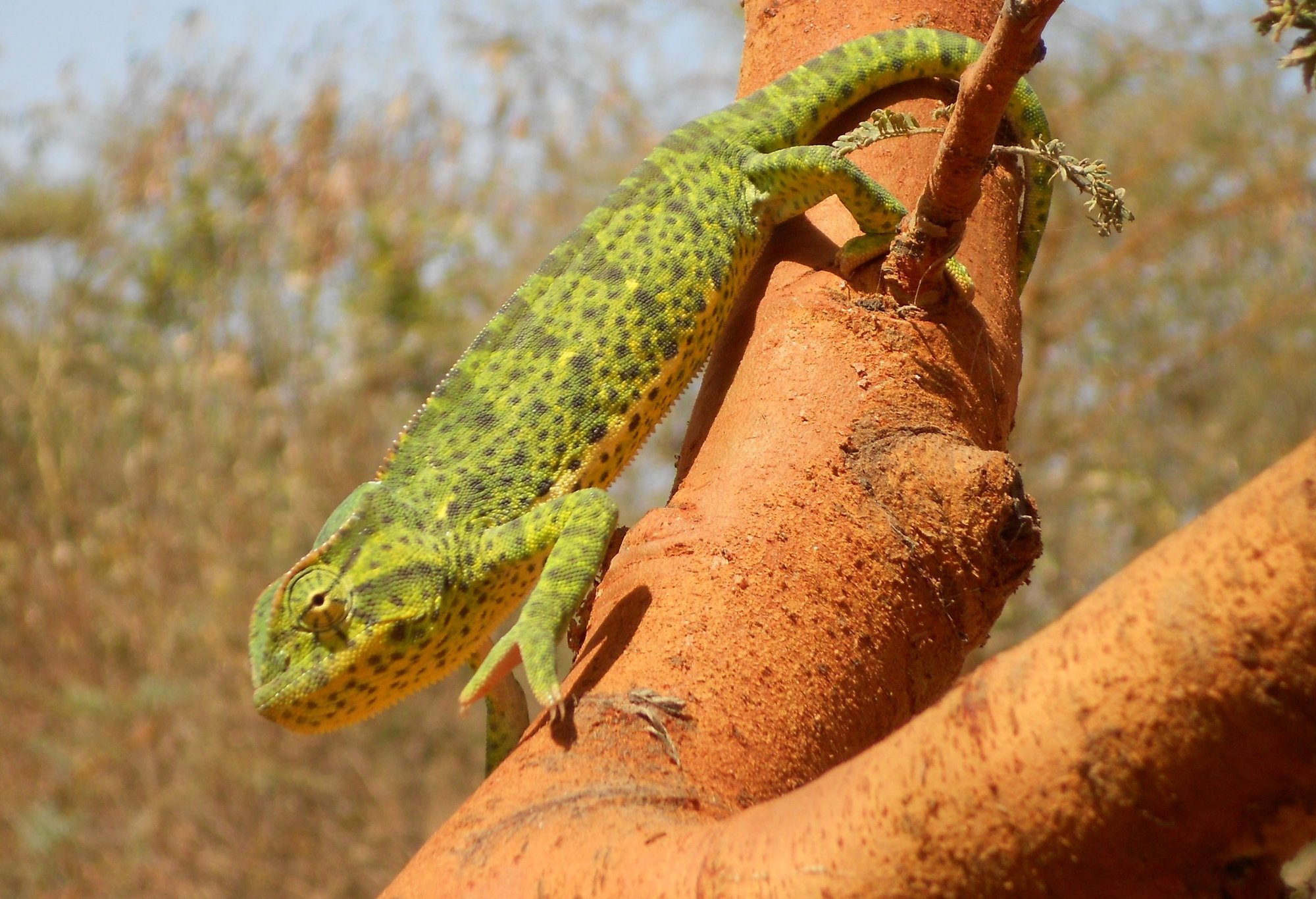
Chameleons · Difficulty: Intermediate
Key facts and care guidance for Senegal chameleon (Chamaeleo senegalensis) (origin: West and Central Africa (Senegal, Gambia, Guinea to Cameroon and Nigeria); savannah, gallery forest, bushland). Adult size around approx. 20–30 cm total length (females usually larger than males). Life expectancy approx. 5–8 years in captivity (males often shorter). The values below are carefully researched guidance.
Short answers
Senegal chameleon: How big does the enclosure need to be?
80×80×120 cm (a mesh or hybrid enclosure, absolute minimum 60×60×120 cm).
Senegal chameleon: What temperature does it need?
Daytime 26–30 °C, basking spot 33–36 °C, at night 20–24 °C.
Senegal chameleon: Does it need UVB lighting?
UVB: UVB needed (Ferguson zone 2–3, UV index 3–4).
Senegal chameleon: How long do they live?
Life expectancy: approx. 5–8 years in captivity (males often shorter).
Senegal chameleon: Is it suitable for beginners?
Rather not – it is considered an intermediate species (difficulty: Intermediate).
Climate
- Daytime temperature
- 26–30 °C
- Night temperature
- 20–24 °C
- Basking spot
- 33–36 °C
- Humidity
- 60–80 % (higher at night, fog in the morning)
- UVB
- UVB needed (Ferguson zone 2–3, UV index 3–4)
Enclosure
- Minimum size
- 80×80×120 cm (a mesh or hybrid enclosure, absolute minimum 60×60×120 cm)
- Substrate
- A humus soil mix or forest floor, dense planting (ficus, schefflera), plenty of climbing branches; good ventilation
Feeding
- Food
- Insects: house crickets, crickets, roaches, locusts, flying insects; varied, and dusted with calcium and vitamins
- Feeding interval
- adults 2–3×/week, juveniles daily
Key facts
- Adult size
- approx. 20–30 cm total length (females usually larger than males)
- Life expectancy
- approx. 5–8 years in captivity (males often shorter)
- Origin
- West and Central Africa (Senegal, Gambia, Guinea to Cameroon and Nigeria); savannah, gallery forest, bushland
- Protection status
- CITES Appendix II / EU Regulation Annex B – specially protected: proof of origin plus registration with the nature conservation authority; usually wild-caught in the trade (which is delicate)
- Brumation
- No real winter rest; a slightly cooler, drier rest period (a night-time drop and reduced feeding) makes sense
- Cohabitation
- Keep them singly. Chameleons are strictly territorial and solitary – housing them together means constant stress and fights between males. NEVER keep males together; mate them only briefly and under supervision
Notes
A delicate species that dehydrates easily – it drinks only droplets from leaves (a misting or drip system is needed). Common mistakes: too dry, stuffy air, and wild-caught imports with parasites and stress. Not for beginners.
Do you keep this species?
Add your animal to Reptoria – Reptoria reminds you about feeding and shedding. Add your animal for free →
Look for Senegal chameleon (Chamaeleo senegalensis) in the marketplace →
Related species
- African chameleon (Chamaeleo africanus) – Intermediate
- Anchieta's chameleon (Chamaeleo anchietae) – Intermediate
- Arabian chameleon (Chamaeleo arabicus) – Intermediate
- Graceful chameleon (Chamaeleo gracilis) – Intermediate
- Common chameleon (Chamaeleo chamaeleon) – Intermediate
- Smooth chameleon (Chamaeleo laevigatus) – Intermediate
- Indian chameleon (Chamaeleo zeylanicus) – Intermediate
- Veiled chameleon (Chamaeleo calyptratus) – Intermediate
What you need to start
To keep Senegal chameleon (Chamaeleo senegalensis) you typically need: a suitable enclosure (80×80×120 cm (a mesh or hybrid enclosure, absolute minimum 60×60×120 cm)), substrate (A humus soil mix or forest floor, dense planting (ficus, schefflera), plenty of climbing branches; good ventilation), a heat source with a thermostat, UVB lighting, thermometer and hygrometer, a water dish and hides. You will find equipment in the Reptoria marketplace.
The complete, interactive care database is in the Reptoria app.
Last updated: 9 October 2026 · Editor: Reptoria editorial team · Sources include: https://en.wikipedia.org/wiki/Senegal_chameleon, https://reptile-database.reptarium.cz/species?genus=Chamaeleo&species=senegalensis, https://reptiledirect.com/senegal-chameleon/
All values are non-binding guidance and do not replace expert advice. Research thoroughly from several sources before acquiring and keeping an animal, and observe the applicable law (species and animal protection in particular).